"We Might Have to Pull Our Kids Out of Private Academies" — Hauling Firms Say They May Have to Give Up Driving as Middle East War Pushes Up Fuel Costs
- Input
- 2026-03-05 16:52:43
- Updated
- 2026-03-05 16:52:43
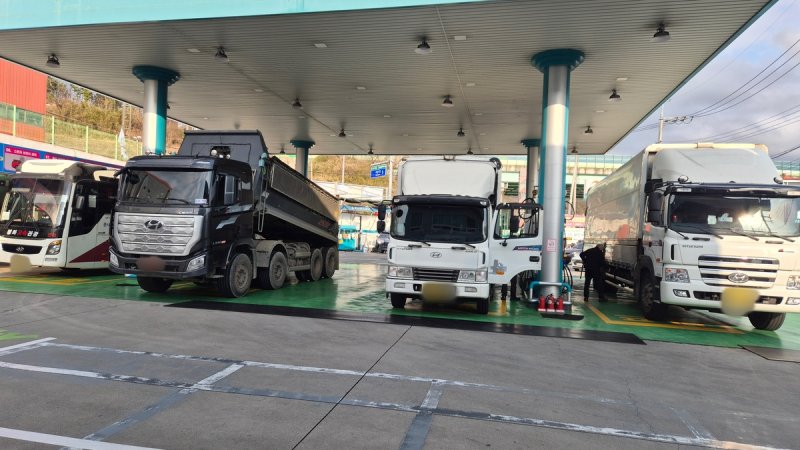
[Financial News] Domestic fuel prices are climbing steeply in the wake of airstrikes by the United States of America (US) and Israel on the Islamic Republic of Iran, and transport operators are already voicing deep frustration. Many are scrambling to find gas stations that have not yet reflected the latest price hikes, but such options are quickly disappearing. Calls are growing for the government to expand subsidy programs so that these businesses can stay afloat.
According to Opinet, the oil price information system run by Korea National Oil Corporation (KNOC), the nationwide average gasoline price as of 3 p.m. on the 5th stood at 1,821.98 won per liter, up 44.5 won from the previous day. Diesel, which is the main fuel for transport operators, rose even more sharply, jumping 82.26 won to 1,811.03 won per liter. This is the first time since December 12, 2022, when it reached 1,807.38 won, that the national average diesel price has climbed back into the 1,800-won range.
For transport operators who spend several hundred thousand won a week on fuel, the situation is an immediate crisis. Mr. Han, 54, who drives a 25-ton truck, said, "Fuel accounts for at least 30% of my revenue, and sometimes more than half. Just last month I spent over 3.5 million won on fuel alone." He added, "Fuel prices are only going to skyrocket from here, and when you factor in truck loan payments and maintenance costs, I really don’t know how we’ll make a living. My wife and I are even talking about whether we have to cut back on our children’s private academies."
Mr. Song, a tow truck driver in his 20s, shared a similar story. "About 40% of my revenue goes straight into fuel. Because gasoline and diesel prices were already converging due to the war, I hunted down the cheapest station I could find and filled up with about 400,000 won worth," he said. "If fuel costs soar much higher, a lot of drivers simply won’t be able to hold on and will end up giving up driving altogether."
Mr. Choi, 58, who runs a freight and parcel delivery depot in the Northern Gyeonggi region and operates a fleet of 12 vehicles, said, "With 12 vehicles on the road, any increase in fuel prices hits our business directly." He continued, "Even when the government cuts fuel taxes, the fuel tax-linked subsidy is reduced at the same time, so we barely feel any benefit. If the war drags on, the government needs not only to lower fuel taxes but also to ease the eligibility criteria for fuel price-linked subsidies or increase the amount paid." Currently, the government provides a fuel price-linked subsidy that covers 50% of the amount by which diesel prices exceed 1,700 won per liter.
The situation is also dire for the large bus industry. Operators there are excluded from fuel subsidy programs, which they say makes the cost burden even heavier. Mr. Song, 43, who has driven charter buses for more than 20 years, explained, "When driving in the city, fuel efficiency is only about 1.2 kilometers per liter, so I sometimes have to refuel three to four times a week. Now that we’re entering the peak tourism season in March, I’m really worried about rising diesel prices. It would be great to receive at least some subsidies, but that’s just wishful thinking for us."
Lee Sang-gon, head of the Charter Bus Union branch, also pointed out, "It already costs more than 500,000 won to fill up just once, and the entire industry is struggling. We do not receive any kind of fuel subsidy, so if diesel climbs past 1,900 or 2,000 won per liter, the industry will inevitably face a major crisis."
Because global oil prices typically take about two to three weeks to be fully reflected in domestic prices, fuel costs are likely to rise further. A representative of the Korea Petroleum Association noted, "Right now, consumers are rushing to fill up earlier than usual out of fear over the war, which has increased turnover and appears to be pushing prices up." The representative added, "If domestic prices continue to track international oil and a blockade of the Strait of Hormuz persists, the scale of domestic fuel price increases will grow."
Experts say that although Korea has crude oil reserves equivalent to about seven months of consumption, the government should prepare support measures for transport operators in case the war lasts longer than that. Jang Yeon-jae, an economics professor at Soongsil University, explained, "If the war does not end quickly, shipping rates, insurance premiums and exchange rates will all rise together, affecting overall prices in the economy. Industries like transportation, where fuel makes up a large share of costs, will face an especially heavy burden." Jang advised, "Along with flexible adjustments to fuel taxes and continuous price monitoring, temporary and targeted support for the transport sector would be the most effective response."
Hong-Jong Cho, an economics professor at Dankook University and president of the Korean Resource Economics Association, also stressed, "We must secure diverse supply routes to prevent severe shocks. To ease the excessive burden on transport operators, the government needs to implement proactive policies such as fuel tax cuts."
[email protected] Reporter Park Sung-hyun Reporter