"Pushing for a 20% Cap on Exchange Ownership Stakes... Legislative Research Service Raises Constitutional Concerns" [Crypto Briefing]
- Input
- 2026-03-05 15:21:42
- Updated
- 2026-03-05 15:21:42
According to The Financial News, as the government and ruling party push a plan to cap major shareholders’ stakes in virtual asset exchanges at 20%, experts from the National Assembly Research Service (NARS), the legal community, and industry are all raising concerns about unconstitutionality and lack of effectiveness. They warn that forcing the ex post disposal of equity that has already been lawfully acquired would violate the principle prohibiting retroactive legislation, and would amount to a so-called "Galapagos regulation" found nowhere else in the world, driving innovative companies overseas.
According to the National Assembly and industry on the 5th, the Financial Services Commission (FSC) and the policy committee of the Democratic Party of Korea have effectively decided to introduce a "20% cap on major shareholders’ stakes" as part of governance reform for virtual asset exchanges, a key issue in the draft General Act on Digital Assets. As a compromise in light of industry backlash, a three-year grace period after the law’s passage is being discussed.
The FSC argues that won-denominated virtual asset exchanges (the won market), used by 11 million people, function as public infrastructure, yet a small number of founders and major shareholders wield influence over overall operations and monopolize fee income. Based on this view, the authority plans to secure governance transparency by applying the "ownership dispersion standard (15–30%)" used for an alternative trading system (ATS) under the Financial Investment Services and Capital Markets Act, and by introducing major shareholder eligibility reviews and ownership limits.
The ruling camp is expected to soon hold a meeting to finalize the proposal. However, after the official opinion from NARS, a wave of criticism from academia and the legal community describing the plan as unconstitutional and excessive regulation has followed, drawing attention to how the debate will unfold.
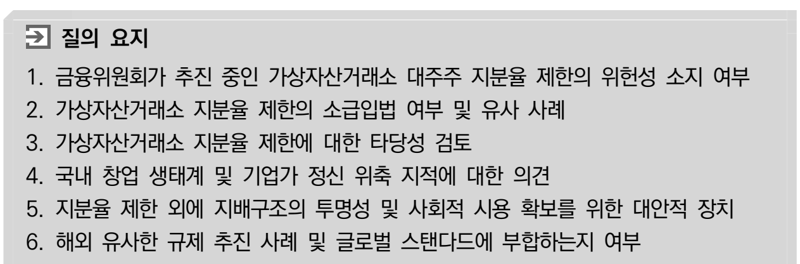
In a recent written response to the office of Kim Sang-hoon, a lawmaker from the People Power Party, the National Assembly Research Service stated, "So-called genuine retroactive legislation, which changes already-completed legal relationships ex post and deprives parties of their rights, is in principle not permissible," raising the possibility of unconstitutionality. NARS also questioned the FSC’s comparison with an alternative trading system (ATS) under the Financial Investment Services and Capital Markets Act, which the regulator has cited as the basis for the regulation. It noted that "an ATS is infrastructure designed from the outset within the framework of the Financial Investment Services and Capital Markets Act on the premise of ownership restrictions, whereas virtual asset exchanges are platforms that have grown under a registration-based, private competitive structure." NARS pointed out that applying the same standard despite this functional mismatch could violate the principle of minimal infringement.
The legal and business communities are also voicing concern. Hyobong Kim, an attorney at Bae, Kim & Lee LLC (BKL), said, "Unlike banks, virtual asset exchanges do not create credit through deposits and loans, so their failure does not trigger systemic risk, nor are they targets for public capital injections." He added, "It is difficult to justify retroactively applying ownership restrictions under the vague label of infrastructure institutions in a way that meets constitutional standards."
Industry officials likewise fear that the new rules will cripple the competitiveness of Korea’s digital finance sector. Yoo Jung-hee, a director at the Korea Venture Business Association (KOVA), stated, "Equity in venture startups is the result of risk-taking and innovation, and if you artificially limit that, no founder will be willing to take risks in Korea." She warned, "In the end, this will trigger an exodus of promising companies to foreign jurisdictions."
Global consistency has also become a major point of contention. Hyun Koo Kang, an attorney at Lee & Ko, noted, "There is no precedent in any major jurisdiction, including the United States of America (US), Japan, or Europe, for imposing ownership caps on virtual asset exchanges." He criticized the plan, saying, "Going beyond controlling major shareholders through eligibility reviews to actually limiting ownership stakes is clearly excessive regulation and a textbook example of Galapagos regulation."
[email protected] Reporter Kim Mi-hee Reporter