Despite opposition protests, Lee pushes three judicial reform bills and Jeonnam-Gwangju integration bill through State Council
- Input
- 2026-03-05 13:39:37
- Updated
- 2026-03-05 13:39:37
[Financial News] The People Power Party held a general meeting of its lawmakers in front of Cheong Wa Dae and urged the president to exercise his veto. Nevertheless, the government on the 5th reviewed and approved at an extraordinary session of the State Council of South Korea the so-called "three judicial reform bills" and the Jeonnam-Gwangju Administrative Integration Special Act. Among the three judicial reform bills, the crime of legal distortion and the system of constitutional complaints against court rulings will take effect immediately upon promulgation, while the increase in the number of Supreme Court Justices will take effect in 2028.
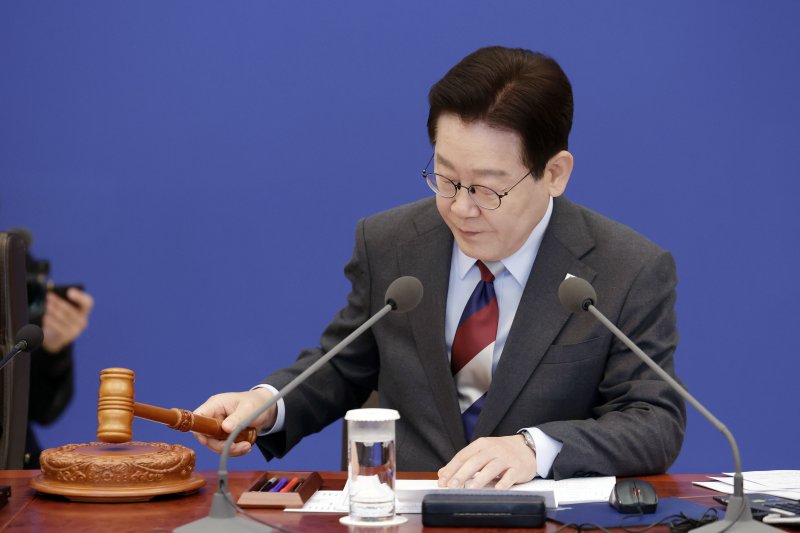
On the same day at Cheong Wa Dae, President Lee Jae-myung presided over the extraordinary State Council meeting and approved promulgation of amendments to the Criminal Act, the Constitutional Court Act, and the Court Organization Act. He also approved the Special Act on the Establishment of the Jeonnam-Gwangju Integrated Metropolitan City and related amendments to the Local Autonomy Act. In addition, the council passed an amendment to the National Referendum Act guaranteeing overseas citizens the right to vote in national referendums, and an amendment to the Commercial Act of the Republic of Korea that, in principle, requires companies to cancel treasury shares within one year. The Commercial Act amendment will take effect immediately upon promulgation.
The Special Act on the Establishment of the Jeonnam-Gwangju Integrated Metropolitan City mainly grants the integrated metropolitan city a status comparable to that of Seoul, along with various special provisions such as state financial support and educational autonomy. The amendment to the Local Autonomy Act provides the legal basis for establishing the integrated metropolitan city and reorganizes its governance structure, including setting the number of vice mayors at four. Once the law is promulgated, the Jeonnam-Gwangju Integrated Metropolitan City is expected to be launched after the election of a unified local government head in the local elections scheduled for June.
Among the three judicial reform bills, the amendment to the Criminal Act stipulates that judges and prosecutors involved in criminal cases who distort the law in relation to ongoing trials or investigations, with the intent to unlawfully or unjustly confer benefits on others or infringe on their rights and interests, shall be punished by up to 10 years in prison and up to 10 years of disqualification from office. Acts of legal distortion are defined as cases where a person "applies a law despite knowing that the requirements for its application are not met, or intentionally influences the outcome by failing to apply a law despite knowing it should be applied." Discretionary judgments made within the reasonable scope of legal interpretation are excluded.
The amendment to the Constitutional Court Act includes court rulings among the matters that can be challenged through a constitutional complaint, allowing parties to contest the constitutionality of a judgment before the Constitutional Court even after a Supreme Court ruling. A constitutional complaint against a court ruling must be filed within 30 days from the date the judgment becomes final. The Constitutional Court may, ex officio or upon the applicant's request, suspend the effect of the judgment until it renders its decision. However, if all justices on the designated panel determine that the grounds for the complaint are not met, the case may be dismissed.
The amendment to the Court Organization Act provides for increasing the current number of Supreme Court Justices from 14 to 26 by adding four justices each year over a three-year period. The changes will take effect starting in 2028.
The amendment to the National Referendum Act includes those "registered on the overseas voter list" among eligible voters in order to guarantee the referendum voting rights of overseas citizens. It also stipulates that a constitutional amendment referendum must be held on the Wednesday immediately preceding the 30th day from the date the National Assembly passes the constitutional amendment bill.
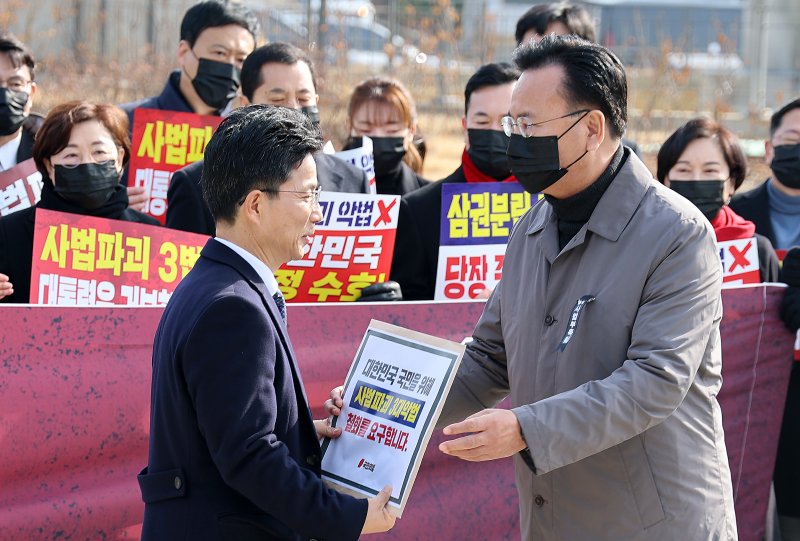
On the same day, the People Power Party held an on-site general meeting of its lawmakers in front of Cheongwadae Sarangchae and repeatedly called for the exercise of the presidential power to request reconsideration, effectively a veto, of the three judicial reform bills. Party leader Jang Dong-hyeok argued, "If these three bills pass, Lee Jae-myung's dictatorship will be complete." Floor leader Song Eon-seok also demanded a veto, saying, "Promulgating the three evil laws that destroy the judiciary is a total denial of the rule of law." The People Power Party had already staged a march on foot from the National Assembly to Cheong Wa Dae on the 3rd, urging the withdrawal of the bills.
[email protected] Seong Seok-woo Reporter