Concerns Grow Over ‘Semiconductor Shock’ from US Tariffs and Iran War; Ruling Party and Government Begin Preparations
- Input
- 2026-03-05 10:31:19
- Updated
- 2026-03-05 10:31:19
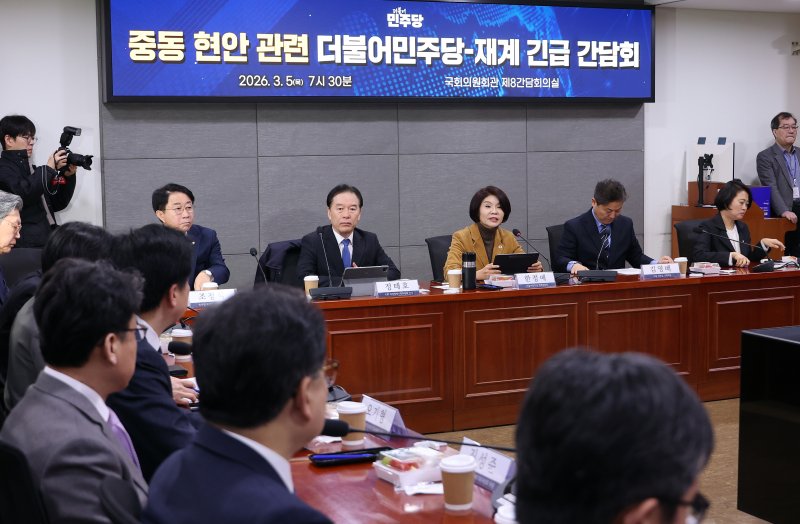
[Financial News] Concerns have been raised that the semiconductor supercycle could lose momentum due to additional tariffs imposed by the Donald John Trump administration in the United States, disruptions in energy supply caused by the war with Iran, and possible delays in building AI data centers. In response, the Lee Jae-myung administration and the Democratic Party of Korea have begun drawing up measures to prepare for the worst-case scenario.
On the 5th, lawmakers from the Foreign Affairs and Unification Committee of the National Assembly, the Strategy and Finance Committee of the National Assembly, and the Trade, Industry, Energy, SMEs and Startups Committee of the National Assembly, all from the DPK, met with business leaders at the National Assembly Members' Office Building. They discussed a joint public–private strategy on US tariff negotiations and the evolving situation in the Middle East. From the business community, participants included The Federation of Korean Industries (FKI), the Korea International Trade Association (KITA), Samsung Electronics, Hyundai Motor, SK Group, LG, Hanwha Ocean, HD Hyundai Oilbank, and GS Caltex.
Representative Kim Young-bae, the DPK secretary on the Foreign Affairs and Unification Committee, told reporters after the meeting that he had heard concerns that US tariffs and the war with Iran could weaken the price competitiveness of semiconductors and reduce demand.
Concerns Over ‘Semiconductor Tariffs’ Even with US Investment Act in Place; Strategy and Finance Committee to Discuss with Deputy Prime Minister on the 6th
On tariffs, the business community is calling for preparations even if the Special Act on Investment in the United States is passed, warning that the Trump administration could still impose item-specific tariffs on semiconductors. In fact, a 100% tariff on semiconductors has been floated since last year.
The ruling and opposition parties have agreed to pass the Special Act on Investment in the United States at the plenary session of the National Assembly on the 12th. However, since the business community believes tariff risks will not be completely eliminated even after the law is enacted, it was agreed that the government would work with them on contingency plans. Representative Jung Tae-ho, the DPK secretary on the Strategy and Finance Committee of the National Assembly and a member of the special committee handling the Special Act on Investment in the United States, said during the meeting that deliberations on the bill are proceeding smoothly. He added that on the 6th he would meet with Koo Yun-cheol, Deputy Prime Minister for Economic Affairs and Minister of Finance and Economy, to convey the concerns of the business sector.
Iran-Driven Electricity Cost Burden and Data Center Delays Seen as Semiconductor Headwinds; Ruling Party Urges MOTIR to Prepare
The most immediate negative factor that could affect the semiconductor supercycle is the war involving Iran. If energy supplies tighten, electricity costs will rise and erode price competitiveness. In addition, if construction of data centers in the Middle East is delayed, semiconductor demand could fall sharply.
On the energy front, seven oil tankers carrying crude equivalent to three days of domestic consumption are currently stuck in the Strait of Hormuz. The government has said that reserves of oil, natural gas, and other resources are sufficient for 208 days of use. However, the business community is calling for concrete scenarios based on how long instability in the Middle East might last. In response, the DPK has asked the Ministry of Trade, Industry and Resources (MOTIR) to prepare contingency plans that assume a range of possible situations.
Regarding the issue of data centers in the Middle East, Representative Kim said, "Focusing on the United Arab Emirates (UAE), there are plans to build AI data centers with a total capacity of 7 to 8 GW in the Middle East by 2030, but there is a high possibility of disruptions," adding, "This could create potential problems for semiconductor demand."
Kim Chang-beom, vice chair of The Federation of Korean Industries (FKI), noted, "There is no immediate shock to semiconductor demand," but added, "We raised the issue out of concern that, if this situation drags on, demand driven by data centers in the Middle East could decline."
[email protected] Kim Yun-ho Reporter