Trump attacks UK and Spain over Iran strike, while German chancellor’s silence seen as ‘humiliating’
- Input
- 2026-03-05 11:18:05
- Updated
- 2026-03-05 11:18:05
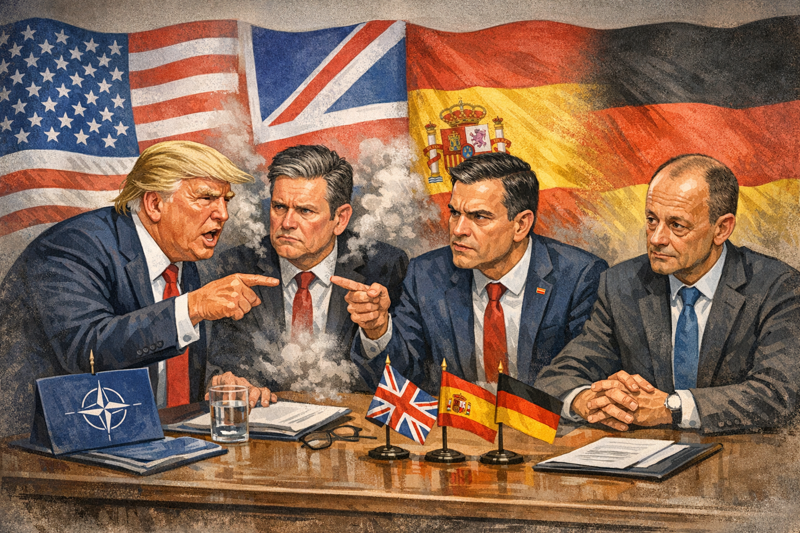
During a summit with Chancellor Friedrich Merz at The White House on the 3rd, President Donald Trump spent a significant amount of time targeting UK Prime Minister Keir Starmer and Pedro Sánchez, the Prime Minister of Spain.
Trump declared, “Spain is terrible,” criticizing Madrid for refusing to allow the use of Spanish military bases for the U.S. strike on Iran and for not joining the North Atlantic Treaty Organization (NATO) pledge to raise defense spending to 5% of its gross domestic product (GDP). He went so far as to threaten, “I will cut off all trade relations with Spain.” His harsh rhetoric toward Spain appears to have been fueled by the fact that Sánchez was the first European leader to openly criticize the U.S. and Israeli bombing of Iran.
Trump then turned to the UK, saying, “I’m not happy with Britain either,” and adding, “We are not dealing with Winston Churchill,” in a clear jab at Keir Starmer. Starmer had initially refused to allow the U.S. military to use the Royal Air Force base at Diego Garcia in the Chagos Archipelago in the Indian Ocean for the Iran strike. Although he later reversed that decision, he had already fallen out of favor with Trump. By contrasting Starmer with Churchill, who led the Allied forces in close cooperation with the United States during World War II, Trump made his displeasure unmistakable.
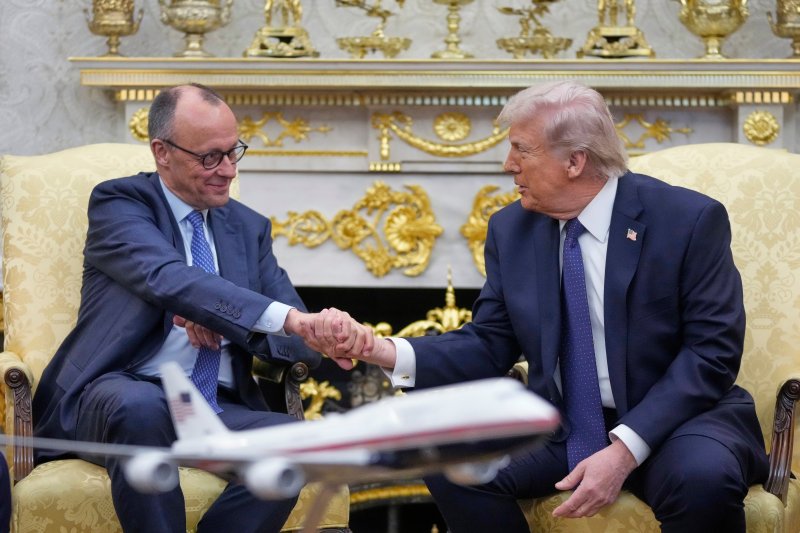
Merz, however, has argued that his silence was part of a broader “strategy for dealing with President Trump.” Given Trump’s impulsive and unpredictable nature, Merz’s calculation was reportedly to avoid contradicting him in front of the cameras and instead try to persuade him of Germany’s position in private talks.
Even before his trip to the United States, Merz had tried not to provoke Trump. While warning that “the U.S. strike on Iran could turn into a quagmire like the Iraq War,” he also said, “This is not the time to lecture our allies,” and expressed support for Washington’s objectives. He then reportedly tried to win Trump’s favor with a series of gifts. According to Deutsche Presse-Agentur (dpa), Merz presented Trump with a replica of the 1785 Treaty of Amity and Commerce between the United States and Prussia, the predecessor state of modern Germany, explaining that it was the first international trade agreement the U.S. ever signed with a third country.
On this point, Politico commented that “judging by the way President Trump called Merz a ‘friend’ during their meeting and praised him for ‘doing a really great job,’ the chancellor appears to have at least succeeded in winning Trump’s personal favor.” During their first meeting in June last year, Merz had already tried to appeal to Trump by giving him his grandfather’s birth certificate—framed in gold—since Trump’s grandfather came from southwestern Germany, and inviting the president to visit his ancestral hometown.
[email protected] Hong Chae-wan Reporter