"Retail investors who tried to catch a falling knife" Fear of forced liquidation spreads after KOSPI plunge
- Input
- 2026-03-05 06:34:33
- Updated
- 2026-03-05 06:34:33
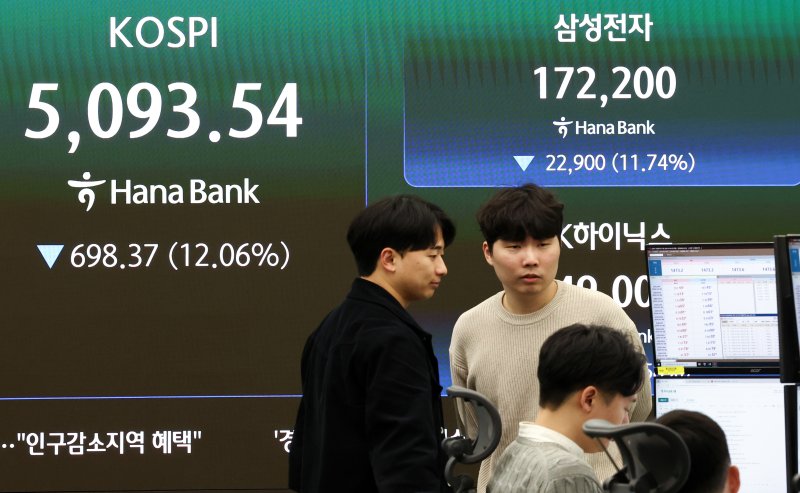
According to The Financial News, the Korea Composite Stock Price Index (KOSPI) has recorded the steepest decline in the history of the Korean stock market since the beginning of March, causing a sharp pullback in buying by individual investors. These retail investors had absorbed more than 5 trillion won of foreign selling, effectively trying to "catch a falling knife," but after consecutive plunges they drastically reduced their net purchases. Fear of forced liquidation of leveraged investing using borrowed money, known as "bit-too," is now hanging heavily over the market.
According to the Korea Exchange (KRX) on the 4th, individual investors’ net purchases on the KOSPI amounted to only 79.7 billion won that day. Compared with the previous session, when they had defended the index by taking the opposite side of more than 5 trillion won in selling by foreigners and institutions, their buying power weakened significantly. Many investors had bet on a rebound after the KOSPI’s 7.24% plunge the previous day, but the index fell even further, logging a record daily drop of 12.06%. At one point during the session, individual investors even turned into net sellers.
As the KOSPI tumbled, debt-fueled investing shifted from a source of hope to a source of fear. According to the Korea Financial Investment Association (KOFIA), as of the 3rd, the balance of margin loans for stock purchases, a key gauge of leveraged investing using borrowed money, reached an all-time high of 32.804 trillion won.
The margin loan balance refers to the amount of stock purchases financed by securities firms that has not yet been repaid, and is a representative indicator of leveraged investing. The balance stood at 22.1859 trillion won on September 3 last year, meaning it has swelled by more than 10 trillion won in about six months. This surge reflects how, during last year’s stock market rally, many investors used loans as leverage to chase high returns.
Market sentiment has now completely reversed. In margin trading, the purchased stocks are pledged as collateral for the loan, and when share prices plunge, securities firms move to forcibly liquidate those collateralized stocks to prevent losses.
As the scale of leveraged investing approached a critical level, securities firms began temporarily suspending new margin loan services. Korea Investment & Securities halted new margin purchases and new short sales via margin lending from 8 a.m. on the 4th, with no date set for resumption. The firm cited exhaustion of its credit extension limit as the reason. Under the Financial Investment Services and Capital Markets Act, the total amount of credit that comprehensive financial investment business entities can extend may not exceed 100% of their equity capital. NH Investment & Securities will also stop new margin purchases starting on the 5th. Shinhan Securities likewise warned the previous day that its limit was nearing exhaustion, stating, "Once the limit is reached, securities-backed loans and margin financing services may be suspended."
[email protected] Reporter Han Seung-gon Reporter