KOSPI Plunges 18%, Limited Risk of Spillover to U.S. Market
- Input
- 2026-03-05 06:29:26
- Updated
- 2026-03-05 06:29:26
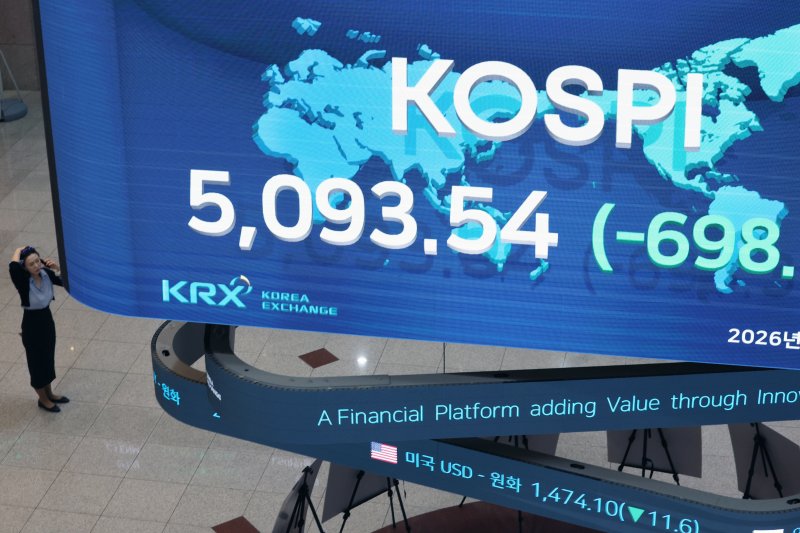
[The Financial News] Foreign media are drawing attention to how geopolitical risks stemming from the Middle East have hit the South Korean stock market.
On the 4th (local time), the Consumer News and Business Channel (CNBC) reported that the Korea Composite Stock Price Index (KOSPI) had suffered its largest-ever one-day drop after news of U.S. and Israeli strikes on Iran. However, Wall Street analysts in New York characterized the move as a Korea-specific "bubble burst" and drew a clear line against the likelihood of contagion to the U.S. stock market.
On the 4th, the Korea Composite Stock Price Index (KOSPI) plunged more than 12% from the previous session, marking its worst single day on record. It has already fallen more than 18% this week alone, putting it on track for the steepest weekly decline since the 2008 Global Financial Crisis (GFC).
The South Korean market took a direct hit from the Middle East turmoil as soon as trading opened on the 3rd. Given the economy’s heavy dependence on energy imports, fears of disruptions to crude oil and natural gas supplies from the Middle East quickly froze investor sentiment. In fact, South Korea relies on the region for about 70% of its crude oil and roughly 30% of its Liquefied Natural Gas (LNG) imports.
U.S. market experts are tracing the root cause of the crash to the extreme concentration of a few stocks in the South Korean equity market.
Larry Tentarelli of Blue Chip Trend Report pointed out, "More than one-third of the KOSPI is made up of just two stocks, Samsung Electronics and SK Hynix." He noted that this stands in stark contrast to the S&P 500 Index, where even the two largest components, Nvidia and Apple, together account for only about 14%.
Over the past year, Samsung Electronics has surged 216% and SK Hynix 356%, driving the index higher. Tentarelli commented, "These numbers were clearly indicative of a short-term bubble," adding, "That is what led to such a sharp correction." During Wednesday’s session, both stocks plunged more than 10%, prompting the Korea Exchange (KRX) to trigger a circuit breaker mechanism that temporarily halted trading.
The exodus of retail investors also accelerated the decline. Viraj Patel, an analyst at VandaTrack, observed, "The iShares MSCI South Korea ETF (ticker: EWY) has gone from being a retail favorite to something they are now rushing to exit," adding, "Record inflows have now flipped into selling accompanied by the highest trading volumes on record."
Some foreign outlets also reported that large leveraged positions that had been betting on further index gains were forced to the brink of margin calls, adding to the downward pressure.
Mizuho Securities assessed that it took "only three days" for the South Korean stock market to enter a full-fledged downturn. As the "free fall" of the market in the world’s 14th-largest economy draws global attention, CNBC reported that investors are now watching closely to see whether this episode will remain a short-term correction or mark the beginning of a prolonged slump.
Despite the historic plunge in South Korean stocks, Wall Street’s reaction has been relatively calm. Jay Woods, Chief Market Strategist at Freedom Capital Markets, noted, "The U.S. stock market is far more diversified than Korea’s, and with a circuit breaker mechanism based on the S&P 500 Index in place, a 12% crash like this is highly unlikely to occur."
[email protected] Yoon Jae-joon Reporter