"AI Robots Lagging Behind the US and China: We Must First Secure Core Component Technologies to Win" [Editorial Desk’s News Analysis]
- Input
- 2026-03-04 18:40:41
- Updated
- 2026-03-04 18:40:41
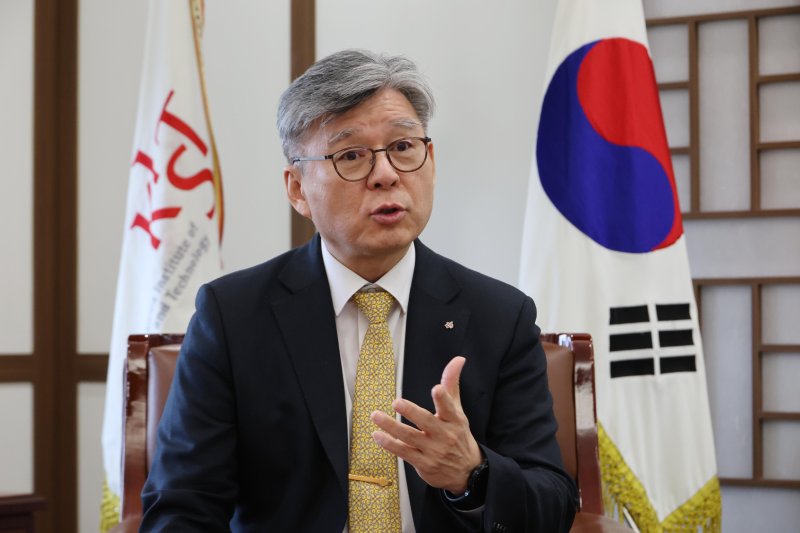
— In the early days, KIST positioned itself as a future-oriented think tank for a poor country. How do you feel as the institute turns 60?
“I joined the institute in 1988 and have spent 37 years here,” Oh said. “Having witnessed more than half of KIST’s 60-year history, I feel a heavy sense of responsibility. The institute began in the basement of Hanil Bank near Cheonggyecheon Stream. We racked our brains there over what kinds of technologies could immediately bring in money. There was tremendous passion for quickly localizing technologies to help companies and build up industry. Then we started creating things that did not exist in the world. In short, KIST’s 60 years can be described as a history of accumulated efforts that drove Korea’s development.”
— If you were to sum up KIST’s accumulated achievements in broad strokes, what would they be?
“Today’s POSCO grew out of a grand blueprint drawn up by our predecessors at KIST,” he noted. “In 1969, the plan for the Pohang Iron and Steel Company (POSCO) was drafted here. At the groundbreaking ceremony, then Deputy Prime Minister Kim Hak-ryeol famously remarked, ‘All the money invested in KIST so far has been recouped with this single plan.’ Without domestically produced steel, our automobile, shipbuilding and chemical industries could never have blossomed. We also achieved early results in digital and robotics fields. KIST developed Korea’s first color TV receiver, the first computer system Sejong-1, and the quadruped humanoid robot CENTAUR.”
— Given the circumstances at the time, what made such bold attempts possible?
“Thinking back to the early days makes me solemn,” Oh recalled. “The president and the older generation had a very clear sense of what the country needed immediately and where it should head. Photos of the 31 key figures from the institute’s early years hang on the first floor of our main building. They gave up a great deal and returned home for the sake of national development. President Park Chung Hee treated them in an unprecedented way. He provided apartments and paid them two to three times the salary of university professors. Even so, their treatment could not have matched what they received abroad. Yet they were united by a burning desire to do something for their homeland. The leadership of our first director, Choi Hyung-seop, and the president’s national vision shone together.”
— Now Korea must pour its energy into fending off China, a latecomer that is catching up fast.
“It is a very difficult issue,” he acknowledged. “China’s current strength comes from its own style of research and development. For example, if you set up a startup and spend money on R&D, there is a system that returns more than the amount you invested. A policy that reimburses R&D costs effectively means you can survive just by doing R&D. Technologies developed in this way are then shared among startups. Instead of everyone competing to develop separate technologies for the same goal, firms in the same industry share what has already been created. This is possible because it is China. The time needed to accumulate technology is drastically shortened. China’s progress in robots and humanoids has followed this pattern.”
— Physical AI and humanoid robots are now hot topics. Compared with China and the United States, where does Korea stand?
“This field is firmly dominated by the two giants, the United States and China,” Oh explained. “The United States is far ahead in the AI ‘head,’ while China clearly leads in AI ‘body’ technologies. Korea is a distant third. Some argue that, since we can never catch up with the top two, we might as well give up. The US and China are overwhelming leaders, but they too still have a long way to go before reaching the final goal. If we say the finish line is at 100, they are only around 20. There is no reason for us to sit down and give up just because we are late. If we hurry now, we could end up arriving first at the finish line, or at least reach it alongside them. What we need is a smart strategy.”
— What kind of strategy do you have in mind?
“We must have our own AI models, and we need to accumulate data and experience in building bodies,” he said. “Humanoids are the sum of hardware and software. Achieving technological self-reliance in core components such as actuators and sensors is the starting line. To evolve into humanoids that behave like humans, physical AI embedded in them and high-quality data that determine performance are crucial. The country that first succeeds in creating a virtuous cycle—deploying more robots in the field to generate better data—will set the technology standards and dominate the global market. Given its strong manufacturing base, Korea is actually in a favorable position.”
— How far has KIST’s robot research come?
“If we look back, we also entered humanoid research quite early,” Oh said. “More than 20 years ago, we developed the networked humanoids Maru and Ara, which helped us build our capabilities. Our humanoid KAPEX, scheduled to be unveiled at the end of the year, is at a world-class level, I dare say. It already has a hardware platform that can be used immediately in the field. We may be behind in capital and manpower right now, but if we can string together the value chain from fundamental technologies to platforms, data and AI, we have a real chance. We plan to use a Korean-style AI humanoid as a platform, tightly connect public test beds, and then open them widely for use by the private sector.”
— There is growing concern about a shortage of technical talent.
“Scientific and technological talent is essential for any technology powerhouse,” he stressed. “We must show that you can live well by pursuing science and technology alone. It is extremely important to provide researchers with a stable and autonomous research environment. Only then can they immerse themselves in long-term missions and turn them into results. We need to make a dramatic improvement in pay and working conditions. Researchers should be able to feel pride in tackling national-level challenges. It is also important to open many paths for technology startups. There must be institutional systems that allow people who fail in a startup to get back on their feet and work again. Practicality and science and technology are closely linked. In essence, science is about being the first to discover something that anyone could use but no one has thought of before. Technology is about turning that discovery into something everyone can actually use. That is what practicality is.”
— What is needed to build up achievements in basic science?
“Autumn is a painful season for Korean scientists,” Oh remarked. “When Nobel Prize season comes around, people ask what we have been doing all this time. I would like to ask that we invest much more in young researchers. This is separate from the treatment given to top scientists. We also need to review and improve the R&D system so that it rekindles researchers’ passion. Under a regime of tight management and evaluation, with rewards tied directly to those results, researchers tend to fall into a routine of simply meeting targets within a given time frame, rather than pursuing bold research that could change the future. I strongly propose a system that delegates full authority to researchers and makes them responsible for the entire process, from project planning to utilization of results. Looking back, government R&D programs began in 1991. It is only now that their outcomes can slowly start to emerge.”
— How are you preparing for the next 60 years?
“In the early days, we focused on issues related to the country’s basic survival,” he said. “From now on, we will devote our capabilities to solving, one by one, the difficult problems that the nation must address but has not yet been able to crack. Two years ago, KIST and its spin-off company Cureverse signed a technology transfer agreement with Italian global pharmaceutical firm Angelini Pharma for a new drug to treat brain diseases. It was a major deal worth 540 billion won. In the future, KIST will concentrate on developing new drugs that can help an aging society, as well as research on next-generation semiconductors and quantum technologies, clean hydrogen, climate and environment, and ultra-high-performance materials for space. Our role is to tackle national challenges, including R&D for future growth engines that will feed the country 10 or 20 years from now.”
Profile: Oh Sang-rok, president of the Korea Institute of Science and Technology (KIST) — Bachelor’s in electronic engineering from Seoul National University (SNU); PhD in robotics from the Korea Advanced Institute of Science and Technology (KAIST); former head of the Robot Systems Research Division at KIST; former president of the Korea Robotics Society (KROS); former distinguished professor at the Korea Institute of Human Resource Development in Science and Technology (KIRD); former head of the KIST Quarantine Robot Project Group; currently chair of the National Technology Level Assessment Steering Committee; and current member of the Special Committee on Innovation and Challenge Promotion under the National Science and Technology Advisory Council.
[email protected] Choi Jin-suk Reporter