[Editorial] Record Volatility in Stocks and Exchange Rates Demands an Emergency Crisis-Response Plan
- Input
- 2026-03-04 18:40:30
- Updated
- 2026-03-04 18:40:30
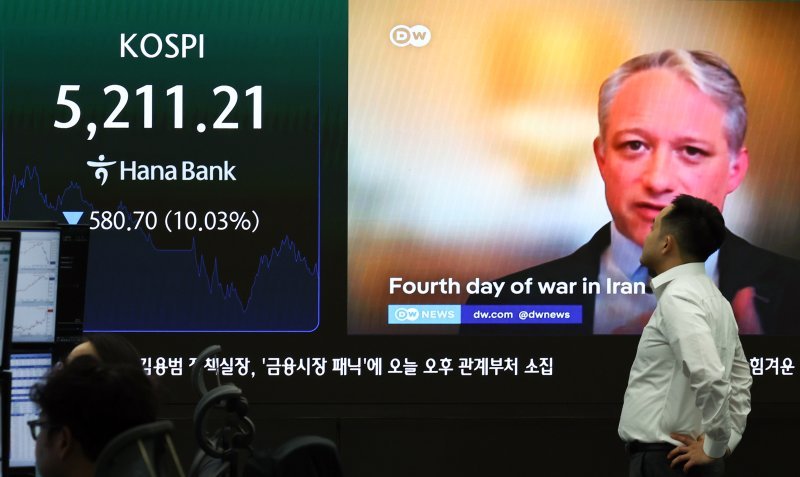
The government is trying to reassure the public, saying the impact on our economy will be limited, but the reality is different. The war is not ending quickly and is instead showing signs of escalation. One reason the KOSPI has fallen more than neighboring markets is that it had surged sharply in a short period. However, it also reflects that the underlying strength of our economy is weaker than that of major countries such as Japan. Rapid rises may feel good on the way up, but when the market turns, they inflict serious damage not only on investors but on the broader economy.
The spike in the exchange rate is partly due to foreign investors selling South Korean stocks, and partly because fear of a wider war is driving money into the safe-haven U.S. dollar. As Iran threatens to close the Strait of Hormuz and attacks oil facilities in the Kingdom of Saudi Arabia (KSA) and Liquefied Natural Gas (LNG) facilities in Qatar, energy prices are also soaring. South Korea consumes a large amount of oil relative to the size of its economy. Global research institutions warn that when oil prices rise, countries such as South Korea and Taiwan will be among the hardest hit.
A weak currency and high oil prices push inflation up like falling dominoes. Rising prices then depress consumption, dragging down the growth rate and locking the economy into a vicious cycle. Citi has projected that if international oil prices stay at 82 dollars per barrel, South Korea’s consumer prices could climb an additional 0.60 percentage points this year, while economic growth could fall by 0.45 percentage points.
South Korea had hoped to return to a 2% growth path this year, but that goal is now in doubt after hitting the reef of war in the Middle East. Even before the downturn has clearly ended, the so-called “three highs” of a weak currency, high oil prices, and high inflation could bring about stagflation, where prices rise even as the economy stagnates. Turmoil in financial markets can quickly spill over into the real economy.
Until the Middle East wars come to an end, the government must draw up an emergency plan. Securing energy supplies, especially oil and gas, is the most urgent task. Officials say the country can hold out for 210 days with its strategic oil reserves, but it is hard to predict how long the current situation will last. Authorities also need to mobilize every available tool to stabilize the stock market and exchange rate, which have fallen into a state of panic like pouring water into a bottomless jar.
Crises can strike at any time, and each time we have managed to overcome them. All economic actors must now faithfully carry out their roles in their respective spheres. Politicians, in particular, must come to their senses. This is no time to spend nights locked in partisan strife. We urge the National Assembly to first pass economic bills that support businesses, including the Special Act for Korea-U.S. Strategic Investment Management. In any crisis, what is needed most is bipartisan cooperation. Lawmakers can resume their battles later; during a crisis, the ruling and opposition parties alike must join hands and do their part for the national economy.