SK Telecom: "Competing to export AI infrastructure with Japan, Taiwan, and Southeast Asia... It’s a race of speed and cost" [MWC 2026]
- Input
- 2026-03-05 08:00:00
- Updated
- 2026-03-05 08:00:00
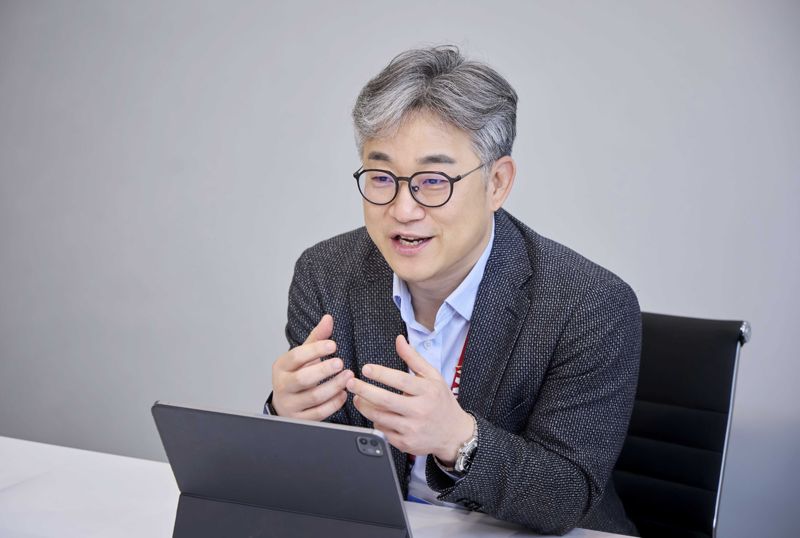
Chung Suk-geun, CTO of SK Telecom, stated at a briefing held on the 3rd (local time) in Barcelona, Spain, where Mobile World Congress (MWC) 2026 is taking place, that "an AI data center is a comprehensive solution package that encompasses energy, software, and more." He added, "Rather than just being one of the top three in AI models, we need to be among the top three when infrastructure is included as well, so that the ripple effects can be much greater."
Chung said, "We are constantly exploring ways to expand our business models, including installing computers for AI data centers and renting out graphics processing units (GPUs)." He pointed out, "The real problem is that putting computers into an AI data center is far more expensive than building the data center itself."
According to Chung, a typical 10-megawatt (MW) AI data center requires about 150 to 200 billion won to construct the building and electrical facilities. However, supplying cutting-edge GPUs such as Nvidia’s B200, which are needed to operate the data center, alone costs around 800 billion won. Fully building out the computing resources for a 10 MW AI data center can push the total investment to roughly 1 trillion won, he explained.
He noted, "That level of investment is not something a single company can shoulder on its own." He continued, "We are discussing various ways to balance business and technology, such as directly offering only part of the GPU as a Service (GPUaaS) ourselves and leaving the rest to other companies."
He predicted that lowering the operating costs of AI data centers will be the key to competitiveness going forward. Chung said, "Right now, demand for GPUs and data centers is extremely high, but there is concern about what the situation will look like a few years from now." He stressed, "In the end, the core competitive edge will lie in who can build data centers more cheaply, provide computing at lower cost, and save on electricity expenses."
Chung underscored the need to support the AI data center industry, which he described as the core of the AI ecosystem. As AI export competition among countries intensifies, he argued that it is difficult for individual companies to raise such massive investment on their own, and that the public and private sectors must work as "one team" to foster AI. "In Korea, there are limits to operating AI data centers based solely on domestic demand," he said, adding, "In a race where we must compete with Japan, Taiwan, and Southeast Asia, the most critical factors are the speed and cost of building out infrastructure."
Regarding the debate over "originality" that emerged during the evaluation of the government’s Independent AI Foundation Model Project (K-LLM), Chung commented, "For a proprietary AI model, it seems appropriate to implement it from scratch, as a model designed in-house." At the same time, he said, "We can distinguish between developing something independently and using it on a day-to-day basis." His remarks suggest that, as Korea works to secure AI competitiveness at a global level, a broad degree of openness and flexibility should be allowed. Previously, NAVER Cloud became embroiled in controversy after it was revealed to have fine-tuned the vision encoder of Alibaba’s Qwen model from China, and it was eliminated in the first round of evaluations.
Chung explained, "Even when we develop internal use cases, we start by using models from OpenAI and Anthropic, and once the service is commercialized and enough data is accumulated, we switch over to our own model." He added, "The government does not appear to be insisting that foreign models never be used, so a phased approach like this seems necessary."
Chung also stressed that building a proprietary AI model is necessary, even if technologies from overseas AI models are used. "Given recent geopolitical developments, there is no question that we need our own capabilities in order to mitigate risks," he said.
mkchang@fnnews.com Jang Min-kwon Reporter