China's Two Sessions Open: Focus on Growth Target and Defense Spending
- Input
- 2026-03-04 18:27:42
- Updated
- 2026-03-04 18:27:42
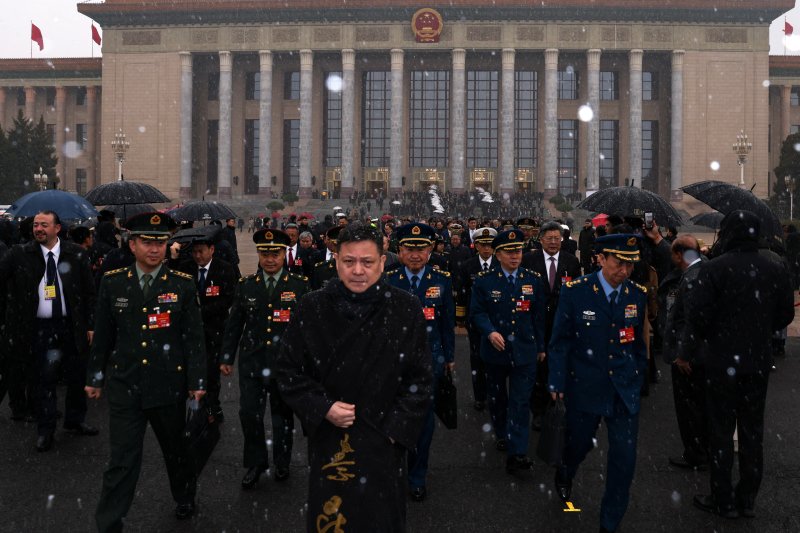
During the Two Sessions, the National Committee of the Chinese People's Political Consultative Conference (CPPCC National Committee), which serves as a key policy advisory body, opened its annual meeting at the Great Hall of the People in Beijing on the same day. CPPCC members are listening to and deliberating on the work report of the Standing Committee of the National Committee of the Chinese People's Political Consultative Conference, and exchanging views on the draft of the 15th Five-Year Plan for Economic and Social Development of the People's Republic of China, which was adopted at the Fourth Plenary Session of the 20th Central Committee of the Communist Party of China last October.
The National People's Congress (NPC), China’s top legislature, will open its annual session on the morning of the 5th at the same venue. Through the government work report delivered by Premier of the State Council of the People's Republic of China Li Qiang, the Two Sessions will unveil this year’s gross domestic product (GDP) growth target, the overall stance of fiscal and monetary policy, and budget allocations by sector, including defense spending. The fiscal deficit ratio, the scale of special government bond issuance, the annual target for new job creation, and the inflation target for consumer prices are also expected to be announced.
Many analysts expect this year’s growth target to be set in a range between 4.5% and 5%.
Citing multiple research notes, the state-run financial newspaper Securities Times reported that there is a growing consensus that "setting the target in the 4.5–5% range would be both proactive and realistic." Ming Pao Daily News in the Hong Kong Special Administrative Region of the People's Republic of China also noted that 21 out of 31 provinces and major cities lowered their growth targets at their own local Two Sessions, and reported that the national target is likewise likely to be set around 4.5–5%.
For the past three years, China has set its official growth target at around 5%, and the actual GDP growth rates came in at 5.2%, 5.0%, and 5.0%, respectively. However, the slowdown became more pronounced from the third and fourth quarters of last year. On top of that, structural headwinds such as tariff pressure and technology controls from the U.S., a prolonged slump in the property market, and high youth unemployment are weighing on the outlook, making this year’s environment even more challenging.
China has long articulated a medium- to long-term goal of raising per capita GDP to more than 20,000 dollars by 2035, roughly double the 2020 level. According to estimates by the International Monetary Fund (IMF), China’s per capita GDP last year stood at about 13,806 dollars.
The 15th Five-Year Plan for Economic and Social Development of the People's Republic of China to be finalized at this year’s Two Sessions is expected to place particular emphasis on industrial self-reliance and strengthening advanced technology capabilities. Building on the concept of "new quality productive forces" championed by President Xi Jinping, Beijing is likely to accelerate the development of semiconductors, Artificial Intelligence (AI), and other strategic industries, while signaling its determination to counter U.S. export controls and sanctions in the military sector.
The scale of the increase in defense spending is another key point of interest. Since 2023, China has raised its defense budget by 7.2% for three consecutive years. With 2027 marking the centennial of the founding of the People’s Liberation Army, many expect Beijing to further speed up military modernization. Following recent changes in top military leadership and internal restructuring, there are also signs that the authorities intend to strengthen mechanisms for managing security risks.
In addition, the NPC is scheduled to deliberate on the Ecological and Environmental Code, the Law on National Development Plans, and the Law on Promoting Ethnic Unity and Progress. The Law on National Development Plans is seen as highly symbolic, as it will be the first special law to provide an institutional framework for the formulation and implementation of Five-Year Plans. The Law on Promoting Ethnic Unity and Progress is reported to include provisions that codify the duty to safeguard national unification and ethnic solidarity, and to prohibit any acts that incite separatism.
This year’s Two Sessions are also expected to produce external messages highlighting the need for cooperation between Beijing and Washington. At a press conference before the opening, Lou Qinjian, Spokesperson for the National People's Congress of China, stated, "China and the United States should respect each other, coexist peacefully, and cooperate for mutual benefit," adding, "Cooperation benefits both sides, while confrontation harms everyone."
With a possible visit to China by President of the United States Donald Trump being discussed for late March or early April, Beijing appears to be calibrating the tone of its public statements in an effort to preserve diplomatic room for maneuver.
[email protected] Kim Kyung-min Reporter