Domestic Refineries Built for Middle Eastern Crude, Making a Quick Shift Away Difficult [U.S.–Iran War]
- Input
- 2026-03-04 18:23:06
- Updated
- 2026-03-04 18:23:06
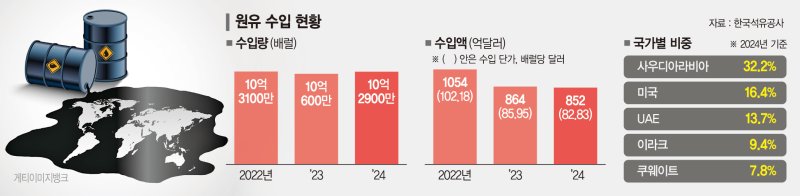
■ United States and South America floated as alternatives to the Middle East
According to the Ministry of Trade, Industry and Resources (MOTIR) and industry data on the 4th, about 70% of South Korea’s crude oil imports come from the Middle East, including the Kingdom of Saudi Arabia, United Arab Emirates (UAE), and Kuwait. Roughly 95% of that volume is shipped through the Strait of Hormuz.
The government has begun reviewing supply chains in preparation for a prolonged crisis. Kang Gi-ryong, vice minister at the Ministry of Economy and Finance (MOEF), convened a joint meeting of relevant agencies that day to examine import trends and substitution options for energy, chemical products, and materials and equipment that are highly dependent on the Middle East and are critical to economic security.
So far, the government sees no unusual developments in domestic energy supply and demand. It says South Korea holds strategic oil reserves equivalent to about 208 days of consumption under International Energy Agency (IEA) standards, giving it ample capacity to respond in the short term. Even so, the government is supporting efforts to find alternative sources, including a plan to raise the ceiling on financing for crude purchases from outside the Middle East, such as North America and Latin America, from 90% to 100%.
Within the industry, some warn that if the crisis drags on, the risk of supply chain disruptions cannot be fully ruled out. They point out that South Korea’s energy import structure remains centered on the Middle East, making it difficult to secure replacement suppliers.
Industry officials cite the United States, South America, and the North Sea as potential alternatives to Middle Eastern crude. A Korea Petroleum Association official said, "Recently, crude import sources have diversified, so the Kingdom of Saudi Arabia now accounts for about 30%, while the United States of America (U.S.) makes up around 17%." The official added, "If there are disruptions to navigation through the Strait of Hormuz, expanding imports of U.S. crude could be a realistic alternative." Even so, many analysts argue that it will be hard to significantly reduce dependence on the Middle East in the short term. Because a large share of crude trading is done under long-term contracts, it is difficult to rapidly overhaul import sources, the industry explains.
The structure of refining facilities is also seen as a key constraint. Domestic refining processes are designed mainly for heavy crude from the Middle East, so switching to crude from other regions could reduce refining efficiency and increase costs. In particular, when geopolitical crises occur, major importing countries around the world are likely to compete simultaneously for supplies outside the Middle East. In that scenario, some warn that upward pressure on prices could become a bigger problem than securing volumes themselves.
■ LNG supplies already diversified
By contrast, the supply structure for Liquefied Natural Gas (LNG) is already far more diversified than for crude oil, leading some analysts to conclude that the impact will be relatively limited. About 20% of South Korea’s LNG imports come from the Middle East, including Qatar. The country secures volumes from a wide range of suppliers, such as the United States of America (U.S.), Australia, and Malaysia, so its dependence on any single region is considered low.
Kim Tae-sik, a research fellow at the Korea Energy Economics Institute, said, "LNG is supplied by multiple countries, including the United States of America (U.S.) and Australia, so there is a high likelihood that securing volumes itself will not pose a major problem." He added, "However, once geopolitical risks emerge, price volatility inevitably increases."
In fact, Asian spot LNG prices recently jumped by about 40% in a single day as tensions in the Middle East were priced in. Still, analysts note that because South Korea relies heavily on long-term contracts, the immediate impact of such spikes may be partially cushioned.
Another factor easing short-term pressure is that domestic gas demand is falling as the winter heating season comes to an end.
■ "Hard to quickly move away from Middle Eastern oil"
Experts say the current crisis once again exposes the vulnerabilities in South Korea’s energy import structure.
Seung Hoon Yoo, a professor in the Department of Future Energy Convergence at Seoul National University of Science and Technology, noted, "LNG import sources have already been significantly diversified to Australia, the United States of America (U.S.), and Southeast Asia, but the situation is different for oil." He continued, "Domestic refining facilities are designed for heavy crude from the Middle East, so it is realistically difficult to shift to a non–Middle East structure in the short term."
He went on to explain, "Most U.S. crude is light, so additional costs can arise in refining processes." He added, "Given energy transition policies and forecasts of declining oil demand, it is also difficult for the refining and petrochemical industries to commit to new facility investments."
[email protected] Park Ji-young and Seo Young-joon Reporter