K-Food exports to the Middle East under strain: companies weigh rerouting and cost cuts amid United States–Iran war
- Input
- 2026-03-04 18:23:03
- Updated
- 2026-03-04 18:23:03
According to industry sources on the 4th, the conflict between the United States and the Islamic Republic of Iran has put the brakes on Middle East exports for Korean food makers that have been targeting the region. On top of this, the Islamic Revolutionary Guard Corps (IRGC) has blocked the Strait of Hormuz, known as a "logistics lifeline," fueling concerns over higher fuel prices, rising logistics costs, and the resulting increase in overall production costs. The burden from the rising US Dollar–South Korean Won exchange rate is also mounting.
In response, major Korean food companies are reviewing adjustments to their global export strategies, including their export plans for the Middle East.
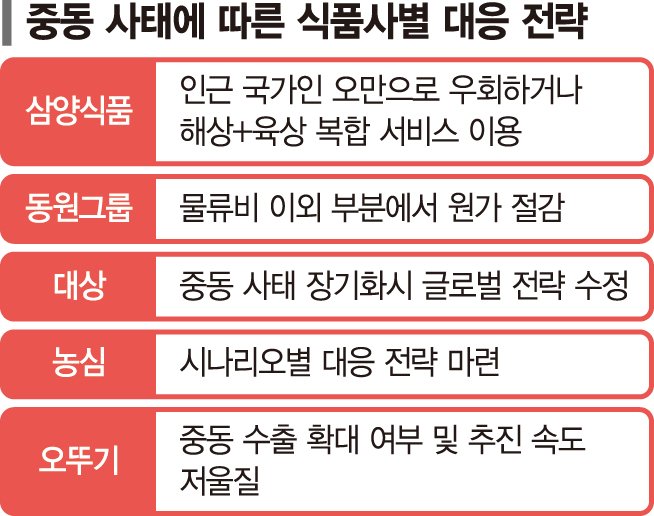
Samyang Foods, which has enjoyed global success with its Hot Chicken Flavor Ramen, is considering moving away from its existing route through the Strait of Hormuz. The company is reviewing options such as rerouting shipments via neighboring Oman or using combined "sea and land" multimodal transport services. Back in 2023, when Red Sea access to the Suez Canal was blocked due to support from the Islamic Republic of Iran for Houthi rebels, Samyang Foods managed to keep exports going by rerouting along the Cape Route off the Cape of Good Hope. A Samyang Foods representative expressed concern, saying, "If routes to the Middle East are suspended because of the war, we believe it will also affect shipping capacity to Europe."
Samyang Foods currently operates in around 10 Middle Eastern countries, including the United Arab Emirates (UAE). However, it does not have a presence in the Islamic Republic of Iran. Last year, the company’s sales in the Middle East reached about 66 billion won.
Dongwon Group is focusing on ways to reduce costs in areas other than logistics. A Dongwon Group official noted, "We expect cost pressures to intensify, including fuel expenses, domestic and international logistics costs, and production costs." Daesang believes that if the Middle East crisis drags on, it will inevitably have to revise its global strategy. A Daesang representative explained, "Higher oil prices and logistics costs are essentially a foregone conclusion," adding, "We have not yet set a specific course of action, but we are closely monitoring the situation."
Nongshim and Ottogi, which have been investing heavily to expand in the Middle East, plan to prepare scenario-based response measures depending on how the situation evolves. Nongshim is drawing up online and offline marketing campaigns, including pop-up events, to strengthen its push into the region this year. Just last month, the company held a Shin Ramyun snack pop-up in Riyadh, Kingdom of Saudi Arabia (KSA). A Nongshim official said, "We are watching developments such as the closure of the Strait of Hormuz and a sharp rise in oil prices, and we will respond in line with how the situation unfolds."
Ottogi, which is seeking to enter the Middle East, is likely to face setbacks in its efforts to tap the local market. The company is still in the early stages of its Middle East business and has so far exported only a limited range of products on a trial basis. An Ottogi representative stated, "Whether we expand exports in the future will be reviewed flexibly, based on a close assessment of regional conditions."
According to the Ministry of Agriculture, Food and Rural Affairs (MAFRA), K-Food exports to the Middle East reached 410 million dollars last year, up 22.6% from a year earlier. However, the region still accounts for only about 3% of total K-Food exports.
ssuccu@fnnews.com Kim Seo-yeon Reporter