Global financial markets left badly bruised as oil, currency, and rates stage a triple surge [U.S.–Iran war]
- Input
- 2026-03-04 18:16:25
- Updated
- 2026-03-04 18:16:25
■ New York market stages late rebound on Trump remarks
On the 3rd local time, the New York Stock Exchange (NYSE) was pushed to the brink as soon as trading opened. When the possibility was raised that Iran might blockade the Strait of Hormuz, the Dow Jones Industrial Average (DJIA) at one point plunged more than 1,200 points intraday, sending the market into panic. Large-cap technology stocks such as Nvidia and Apple, which had been driving the market until the previous day, were hit hard, along with economically sensitive small caps, and the NASDAQ Composite Index (NASDAQ) at one stage fell more than 4% during the session.
What reversed the market mood was an emergency statement from U.S. President Donald Trump. Through a briefing at The White House, Trump said, "The energy supply chain is the lifeline of the global economy," and declared, "If necessary, we will deploy the United States Navy (U.S. Navy) to directly escort every oil tanker passing through the Strait of Hormuz."
Once the president’s strong willingness to intervene became clear, the wave of panic selling subsided and New York stocks staged a dramatic V-shaped rebound into the close. The DJIA barely held on, ending at 48,501, down 0.83% from the previous day. The S&P 500 Index also slipped 0.94% to finish at 6,816.63. The NASDAQ closed at 22,516, a decline of 1.02%.
■ Triple surge fuels fears of supply-chain paralysis
While stock markets were whipsawing, real-economy indicators that put pressure on growth all shot past danger levels at once. International oil prices reacted first. West Texas Intermediate crude oil (WTI) spiked nearly 9% intraday immediately after Iran’s airstrike, briefly breaking above $77 per barrel, while Brent Crude Oil surged past $84. The moves reflected mounting concern that the Strait of Hormuz, the main artery for global crude shipments, could turn into a battlefield. WTI has since been hovering around the $74 level with extreme volatility, underscoring the market’s tension.
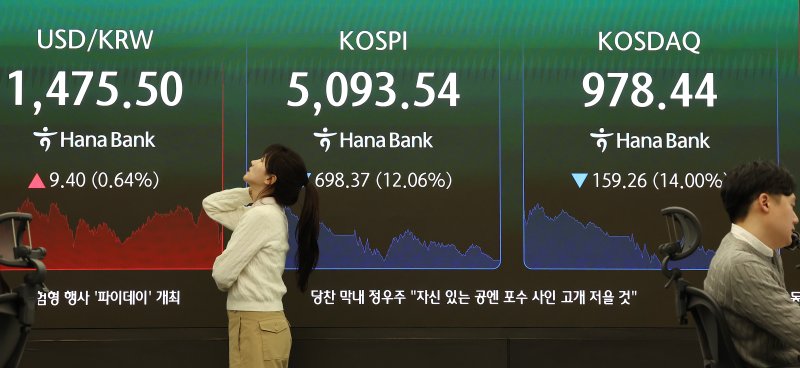
A flight to safe-haven assets also drove up the value of the U.S. dollar. The U.S. Dollar Index (DXY), which measures the greenback against six major currencies, broke above 99.20, cementing a strong-dollar trend. As a result, the won–dollar exchange rate surged toward the 1,500-won mark, its highest level since the global financial crisis, putting South Korea’s foreign-exchange authorities on high alert. On top of this, renewed fears of inflation pushed the yield on the 10-year U.S. Treasury note up to 4.07%, further increasing funding costs for companies.
Market participants described the situation as "a sign of systemic crisis that goes beyond a typical risk-off episode." In particular, the VIX, often dubbed the fear gauge, soared intraday to 28.15, signaling that investor sentiment had frozen over. Analysts warned that rising oil prices are stoking inflation, which in turn is reinforcing a high-interest-rate environment, creating a vicious cycle.
■ ‘Black Wednesday’ for Asian stock markets
Global market jitters hit Asia hard, especially assets linked to South Korea, whose economy is highly dependent on external demand. The iShares MSCI South Korea ETF (EWY), an exchange-traded fund listed in New York that tracks Korean equity indices, plunged 10.30% in a single day to close at $132.34. During the session, it was at one point down more than 14%.
This trend quickly spread to major stock markets across Asia. Japan’s Nikkei 225 index at one point dropped more than 4% intraday, tumbling to the 53,000 level. Taiwan’s Taiwan Capitalization Weighted Stock Index (TAIEX) also suffered a steep decline as heavy selling of technology stocks coincided with rising geopolitical risk.
A source in the financial investment industry explained, "South Korea is highly dependent on energy imports and vulnerable to exchange-rate volatility, so in times of geopolitical crisis it is like a canary in the coal mine, taking the first hit among global markets." The person added, "The double-digit plunge in EWY is a powerful warning sign that foreign capital could flow out of the domestic stock market in large volumes going forward."
[email protected] Kim Kyung-min Reporter