Ruling and opposition parties unite against U.S. tariffs: U.S. investment bill to pass on the 12th, delegation to visit Washington on the 23rd
- Input
- 2026-03-04 16:16:39
- Updated
- 2026-03-04 16:16:39
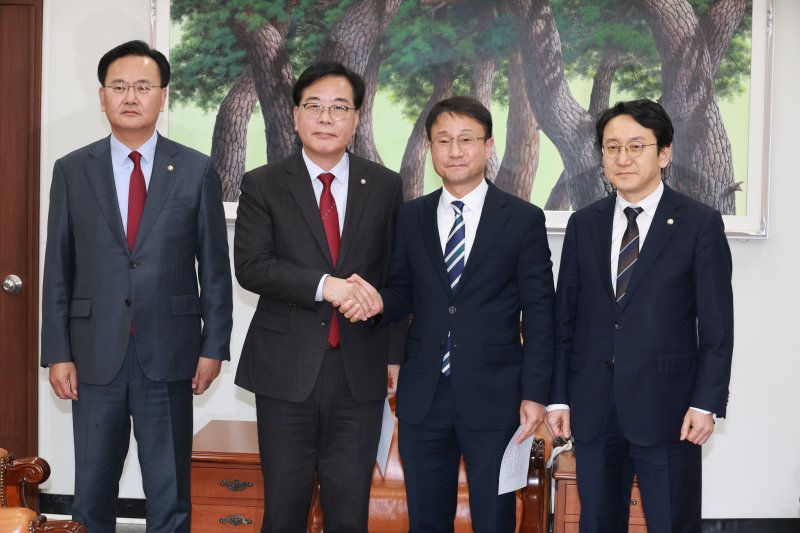
[Financial News] The ruling and opposition parties have closed ranks in response to pressure from the Donald Trump administration to reimpose higher tariffs. They agreed to pass the "Special Act on Strategic Investment Management between Korea and the United States" (commonly called the Special Act on Investment in the United States) on the 12th, and lawmakers belonging to the Korea-U.S. Parliamentary Association plan to visit the U.S. Congress together on the 23rd.
Special committee on U.S. investment resumes; parties agree to pass bill at plenary session on the 12th
First, the National Assembly Special Committee on the Handling of the Special Act on Investment in the United States formed a bill review subcommittee on this day and began full-scale deliberations. On the same day, DPK floor leader Han Byung-do and PPP floor leader Song Eon-seok met and agreed to put the Special Act on Investment in the United States to a vote at the National Assembly plenary session on the 12th.
The special committee placed nine versions of the Special Act on Investment in the United States, submitted by both the ruling and opposition parties, on the agenda of its full session and referred them to the subcommittee. The subcommittee, chaired by DPK lawmaker Jung Tae-ho, who also serves as the DPK secretary on the special committee, plans to produce a compromise bill by the committee’s deadline on the 9th.
The subcommittee was originally scheduled to be formed on the 24th of last month. However, it was delayed after the PPP boycotted in protest against the DPK’s push to railroad judicial reform and other contentious bills. Despite its ongoing confrontation with the DPK, the PPP then decided to help respond to U.S. tariffs in the national interest, allowing the special committee to resume its work.
In addition, the floor leadership of both parties agreed to pass the Special Act on Investment in the United States at the plenary session on the 12th. Speaking to reporters immediately after the floor leaders’ meeting, Yoo Sang-beom, the PPP’s senior deputy floor leader, stated, "If the handling of the Special Act on Investment in the United States is delayed, various problems such as tariff imposition could arise, so we decided to deal with it in a broad-minded way from the perspective of the national interest." Chun Joon-ho, the DPK’s senior deputy floor leader, said, "We are grateful that the People Power Party agreed to the schedule for handling the Special Act on Investment in the United States despite its various circumstances."
However, despite the agreement on the principle of swift passage, sharp differences remain over key issues such as whether to establish a dedicated investment corporation and the scope of parliamentary approval, making a smooth compromise unlikely. Heated exchanges were already seen at the special committee’s full session that day. The PPP argues that the Korea Investment Corporation (KIC) can take on the role, and that each U.S. investment project should be subject to prior approval by the National Assembly.
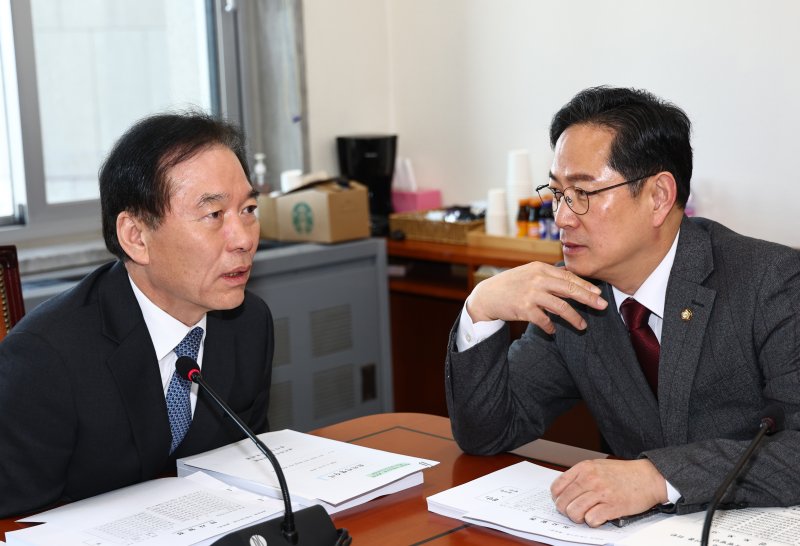
Korea-U.S. Parliamentary Association to visit U.S. on the 23rd to address tariffs, including adjustments to the Online Platform Fairness Act; ruling party to meet business leaders on the 5th
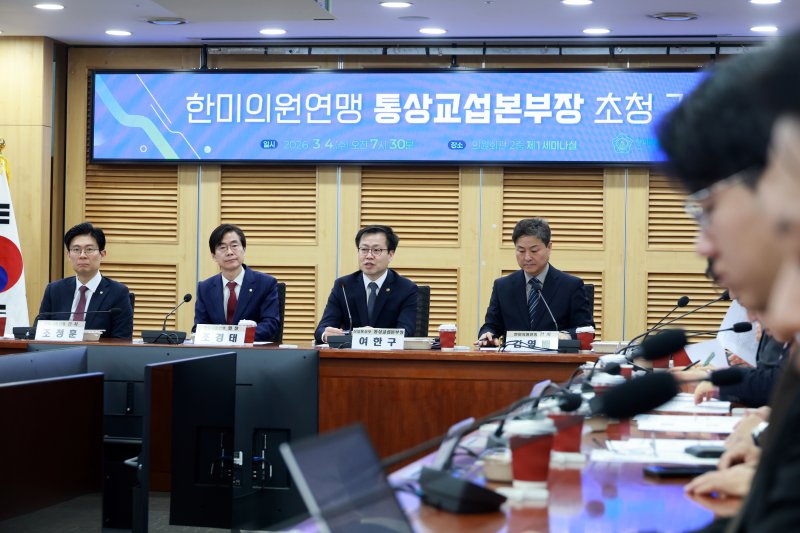
The ruling and opposition parties also plan to respond directly to tariff issues by visiting the U.S. Congress after passing the Special Act on Investment in the United States. The Korea-U.S. Parliamentary Association received a briefing on the status of tariff negotiations from Yeo Han-koo, head of the Trade Negotiations Office at the Ministry of Trade, Industry and Energy (MOTIE), and then announced that it would travel to the United States on the 23rd.
Kim Young-bae, the DPK secretary of the association, said they would inform the U.S. Congress not only of the passage of the Special Act on Investment in the United States, but also of Korea’s plan to adjust regulations on major U.S. big tech companies, which the Trump administration has taken issue with.
Specifically, regarding complaints from the U.S. government and business community triggered by Coupang, they plan to explain the actual circumstances of personal data leaks to persuade them that the measures are not unfair sanctions. On the issue of monopoly regulations under the Online Platform Fairness Act, they intend to convey that Korea will adjust the law to reflect U.S. concerns. Lawmakers from both parties in the association will discuss how to revise the Online Platform Fairness Act and other legal provisions that U.S. companies have criticized.
The government is pinning hopes on the association’s trip to Washington, given that trade policy authority in the United States is concentrated in Congress. This comes as suspicions of unfair treatment by the U.S. side persist, even though the Korean government recently allowed the overseas export of high-precision maps under conditions such as masking military and security facilities. Yeo stressed, "It is extremely important to explain the policy intentions behind various bills accurately to the United States and prevent misunderstandings."
Communication with Korean business circles will be led by the government and the ruling party. On the 5th, DPK lawmakers on the National Assembly Foreign Affairs and Unification Committee, the Strategy and Finance Committee, and the Trade, Industry, Energy, SMEs and Startups Committee will invite major companies such as Samsung, Hyundai Motor, LG, SK Group, HD Hyundai, Hanwha, and HMM, as well as the Federation of Korean Industries (FKI), the Korea International Trade Association (KITA), and the Korea Trade-Investment Promotion Agency (KOTRA), to discuss pending tariff issues.
Meanwhile, the ruling and opposition parties and the government also discussed energy supply issues arising from the closure of the Strait of Hormuz due to the situation in the Islamic Republic of Iran. Yeo said that Korea currently has sufficient oil and gas reserves, but added that the government is securing alternative supplies in case the war in the Middle East becomes prolonged. The meeting between the DPK and business leaders on the 5th will also address ways to respond to energy risks stemming from the Middle East.
[email protected] Kim Yun-ho, Kim Hyeong-gu Reporter