Hyundai Movex unveils full robot lineup, aiming to become the ultimate “logistics AI agent”
- Input
- 2026-03-04 15:50:11
- Updated
- 2026-03-04 15:50:11
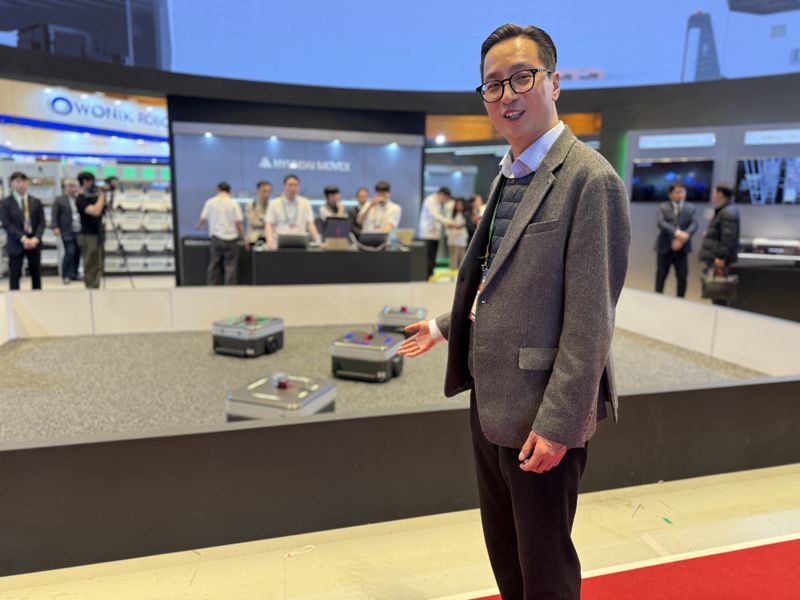
Hyundai Movex has declared the dawn of the "logistics AI agent" era, backed by a full lineup of robots developed in-house. From Automated Guided Vehicles (AGVs) and Autonomous Mobile Robots (AMRs) to gantry robots, indoor delivery robots, and interactive robots, the company designs and manufactures hardware across the entire spectrum and is combining this capability with artificial intelligence (AI) to become the ultimate game-changer in logistics automation.
■ "Full automation down to the layout": Taking on the logistics AI agent challenge
Speaking with reporters on the 4th at Smart Factory + Automation World 2026 (AW 2026) at COEX in Gangnam, Seoul, Youngho Lee said, "We will take on the challenge of building a logistics AI agent capable of full automation, including layout design." He added, "Because logistics centers require investments of hundreds of millions of dollars, we plan to validate our approach through multi-year simulations."
A logistics AI agent goes far beyond traditional AGVs that simply follow predefined routes. It is envisioned as an AI system that autonomously perceives thousands of variables in the logistics field in real time and makes high-level decisions, from layout design and equipment placement to route optimization.
This ambitious goal is backed by more than 35 years of experience in logistics. Lee noted, "We have accumulated data from a wide range of logistics sites, from tire manufacturing and pharmaceutical and biotech to e-commerce and ESS and other secondary battery sectors," and expressed confidence that "the scale of this data is more than sufficient for AI-based cognitive control."
The Hyundai Movex booth at AW 2026 functioned virtually as a "robot gallery." The robots on display were grouped into five main categories. The low-profile AGV (Automated Guided Vehicle) concentrates the company’s autonomous driving technologies. Each unit can carry loads of around 2 tons and move omnidirectionally with 360-degree freedom. While conventional AGVs are limited to fixed routes, Hyundai Movex’s low-profile AGV features a slim design that hugs the floor, allowing it to slide under various pallets and carts to lift cargo. The model has undergone 24-hour driving tests at Hyundai Movex’s Cheongna R&D Center to verify durability and stability. A single AGV can replace a three-shift workforce, delivering substantial labor cost savings.
Hyundai Movex also staged a "swarm parade" of Autonomous Mobile Robots (AMRs) in the demonstration zone. Multiple AMRs moved in formation, autonomously selecting optimal routes and avoiding collisions, a scene that captivated visitors. Unlike AGVs, which follow fixed guidelines, AMRs use sensors and AI algorithms to avoid obstacles and recalculate their paths in real time. This means they can respond immediately to dynamic changes in a logistics center environment.
The gantry robot demonstrates its strength in handling heavy items such as tires. It travels along rails installed on the ceiling, loading and transporting large cargo to precise locations. This gantry robot technology played a key role in Hyundai Movex winning a smart logistics system contract worth around 100 billion won for Hankook Tire & Technology’s plant in Tennessee in the United States.
The elevator-integrated indoor delivery robot is designed for unmanned delivery. It automatically interfaces with building elevators and can move autonomously between floors. The product targets last-mile delivery needs in multi-story facilities such as hospitals, hotels, and office buildings.
The mobile chatbot robot, an interactive model, is equipped with guidance and serving functions. It combines voice recognition with conversational AI to communicate directly with users. The product reflects Hyundai Movex’s intention to expand the application of robots beyond logistics sites into the broader service industry.
■ Precise sorting with "OmniSorter": A solution for the era of high-mix, low-volume logistics
Another highlight in the demonstration zone was the "OmniSorter." This automated sorting system is optimized for a wide variety of small items and identifies each product’s size, weight, and destination to sort them with high accuracy. As the e-commerce market has grown explosively, it is emerging as essential equipment for fulfillment centers that must process tens of thousands to hundreds of thousands of orders per day. Hyundai Movex also showcased a shuttle-based storage system capable of omnidirectional movement. Combined with existing stacker crane–type Automated Storage and Retrieval Systems (AS/RS), it creates an integrated logistics flow from shelving and stacker cranes to transfer, conveyors, and sorters in a single package.
Hyundai Movex’s strength in robotics stems from its "100% in-house design" approach. At its Cheongna R&D Center in Incheon, the company develops everything from mechanical design and motor control to sensor fusion and operating software. Lee explained, "Because we build not only the hardware but also the software ourselves, we can fully manufacture logistics equipment in-house," adding, "Our technology covers all logistics domains, and even when we outsource, we can provide clear direction."
This becomes a decisive differentiator at a time when low-cost Chinese AGVs and AMRs are flooding the market. Hyundai Movex does not just sell robot hardware; it offers total engineering packages that include customized layout design tailored to each customer’s process characteristics and software for operational optimization.
The company is particularly strong on efficiency. "By predicting shipping times in advance, we enable process equipment to dispatch goods ahead of time," Lee said, adding, "We are optimizing the use of time as a resource." The strategy is to reduce costs through AI-based optimization in all areas except for special layouts dictated by each customer’s unique equipment characteristics and process sequence.
Hyundai Movex is also conducting research to integrate advanced technologies such as Physical AI into its automation systems. Physical AI refers to next-generation technology that allows robots to perceive their physical environment, make their own decisions, and act accordingly, with a focus on improving both worker safety and productivity. As environments where robots and humans coexist become more common in logistics sites, enhancing safety features such as collision avoidance, anomaly detection, and emergency stops has emerged as a key challenge.
■ Merger with Hyundai U&I seen as a masterstroke, unleashing IT–logistics synergies
Hyundai Movex’s capabilities in robotics and AI did not emerge overnight. The company was established in 2017 by spinning off the logistics automation division of Hyundai Elevator, and the following year it merged with Hyundai U&I, which had been responsible for the group’s IT services. Looking back, this decision by Hyundai Group Chair Hyun Jeong-eun has proven to be a masterstroke. By combining logistics hardware expertise with IT and software capabilities, Hyundai Movex built a fully in-house development system covering everything from robot control software to Warehouse Management Systems (WMS) and simulation platforms. As a result, the company can flexibly deploy AGVs and AMRs to meet each customer’s needs and offer total solutions that centrally control the entire logistics flow through software.
The advancement of its robotics and AI business is also showing up in financial results. Hyundai Movex’s sales in 2025 are estimated at around 395.4 billion won, reflecting growth as large contracts, including the project for Hankook Tire & Technology’s U.S. plant, are converted into revenue. Securities analysts forecast 2026 sales of 496.3 billion won, up about 27% year-on-year, and operating profit of 38.5 billion won, an increase of roughly 62%. If additional large-scale orders are secured, the growth could be even stronger.
Lee emphasized, "Automation technologies that combine AI and robotics will no longer be optional but essential," and declared, "Hyundai Movex will become a global leader in smart logistics that delivers both efficiency and safety in a rapidly changing industrial environment."
[email protected] Kang Gugi Reporter