"It's in even deeper trouble than KG Mobility"... How Homeplus is similar to, yet different from, KG Mobility
- Input
- 2026-03-04 16:21:14
- Updated
- 2026-03-04 16:21:14
With Homeplus' court receivership extended by two months until May 4, attention is turning again to the case of KG Mobility, which went through a similar process five years ago. However, many observers believe that selling Homeplus, a retail company, will be more difficult than selling KG Mobility, which is a manufacturer.
Lee Wang-min, an attorney at D&A LLC, said on the 4th, "KG Mobility, as a manufacturer, had appeal for potential buyers because of its technology, design capabilities, and brand competitiveness," adding, "By contrast, from the perspective of existing retailers, it is hard to expect much synergy from acquiring Homeplus, and in the retail sector its brand power is not a significant advantage."
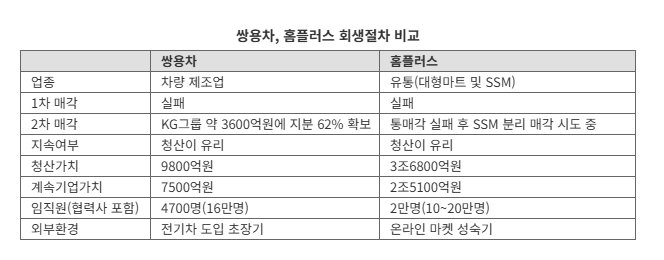
Both KG Mobility and Homeplus were evaluated during their rehabilitation proceedings as having a higher liquidation value than going-concern value.
Ernst & Young Han Young (EY Han Young), which was appointed as the examiner for KG Mobility in June 2021, estimated the company’s liquidation value at 980 billion won and its going-concern value at 750 billion won. Going-concern value refers to the present value of profits expected to be generated over the next 10 years of operations.
From 2007 to 2020, KG Mobility posted losses for 14 years, except for a single year in 2016. During the first attempt to sell the company, electric bus maker Edison Motors was selected as the preferred bidder, but the contract was terminated after it failed to pay 90% of the acquisition price.
KG Mobility was eventually acquired by KG Group in August 2022 after a second attempt at a sale. KG Group took on overdue wages and other debts, and the acquisition price came to 360 billion won. Following the acquisition, KG Mobility successfully normalized its operations and has been posting profits for three consecutive years since 2023.
According to an examiner’s report that Samil PricewaterhouseCoopers submitted to the court in June last year, Homeplus likewise has a liquidation value of about 3.7 trillion won and a going-concern value of 2.5 trillion won, indicating that liquidation would be more advantageous economically. The report projected that Homeplus would remain in the red from 2026 to 2028, but after restructuring and other measures, it could reach 8.2 trillion won in sales and 180 billion won in operating profit by 2036.
Homeplus is also pursuing an M&A deal before its rehabilitation plan is approved. Its first open bidding process failed. No parties expressed interest in the first open sale held in December last year. The market has interpreted this as a result of MBK Partners, Homeplus’ largest shareholder, having already sold off many of its key stores, which reduced the company’s attractiveness, as well as the weakening competitiveness of big-box hypermarkets amid the rapid growth of online marketplaces. Homeplus has abandoned a one-shot sale of all its stores and is now pushing for a Homeplus Express spin-off sale of its supermarket (SSM) division.
At present, some manufacturers have stopped supplying products to Homeplus due to concerns about collecting payments, so the retailer is filling its shelves mainly with its own private brand product lines. This has created a vicious cycle of "fewer products → fewer customers → deteriorating operating profit." Employees’ January wages were paid late, and wages and bonuses for February, totaling about 90 billion won, are reportedly still unpaid.
Chang-Hyun Ahn, an attorney at Daeyul Law Firm, commented, "Even if Homeplus succeeds in raising funds through the sale of Homeplus Express, the repayment rate on its existing debt is unlikely to be high," and added, "Given that self-rescue is difficult, additional steps such as attracting external capital, restructuring its debt, and broader corporate restructuring will be necessary."
Meanwhile, the Seoul Bankruptcy Court plans to discuss forming a Business Normalization Task Force (TF) this week, with participation from the debtor, shareholders, and the creditors' council.
[email protected] Lee Hwan-joo Reporter