Yoon’s Side Argues in Second Trial Over ‘Obstruction of Arrest’ That First Court Overstretched CIO’s Investigative Powers
- Input
- 2026-03-04 16:08:50
- Updated
- 2026-03-04 16:08:50
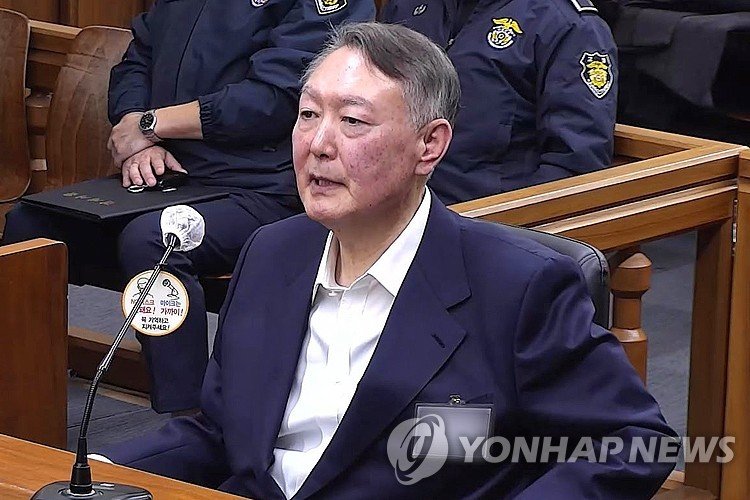
According to The Financial News, former President Yoon Suk Yeol, who was sentenced to five years in prison at first instance for obstructing the execution of an arrest warrant issued by the Corruption Investigation Office for High-ranking Officials (CIO), again argued on appeal that the CIO has no investigative authority. The special prosecutor team countered by challenging parts of the acquittal in the first ruling and the overall sentence as problematic.
Criminal Division 1 of the Seoul High Court, presided over by Presiding Judge Yoon Sung-sik of the Seoul High Court Criminal Division 1, held the first appellate hearing in the afternoon of the 4th on charges including obstruction of special official duties against Yoon. Yoon appeared in court wearing a navy suit and a white shirt. He looked somewhat thinner, and he wore a badge on the left side of his chest displaying his inmate number.
Both sides engaged in an intense legal battle, using presentations to lay out the grounds for their appeals.
The Special Prosecutor Team for Insurrection and Treason, led by Special Prosecutor Cho Eun-seok, argued that the first-instance court had misapplied the law when it acquitted Yoon on several counts: abuse of power for infringing the deliberation rights of two Members of the State Council, issues related to the drafting and use of documents after the fact, abuse of power and obstruction of the exercise of rights in connection with false public statements, and the finding that there was no conspiracy with senior officials of the Presidential Security Service (PSS) in relation to the obstruction of arrest.
The special prosecutor team contended that the deliberation rights of the two Members of the State Council who were unable to attend the State Council of South Korea during Martial Law should also be considered infringed. They further argued that any document prepared after the fact must be deemed to have been "used" as long as it was kept on file, and that the act of issuing false public statements itself falls under forcing officials to perform duties they are not legally obliged to perform.
They also insisted that the sentence imposed was excessively light. The team stated, "The defendant committed crimes that undermined the constitutional order, yet he completely denies the offenses and has consistently offered explanations that are impossible to accept," adding, "He has issued no message of apology to the people who entrusted him with the powers of the presidency, and he has denied or disparaged the judicial system of the Republic of Korea." On that basis, they argued that the original sentence was far too lenient.
Yoon’s defense, on the other hand, argued that the first-instance court had erred in its legal interpretation regarding the counts on which he was convicted: including the charge of drafting false official documents, the charge of instigating violations of the Presidential Security Act, and the charge of obstruction of special official duties.
Yoon’s side asserted, "The first-instance judgment fundamentally misunderstood the constitutional nature and function of the deliberation rights of Members of the State Council, and, by expansively interpreting them as rights of members who did not attend, excluded the defendant’s intent without any basis." Regarding the alleged instigation of violations of the Presidential Security Act, they added, "The lower court’s conclusion that a crime is established based on mere instructions runs counter to firmly established Supreme Court precedent."
In particular, with respect to the charge of obstruction of special official duties, the defense again made the scope of the CIO’s investigative authority a central issue. They argued, "By interpreting the law in an excessively expansive way, beyond the clear limits set out regarding the investigative authority of the Corruption Investigation Office for High-ranking Officials (CIO), the court undermined the basic rule-of-law principles governing the allocation of powers and jurisdiction."
The case has been assigned to the Special Panel for Insurrection Cases within Criminal Division 1 of the Seoul High Court. The panel granted the special prosecutor’s request for live broadcasting and authorized gavel-to-gavel coverage of all hearings. The video recordings will be released after the trial concludes, once personal information has been anonymized.
The court explained, "In light of the gravity of the case, the public’s right to know, and the need to balance the fairness of the trial with the protection of privacy, we have decided to allow broadcasting of all hearings from opening to close," while adding, "Depending on how the proceedings unfold, if any statutory grounds for prohibition arise, we may deny broadcasting for specific sessions."
In the earlier first-instance ruling, the court found Yoon guilty of infringing the deliberation rights of seven Members of the State Council in connection with Martial Law, drafting false official documents during the preparation and later disposal of the Martial Law proclamation, ordering the deletion of secure phone call logs, and obstructing the execution of an arrest warrant by investigative authorities, and sentenced him to five years in prison.
[email protected] Choi Eun-sol Reporter