Korean stock market tumbles... KOSPI and KOSDAQ plunge over 10% [fn Afternoon Market Report]
- Input
- 2026-03-04 14:30:39
- Updated
- 2026-03-04 14:30:39
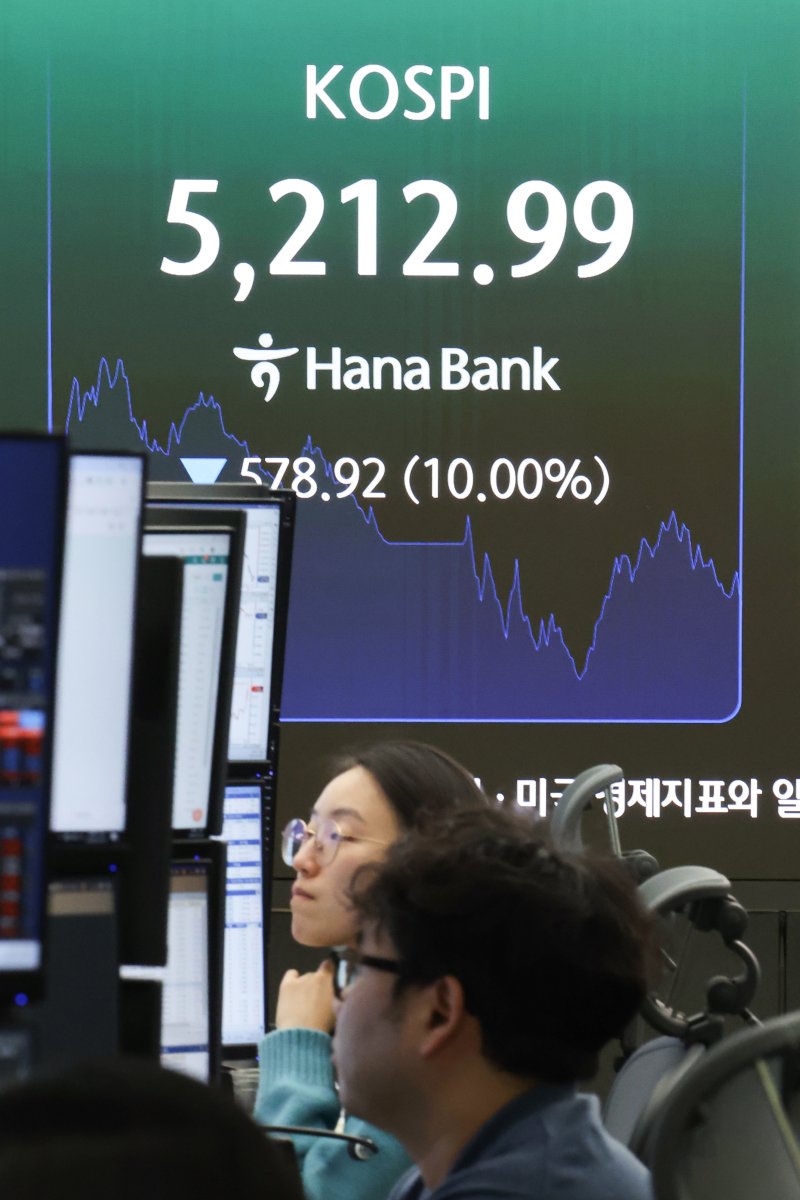
[Financial News] The Korean stock market is suffering one of its worst days ever as geopolitical risks in the Middle East intensify. Both major indices have plunged more than 8%, triggering circuit breaker mechanisms on the country’s two main exchanges.
As of 2:15 p.m. on the 4th, the Korea Composite Stock Price Index (KOSPI) was trading at 5,326.22, down 555.69 points (9.59%) from the previous session. The index opened 3.44% lower at 5,592.59 and extended its losses immediately after the market opened.
In the afternoon, it fell as far as 5,059.45, a drop of 732.46 points (12.65%). This marks the largest decline ever in both percentage and points. It surpasses the 12.0% plunge recorded on September 12, 2001, right after the September 11 attacks (9/11 attacks) in the United States.
At the same time, the KOSDAQ Index was at 999.19, down 138.41 points (12.17%) from the previous trading day.
The Korea Securities Dealers Automated Quotations (KOSDAQ) started the day at 1,112.08. During intraday trading, it at one point plunged 161.16 points (14.17%) to 976.54.
As both indices tumbled, the Korea Exchange activated circuit breaker mechanisms on the KOSPI and KOSDAQ markets. A circuit breaker mechanism halts trading for 20 minutes if the index falls more than 8% from the previous day’s close and that drop continues for at least one minute.
This is only the fourth time in history that circuit breaker mechanisms have been triggered simultaneously on both the KOSPI and KOSDAQ. The most recent case was on August 5, 2024, when weak U.S. economic data and the unwinding of the yen carry trade coincided. At that time, the KOSPI fell 8.77% and the KOSDAQ dropped 11.3% from the previous session.
Among large-cap stocks by market capitalization, all major names are sharply lower, including Samsung Electronics (-8.97%), SK Hynix (-6.39%), and Hyundai Motor (-14.12%).
Eun Taek Lee, a researcher at KB Securities, said, "In general, people tend to think there will be no major corrections during a bull market, but in an average year a correction of more than 10% occurs about once a year, while in a bull market it happens at least twice." He added, "If daily volatility is usually around 2–3%, in a bull market it frequently exceeds 4–5%. The stronger the rally, the deeper the pullback."
He went on to say, "The market is plunging now because of the Iran crisis, but even without this, the second quarter was vulnerable to a correction." He added, "Looking at past cases where the market surged this quickly and then corrected, the drawdown was generally between 15% and 23%. In index terms, that would translate to a range of roughly 4,850 to 5,400."
[email protected] Park Ji-yeon Reporter