KOSPI plunges 12% in a '9/11-level' crash... Brokerages still say "it’s going to 7,500"
- Input
- 2026-03-04 14:28:51
- Updated
- 2026-03-04 14:28:51
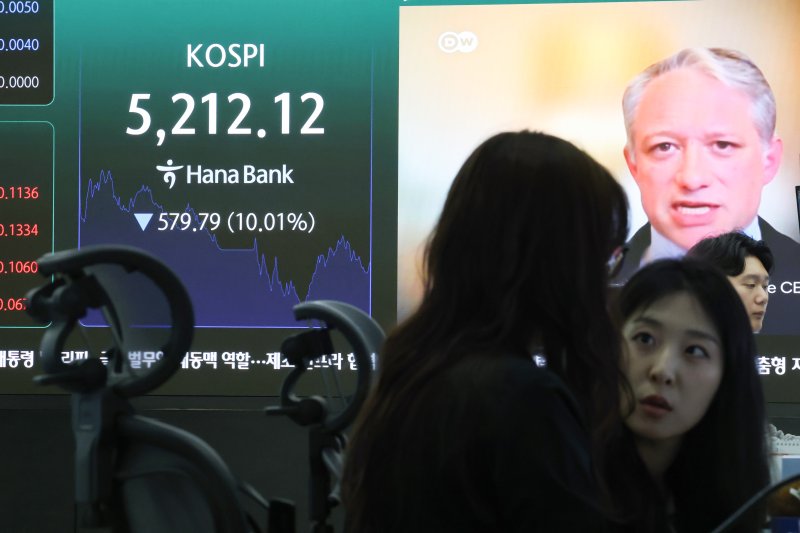
[The Financial News] Hit by a “Middle East shock” triggered by the Islamic Republic of Iran, the KOSPI has tumbled sharply for two consecutive days, badly shaking retail investors’ sentiment. Nevertheless, securities firms are continuing to project that the KOSPI’s upward trend will remain intact.
‘Middle East shock’ panic selling sends intraday plunge to 12.64%... largest drop on record
On the 4th, the Korea Exchange halted trading on the KOSDAQ Market from 11:16 a.m. to 11:36 a.m., and on the KOSPI market from 11:19 a.m. to 11:39 a.m., activating the circuit breaker mechanism. This was because both the KOSPI and KOSDAQ Market indices had fallen more than 8% from the previous day’s closing level and stayed there for at least one minute, meeting the conditions for a circuit breaker mechanism. Around 9 a.m. that day, a sidecar was also triggered simultaneously on the KOSPI and KOSDAQ Market, temporarily suspending program sell orders.
During intraday trading, the KOSPI fell 12.64% from the previous close, marking the largest decline on record and surpassing the 12.02% drop seen during the September 11 attacks (9/11) in 2001.
Despite the fear that has swept through the stock market, positive outlooks continue to emerge from the securities industry. Analysts note that the market had overheated as it surged toward the “6,000-point KOSPI” level in a short period, but say that some of this froth has now been removed, turning the current phase into a potential buying opportunity. While some caution that the situation could drag on and should not be taken lightly, the prevailing view is that if conditions stabilize without damaging corporate fundamentals—led by semiconductor companies—the upward trend is likely to resume.
"Geopolitical risk is temporary"... Brokerages say there is still ample room for gains
In fact, Daishin Securities, in a report released on the 3rd, raised its year-end KOSPI target from 5,800 points to 7,500 points, even as the index was entering a correction phase. Analyst Lee Kyung-min at Daishin Securities cited shifts in monetary policy stance and a slowdown in next year’s earnings growth as risk factors, but added, "Geopolitical risks such as the war involving the Islamic Republic of Iran may increase short-term volatility, but if interest rate cuts and fiscal stimulus in the United States of America (US), China, and South Korea gain full momentum, there could be additional upside potential."
Heo Jae-hwan, an analyst at Eugene Investment & Securities, also commented, "The Islamic Republic of Iran’s last-ditch resistance, with its military capabilities seemingly nearly exhausted, could last longer than expected. The fundamental risk of an energy shock has not been resolved," but went on to say, "Historically, geopolitical risks have always turned into opportunities once they passed. It does not seem that the opportunity is very far away."
Heo further explained, "The Cboe Volatility Index (VIX) has risen to 27 points. That is about one standard deviation above its historical average, and when it reaches the 30–40 range, the probability of a market bottom is quite high." He emphasized, "Since Coronavirus disease 2019 (COVID-19), the KOSPI’s declines from its peaks have generally been around 10%. During the global market downturn in 2022–2023 caused by US monetary tightening, except for the 30% drop and the 20% fall on Liberation Day, the declines rarely exceeded 8–15%."
Han Ji-young, an analyst at Kiwoom Securities, also addressed comparisons some market participants are making between the current situation involving the Islamic Republic of Iran and the outbreak of the Russo-Ukrainian War, noting, "The Russo-Ukrainian War was a black-swan-type event that few had anticipated, whereas the current Middle East crisis is the materialization of a potential risk that has been visible to the market since January. That is a key difference."
Unlike the previous period, when the KOSPI was losing momentum, she pointed out that earnings momentum is now accelerating, and therefore the upward trend is likely to continue even after the first-quarter earnings season. Han said, "It seems premature to talk about a structural downtrend in the index," and advised, "Rather than cutting positions in a panic and joining the sell-off, it would be more beneficial either to maintain existing positions or to buy leading stocks that have fallen excessively."
[email protected] Kim Hee-sun Reporter