[Exclusive] Constitutional Court’s ‘Over Two-Year Merits Review’... New Constitutional Complaint System May Worsen Backlog
- Input
- 2026-03-04 15:57:31
- Updated
- 2026-03-04 15:57:31
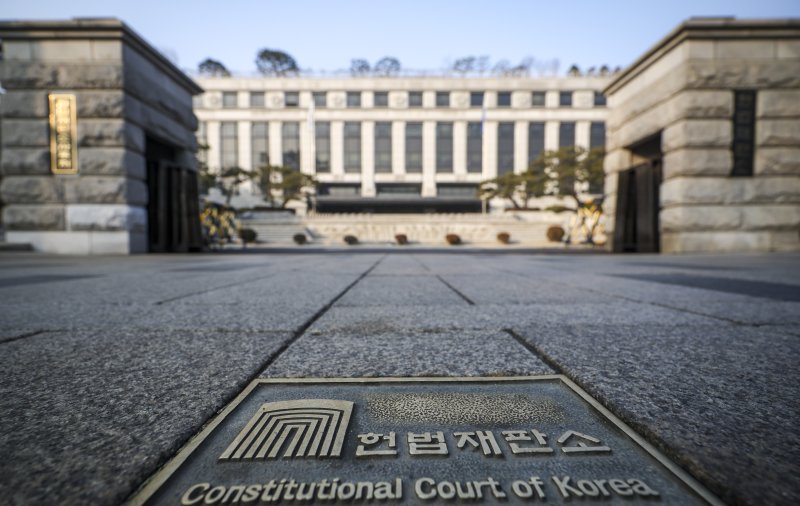
According to The Financial News, the average time it will take the Constitutional Court of Korea in 2025 to handle cases related to the system allowing constitutional complaints against court rulings is projected to far exceed two years. The Court says that once more rapporteur judges and other staff are added and the new system settles in, it will be able to manage the caseload. However, many observers still expect that, once constitutional complaints against court rulings are fully implemented, further delays in proceedings will be unavoidable.
Data that Representative Ju Jin-woo of the People Power Party received from the Constitutional Court of Korea on the 4th show that, excluding cases dismissed by the three-judge preliminary review panels, the average processing time for 628 merits cases in 2025 is 753.2 days, or about two years and one month. This is roughly 30 days longer than the previous year’s average of 724.7 days.
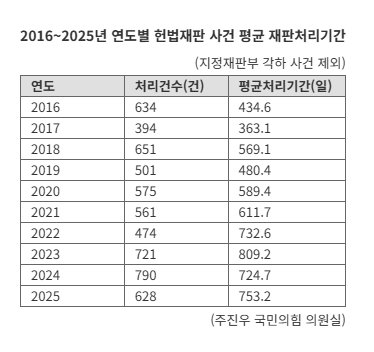
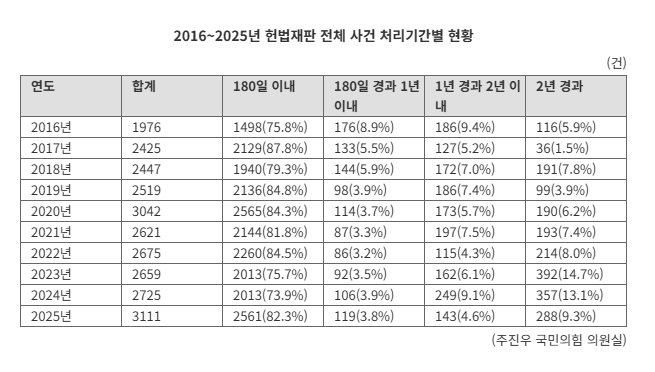
Since 2022, the Constitutional Court of Korea’s average processing time has remained in the 700–800 day range. It peaked at 809.2 days in 2023, then shortened by about three months in 2024, only to increase again by roughly one month last year. Compared with the 2017 average of 363.1 days, the current figure is more than double. The Court handled a total of 3,111 cases last year. Of these, 550 cases (17.7%) exceeded the six‐month statutory time limit set by the Constitutional Court Act. Specifically, 288 cases (9.3%) took more than two years, 143 cases (4.6%) took more than one year but less than two, 119 cases (3.8%) took more than 180 days but less than one year, and 2,561 cases (82.3%) were resolved within 180 days.
As of the end of last year, there were 1,382 unresolved pending cases. This is slightly fewer than the 1,401 cases the previous year, but the number has stayed above 1,000 for several years. In particular, many constitutional review requests on the constitutionality of specific statutes and constitutional complaints have dragged on for long periods. As of the end of January, 800 statutory cases remained pending at the Constitutional Court of Korea. A constitutional complaint challenging Article 4(1) of the Addenda to the Public Officials Pension Act, among others, has been awaiting a decision for more than five years since it was filed in August 2020. Because the Court repeatedly seeks opinions from related agencies and written arguments go back and forth, the structure itself leads to prolonged proceedings.
On top of this, when impeachment cases involving the president or high-ranking public officials are filed, they become the Court’s top priority, inevitably pushing ordinary cases further back in the queue. In this situation, critics warn that if a large number of constitutional complaints against court rulings start flowing in, the processing time for existing cases will only grow longer. Representative Ju Jin-woo argued, "The public is already deeply dissatisfied because current cases are not being handled in a timely manner. Introducing constitutional complaints against court rulings now would only bring about judicial paralysis."
On February 18, the Supreme Court of Korea released a reference report projecting that the current staff of nine justices and around 70 rapporteur judges at the Constitutional Court of Korea would not be able to cope with the expected increase in constitutional complaints against court rulings. It estimated that if just 30% of the Supreme Court of Korea’s 50,000 annual merits cases led to such constitutional complaints, more than 15,000 additional cases a year could be filed.
The legal community also believes that expanding personnel is unavoidable. Noh Hee-bum, a former rapporteur judge at the Constitutional Court and now an attorney, stated, "If constitutional complaints against court rulings are introduced, increasing staff is a given," adding, "I believe at least 50 more research staff and more than 20 additional administrative employees will be needed." Jang Young-soo, emeritus professor at Korea University School of Law, noted, "Given Korea’s high appeal rate, the Constitutional Court of Korea’s caseload could increase by 300–400% once constitutional complaints against court rulings are introduced," and suggested, "The number of constitutional justices should be more than doubled so that two separate panels can be formed; only then will the reform offer any real help."
The Constitutional Court of Korea held a meeting of justices the previous day, chaired by President Kim Sang-hwan, to discuss follow-up procedures. Earlier, the Court had cited Taiwan’s 2022 introduction of a similar system, explaining that while there was an initial surge in cases, the situation later stabilized. At the same time, it acknowledged, "If a system of constitutional complaints against court rulings is introduced, it may be necessary to secure additional budget to increase the number of rapporteur judges and support staff for adjudication."
[email protected] Choi Eun-sol Reporter