"I bought in when they said KOSPI was going to 7,000" – retail investors rattled as Samsung Electronics plunges 10%, down another 6% today
- Input
- 2026-03-04 10:40:01
- Updated
- 2026-03-04 10:40:01
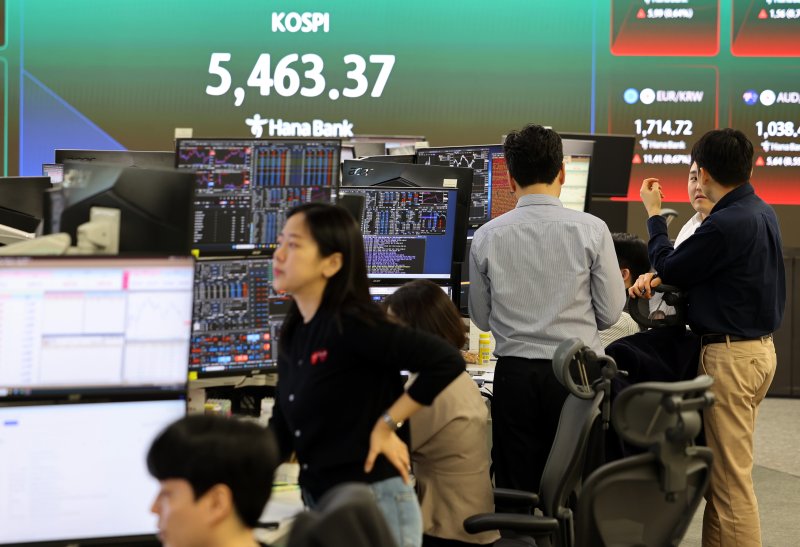
[The Financial News] The domestic stock market is swinging sharply in the wake of military clashes between the United States of America (US) and the Islamic Republic of Iran. As sectors diverge, retail investors’ sentiment is also splitting in two.
"Stocks are really easy" – retail investors in defense stocks grow confident
According to the Korea Exchange on the 4th, the previous day the KOSPI closed at 5,791.91, down 452.22 points (7.24%) from the session before. As of 9:30 a.m., it was trading at 5,514.29. In terms of point decline, it was the largest on record, and even by percentage drop it ranked as the 14th biggest fall in history.
However, the market is showing stark sector-by-sector divergence. Geopolitical risks stemming from the US-driven "Middle East shock" sent defense names such as LIG Nex1 (up 29.86%), Hanwha Systems (up 29.93%), Hanwha Aerospace (up 19.83%), and Hyundai Rotem (up 8.03%), as well as refiners and shippers including S-Oil (up 28.45%), sharply higher across the board.
By contrast, airline and travel stocks, which were hit directly by surging oil prices and a weaker won, plunged. Hanjin KAL fell 12.67%, Korean Air dropped 10.32%, and Jeju Air lost 7.72%.
Retail investors are also reacting in sharply different ways to these extreme market conditions. Those who jumped into war-related plays and booked profits are posting in online communities, saying things like, "Stocks are really easy. This month I’ll just dump all my semiconductor holdings and only buy defense and refining stocks," expressing growing confidence.
Retail investors in blue chips grow anxious: "Whenever I buy, it falls; when I sell, it goes up"
On the other hand, investors in large-cap stocks are watching the market nervously. Even Samsung Electronics and SK Hynix, the twin engines that drove the 6,000-point KOSPI era on the back of semiconductors, have slumped on the fallout from the US–Islamic Republic of Iran conflict, shattering the "200,000-won Samsung Electronics" and "1 million-won SK Hynix" narratives. This is why retail investors keep lamenting, "Whenever I buy, it falls; when I sell, it goes up. I’m too exhausted to keep trading stocks."
Fear among retail investors also produced a farcical roller-coaster in Kumho Petrochemical the previous day. According to investors, "Kumho Petrochemical is a chemical stock, but because it has 'petro' in its name, people piled in thinking it was an oil refiner and ended up stuck in the stock." Kumho Petrochemical jumped 5% intraday before closing down 9%, and the decline has continued in early trading on the 4th.
Securities industry: "Once the situation calms down, the uptrend can resume"
Meanwhile, in the securities industry, some warn that if Middle East risks drag on, the market could enter a full-fledged downtrend. However, many also believe that as long as corporate fundamentals, led by semiconductors, remain intact and the situation stabilizes, the market will see only temporary volatility before the broader uptrend resumes.
Indeed, even amid the KOSPI’s slide the previous day, Daishin Securities raised its KOSPI year-end target from 5,800 points to 7,500, citing earnings prospects in key sectors, a recovery in the semiconductor cycle, and policy momentum.
Lee Kyung-min, a researcher at Daishin Securities, pointed to shifts in monetary policy stance and a slowdown in next year’s earnings growth as risk factors. However, Lee also stated, "Geopolitical risks such as the war involving Iran may increase short-term volatility, but if interest-rate cuts and fiscal stimulus in the US, China, and Korea gather pace, there could be further room for the market to rise."
[email protected] Kim Hee-sun Reporter