[Editorial] To Overcome the Compound Crisis, the U.S. Investment Act Must Be Passed Quickly
- Input
- 2026-03-03 19:12:33
- Updated
- 2026-03-03 19:12:33
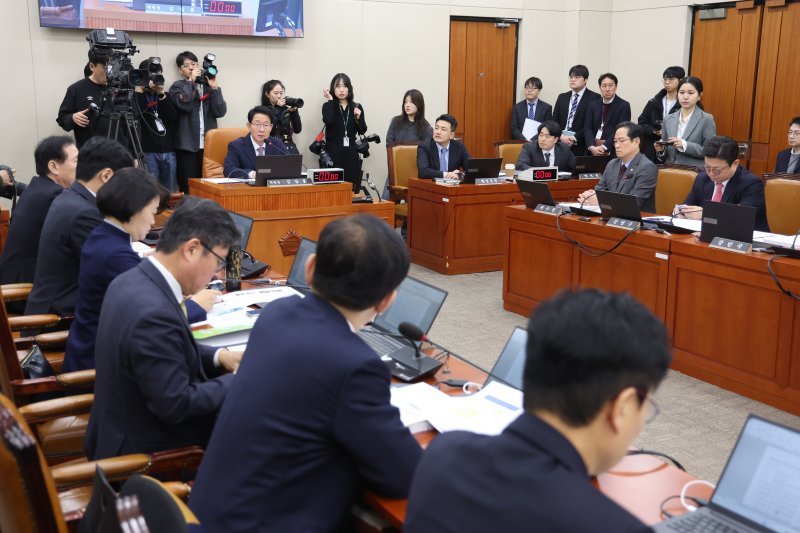
On top of this, President Donald Trump’s push for steep tariffs has further clouded the outlook for Korea’s export-driven economy. As multiple economic crises hit at once, policymakers must at least resolve the difficult issues that can be addressed. One such task is passing the “Special Act on Strategic Investment Management between Korea and the United States,” commonly called the special U.S. investment act, which is pending in the National Assembly. It speaks volumes that the six major business organizations issued an emergency appeal on the 3rd, in the midst of political turmoil, earnestly calling for the bill’s passage. Both the ruling and opposition parties must take the business community’s plea seriously.
Business leaders share a common view: for Korean companies to proactively enter overseas markets and make bold investments, uncertainty in global trade must first be reduced as much as possible. When layers of complex risks pile up, companies cannot easily make investment decisions. Among these risks, the most critical issue directly tied to corporate interests is the relationship with the United States. Reducing even one source of unnecessary friction in economic relations with the U.S. would benefit both Korean companies and the national interest.
Yet the trade environment in the United States is so volatile that it is hard to predict even the near future. On July 20, the Supreme Court of the United States (SCOTUS) ruled that the Trump administration’s reciprocal tariffs were unlawful, which briefly seemed like a relief. However, the situation has in fact become more complicated. Trump is now threatening to maintain his existing tariff stance through alternative legislation while imposing additional, selective tariffs on specific countries and products. If this continues, Korea’s key industries with high export exposure to the U.S.—such as semiconductors, automobiles, and pharmaceuticals—could be hit directly.
Concerns that expanding investment in the United States could accelerate the hollowing-out of domestic industry cannot simply be brushed aside. It is also right to scrutinize whether such investment truly serves the interests of Korean companies and the national economy. Even so, the real choice now boils down to this: will we live with the risk of U.S. tariffs, or will we try to resolve it through negotiation?
If tariff barriers rise, the export competitiveness of Korean firms will erode, and the damage will show up as weaker domestic employment and reduced investment. The longer it takes to pass this act, the more bargaining power Korean companies will lose in negotiations over investment in the U.S. The tangible benefits they could secure will shrink accordingly.
When risks emerge in combination, responses must be more sophisticated and multidimensional. The Russo-Ukrainian war, the Middle East crisis, and U.S. tariffs are piling up one after another, posing a serious external threat to Korea. These are problems that are difficult for us to solve on our own. Even so, the U.S. investment act is at least something we can address ourselves. We must not turn our backs on that opportunity.
In an already challenging economic environment, companies are finding it hard even to make decisions on capital spending, hiring, and overseas expansion. The National Assembly may not be able to actively help them, but it should at least refrain from holding them back. Lawmakers must not let the special committee on the U.S. investment act run past its activity deadline of the 9th. Continued foot-dragging will only weaken Korea’s negotiating position. The parties may clash over other issues, but they must still do what clearly needs to be done. Otherwise, they will not escape criticism for neglecting their duties.