KOSPI in Panic: Is Now the Time to Buy Samsung Electronics and SK Hynix?
- Input
- 2026-03-03 18:30:49
- Updated
- 2026-03-03 18:30:49

The domestic stock market was hit hard by risks stemming from the Middle East. Foreign investors dumped more than 5 trillion won worth of shares in a single day, unleashing a barrage of sell orders that dragged the indexes down.
On the 3rd, the Korea Composite Stock Price Index (KOSPI) closed at 5,791.91, down 452.22 points, or 7.24%, from the previous trading day. It was the first time in seven sessions, since it finished at 5,677.25 on the 19th of last month, that the KOSPI ended below the 5,800 level. The KOSDAQ Index closed at 1,137.70, down 55.08 points, or 4.62%, from the previous session.
Samsung falls below 200,000 won, SK Hynix under 1 million won, while defense stocks rally
The sharp plunge in the KOSPI triggered a temporary halt in program sell orders, known as a "sidecar," at one point during the session. A sell-side sidecar is activated when the KOSPI 200 Futures fall by 5% or more and stay at that level for at least one minute. This was the first time in about a month, since the 6th of last month, that a sell-side sidecar had been triggered on the KOSPI. In the KOSPI market, retail investors were net buyers of 5.7974 trillion won, but foreign investors were net sellers of 5.1482 trillion won, pulling the index lower. Institutions also showed a net selling stance of 886.3 billion won.
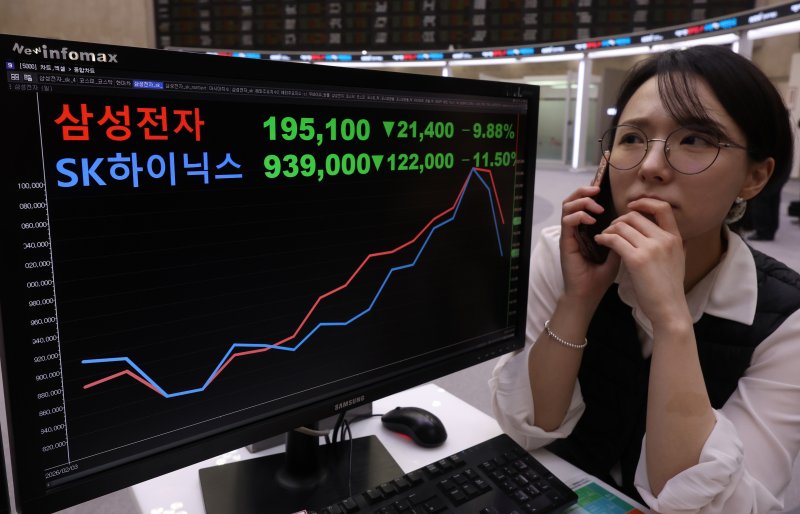
Large-cap stocks by market capitalization were unable to escape the downturn. Samsung Electronics and SK Hynix plunged 9.88% and 11.50%, respectively, sending Samsung below 200,000 won and SK Hynix under 1 million won. Other major names also slumped, including Hyundai Motor (-11.72%), LG Energy Solution (-7.96%), Samsung Biologics (-5.46%), and SK Square (-9.92%). In contrast, leading defense stock Hanwha Aerospace surged 19.83%, showing strong gains.
Investor sentiment froze as concerns grew that the war could drag on following the US airstrikes on the Islamic Republic of Iran. The impact was seen as particularly severe because the Korea Composite Stock Price Index (KOSPI) had already posted strong gains this year, on top of last year’s rally. Joain, a researcher at Samsung Securities, noted, "From the start of the year through last month, the KOSPI rose 48% and the KOSDAQ climbed 29%, far outperforming global markets and creating strong pressure for profit-taking." Joain added, "About 70% of South Korea’s imported crude oil passes through the Strait of Hormuz, so concerns are spreading that this could become a burden for the energy-dependent Korean economy."
"A burden on the Korean economy"...exchange rate jumps 26.4 won
Lee Kyung-min, a researcher at Daishin Securities, said, "At this point, we expect the situation to calm down and be resolved within about a month, so there is no need to overinterpret this event or be gripped by vague fear." Lee predicted, "If the situation ends without damaging economic fundamentals, the stock market is likely to quickly resume its upward trend."
The "Iran situation" also sent the currency market swinging. In the Seoul foreign exchange market on the same day, the US Dollar–South Korean Won exchange rate closed at 1,466.1 won, up 26.4 won from the previous session. The rate opened at 1,462.3 won, up 22.6 won, and fluctuated within the 1,460-won range during the session. The rise in the opening rate compared with the previous close was the largest in five months, since a 23.0-won jump on October 10 last year.
The move was attributed to heightened geopolitical tensions, which boosted demand for safe-haven assets such as the US dollar. Yoo Myung-gan, a researcher at Mirae Asset Securities, said, "For the time being, caution over a possible blockade of the Strait of Hormuz, monitoring of the risk that the war could expand, and global preference for safe assets are likely to keep upward pressure on the US Dollar–South Korean Won exchange rate."
[email protected] Seo Min-ji and Hong Ye-ji Reporter