"Cheaper Than Water?" Duty-Free Imported Milk Flying Off Shelves, Domestic Producers Sigh
- Input
- 2026-03-03 17:10:39
- Updated
- 2026-03-03 17:10:39
According to Financial News, imports and consumption of sterilized milk have surged since a duty-free measure on imported sterilized milk took effect this year. Cheaper prices than domestic milk and longer shelf life are making it a popular choice among self-employed business owners and single-person households. In contrast, the domestic dairy and milk industries are facing a double blow as overall milk consumption declines while preference for imported products rises.
Imported milk consumption surges on zero tariffs
According to the Korea International Trade Association (KITA) on the 3rd, imports of sterilized milk reached 3,553 tons in January, when the duty-free measure on imported sterilized milk took effect. This was an increase of 275 tons, or 8.4%, from 3,278 tons a year earlier. The duty-free treatment stems from the United States–Korea Free Trade Agreement (KORUS FTA) and the EU–South Korea Free Trade Agreement (FTA). Tariffs of 2.4% on U.S. sterilized milk were eliminated in January, and EU products, currently subject to a 2.2% tariff, will become duty-free starting in July. This follows the government’s steady reduction of dairy tariffs, which averaged about 36% in 2011–2012.
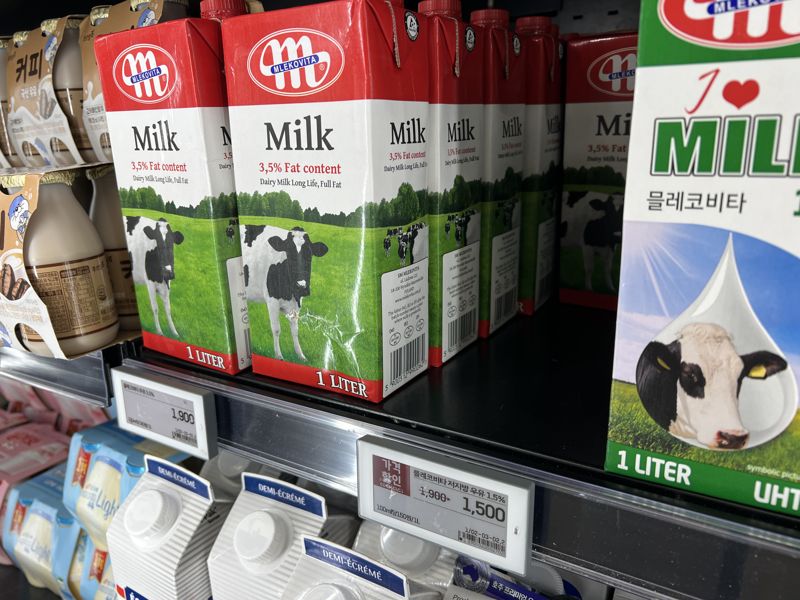
As a result, the price of imported sterilized milk, currently around 1,500–2,000 won per liter, is expected to fall by roughly 40–50 won. As of February 2 at the Lotte Mart Zettaplex Seoul Station Branch, a 1-liter carton of Polish sterilized milk, Mlekovita 1.5% milk, was selling for 1,500 won. By comparison, a 1-liter carton of domestic fresh milk, Seoul Milk Na 100%, was priced at 2,970 won, and a two-pack of 900-milliliter Namyang Delicious Milk GT Lactose-Free was 4,980 won. Overall, domestic products are priced significantly higher than imported sterilized milk.
Sterilized milk, which is heated at a high temperature of 130–150 degrees Celsius, has long been less favored by Korean consumers than fresh milk treated with standard pasteurization. The high-heat process can break down proteins, creating a cooked flavor and a somewhat bland taste. In addition, because Koreans mainly drink milk rather than use it for cooking, fresh milk with its characteristic refreshing taste has traditionally been the preferred option.
However, while the price of domestic milk continues to climb under the raw milk price linkage system, the price of imported sterilized milk has fallen to roughly half that of domestic milk thanks to repeated tariff cuts. In response, self-employed operators such as cafés and bakeries are increasingly switching to cheaper imported sterilized milk for beverages and desserts to protect their profit margins.
Domestic dairy sector faces a double squeeze
Imported sterilized milk is also gaining popularity among ordinary consumers. At Lotte Mart, sales of imported sterilized milk in January rose 8% from a year earlier. Industry officials note that overseas manufacturers have significantly improved the cooked flavor once seen as a drawback of sterilized milk by tightening quality control and shifting from confined housing to pasture-based farming. On top of that, the rise in single-person households is driving stronger preference for sterilized milk, which can be stored for long periods.
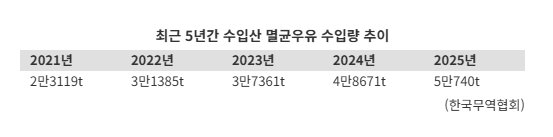
The domestic dairy and milk industries are taking a direct hit from the onslaught of imported sterilized milk. Import volumes of sterilized milk climbed from 23,119 tons in 2021 to 31,385 tons in 2022, 37,361 tons in 2023, 48,671 tons in 2024, and 50,740 tons last year, showing rapid annual growth. Meanwhile, deliveries of domestic milk for school meals and other uses have been steadily shrinking, partly due to the impact of low birth rates. Data from the Ministry of Agriculture, Food and Rural Affairs (MAFRA) and the Korea Dairy Committee show that per capita consumption of plain white milk peaked at 26.6 kilograms in 2021, then fell to 25.3 kilograms in 2024, continuing a downward trend.
A representative of the dairy industry said, "It is true that the 15-year phase-out of tariffs has given the industry ample time to prepare," but added, "Because we cannot compete on price, we are responding by emphasizing freshness and premium quality that imported products cannot offer."
[email protected] Park Kyung-ho Reporter