KT: "Prioritizing reliability over speed... building an unbreakable 6G network" [Mobile World Congress 2026 (MWC 2026)]
- Input
- 2026-03-03 08:00:00
- Updated
- 2026-03-03 08:00:00
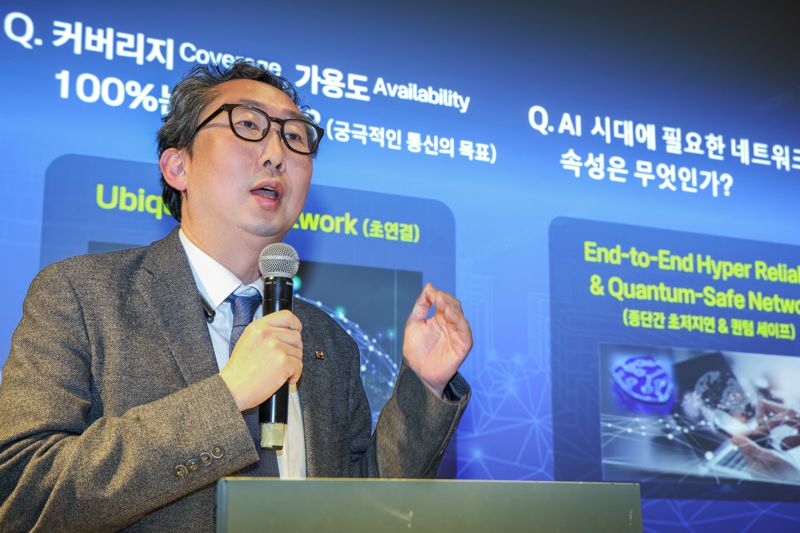
■ Building three-dimensional coverage across land, sea, and airAt the press briefing in Barcelona, Spain, on the 2nd (local time), Jongsik Lee, Head of Network Research Institute and executive vice president at KT, said, "When we talk about 6G, we usually refer to reliability metrics such as latency between the device and the base station, but from the customer’s perspective, latency all the way to the data center is more important." He added, "KT’s 6G will focus on delivering tangible changes for customers." Lee predicted that in the AI-based 6G era, the ability to realize truly "real-time" services will become a core competitive edge for telecom operators.
KT highlighted six key technologies for 6G: ultra-connectivity, ultra-low latency, Quantum-safe cryptography, AI-native architecture, autonomous networks, and semantic-based transmission.
KT plans to strengthen ultra-connectivity by building three-dimensional coverage that spans land, sea, and air. The goal is not only to improve perceived quality in urban and indoor environments, but also to ensure uninterrupted connectivity during disasters and emergencies. "Telecommunications can be directly tied to matters of life and death," Lee explained, adding, "The key question is whether we can provide communication services at decisive moments such as disasters and large-scale incidents."
KT is also working to establish a reliability-centered 6G network foundation. This will be based on an integrated architecture that combines non-terrestrial network (NTN) and terrestrial mobile networks, as well as Super Cell technology that can rapidly deploy temporary networks and provide communication services in disaster scenarios. With the spread of new mobility modes such as aircraft, ships, and Urban Air Mobility (UAM), KT believes that three-dimensional coverage will be an essential requirement in the 6G era.
KT intends to design an ultra-low-latency architecture that extends beyond devices and radio access networks to the backbone connecting to AI data centers. By combining Network Slicing, which guarantees service-specific quality across both wired and wireless segments, with a photonic network, the company has proposed an "end-to-end ultra-low-latency infrastructure" that minimizes delay from the device all the way to the data center.
■Strengthening 6G security with quantum-safe cryptographyKT plans to apply its in-house Quantum-safe cryptography technologies to 6G networks to prepare for a future in which the quantum computer becomes commercialized. To this end, it will embed security across the entire network by deploying next-generation security technologies such as Quantum Key Distribution (QKD), AI-based intrusion detection, and Homomorphic Encryption. "Only telecom operators that can withstand the era of quantum computer commercialization will survive," Lee said.
KT aims to secure flexibility in infrastructure investment by adopting an architecture that integrates telecommunications and AI workload. In parallel with improving network quality, it will build infrastructure that delivers AI services closer to end users.
The way networks are operated will fundamentally shift toward autonomous networks. KT plans to automate the entire lifecycle of network design, deployment, and control by combining a network foundation model (NFM) built on a network-specialized Large Language Model (LLM) with Digital Twin technology and AI agents. This marks a transition from human-centered, manual operations to AI-operator-centered autonomous networks.
KT has proposed semantic-based transmission as a new communication paradigm for the 6G era. Instead of sending entire data sets, the network will selectively transmit only the key information needed for a given purpose. This approach is expected to create an optimized communication environment for low-latency, high-efficiency services such as Artificial Intelligence of Things (AIoT), autonomous driving, and remote robot control.
KT expects that its experience in building and operating standalone 5G architectures, including 5G SA, will serve as a key technical asset in designing and commercializing 6G architectures.
Lee said, "During 5G, we raced at full speed to deliver trial services in Pyeongchang County and achieve the world’s first commercialization. For 6G, however, we will focus on innovations in customer experience that users can truly feel, as well as on transforming our cost structure and creating new market opportunities so that we can sustain growth as a telecom operator."
[email protected] Reporter Jang Min-kwon Reporter