Oil Prices Surge on Threat to Strait of Hormuz... Domestic Impact Expected After Mid-Month [Middle East Under Fire]
- Input
- 2026-03-02 18:28:43
- Updated
- 2026-03-02 18:28:43
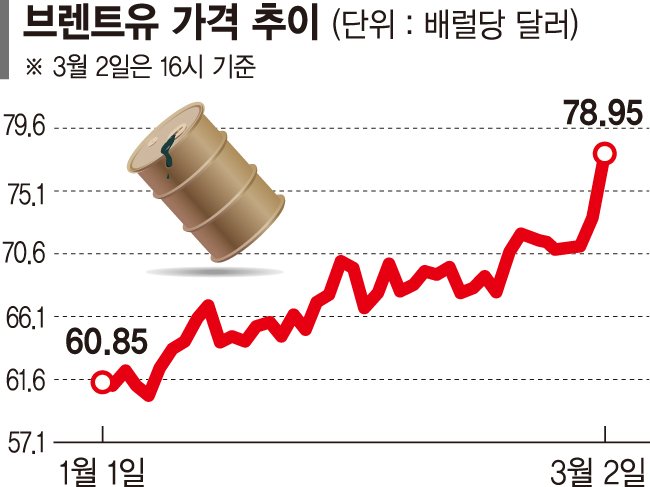
According to industry sources on the 2nd, West Texas Intermediate crude oil (WTI) and Brent crude oil were trading at $71.3 and $77.7 per barrel, respectively, as of 1 a.m. that day, both up more than 6% from Friday’s closing prices. Brent crude briefly surged to as high as $82 per barrel during intraday trading.
The key factor driving market anxiety is the Strait of Hormuz. Tensions escalated after the Islamic Revolutionary Guard Corps of Iran (IRGC) declared it would blockade this chokepoint, through which about 20% of the world’s seaborne crude oil passes. Concerns deepened further after reports that four civilian vessels near the strait were attacked, causing casualties. The Strait of Hormuz is a critical energy corridor that accounts for roughly 30% of global seaborne oil shipments, and a full blockade has never actually been enforced before. The Organization of the Petroleum Exporting Countries (OPEC) and major oil-producing nations have announced they will resume additional production increases that were halted earlier this year, but many in the market believe this volume is far from sufficient to offset the heightened geopolitical risks.
South Korea’s energy import structure is another source of vulnerability. According to the Korea International Trade Association (KITA), South Korea imports 70.7% of its crude oil and 20.4% of its liquefied natural gas (LNG) from the Middle East. The country is not currently importing Iranian crude directly, but if major buyers of Iranian oil such as China and India rush to secure alternative supplies, competition for imports could intensify and put additional upward pressure on global oil prices.
Tomoyuki Akuta, a senior researcher at Mitsubishi UFJ Research and Consulting, noted, "When the United States attacked Iran in June last year, oil prices rose by more than $10 per barrel." He added, "Given the gravity of the current situation, involving the death of the supreme leader, prices could climb by more than $20 this time."
A blockade of the Strait of Hormuz would inevitably disrupt energy supplies. If tankers are forced to use alternative routes, shipping costs could rise by as much as 50% to 80% compared with current levels, and factoring in overland transport and customs procedures, delivery times could be extended by about three to five days. In past crises in this region, war-risk insurance premiums have been surcharged by up to sevenfold. With U.S. President Donald Trump suggesting that military operations could continue for up to four weeks, the possibility of a prolonged standoff cannot be ruled out.
The sharp rise in international oil prices is expected to feed through to domestic fuel prices with a time lag.
An industry official said, "Because there is usually a lag of about two weeks before changes are reflected, domestic fuel prices could jump significantly after the middle of this month."
[email protected] Reporter