Japanese experts warn crude oil could rise to $120, putting up to 3% downside pressure on GDP
- Input
- 2026-03-02 13:12:20
- Updated
- 2026-03-02 13:12:20
Financial News, Tokyo — Reporter Seo Hye-jin — If the Strait of Hormuz is closed following airstrikes on the Islamic Republic of Iran by the United States of America (US) and Israel, crude oil prices could climb as high as $120 per barrel, and in the worst case Japan’s Gross Domestic Product (GDP) could face downside pressure of around 3%.
According to Japan Broadcasting Corporation (NHK) on the 2nd, Yuki Tsugano, a researcher at the Japan Center for Economic Research (JCER), said in an interview that if the Strait of Hormuz is blocked, the price of West Texas Intermediate crude oil (WTI) could jump by about $50 and surge to around $120 per barrel.
As of 6:49 p.m. on the 1st (local time) at the New York Mercantile Exchange (NYMEX), WTI futures were trading at $72.35 per barrel, up 7.95% from the previous session. Brent crude oil, the international benchmark, was at $79.01 per barrel, an increase of 8.43%.
Tsugano noted, "Japan relies heavily on the Middle East for crude oil imports, so the economic impact would be significant," projecting that in a worst-case scenario where fossil fuel imports from the Middle East are completely halted, Japan’s GDP could come under downside pressure of about 3%.
He explained, "Because Japan has strategic petroleum reserves, an immediate shortage can be avoided, but if crude oil imports are cut off, refining activities to produce gasoline and diesel could be suspended. The impact would then spread across fuel-consuming industries such as transportation and services, ultimately leading to a decline in GDP."
Tomoyuki Akuta, a senior researcher at Mitsubishi UFJ Research and Consulting, also warned, "Since there is a certain level of petroleum reserves, the impact can be contained in the short term, but if the closure of the strait continues for a long period, prices of petroleum products such as gasoline, diesel, and kerosene will rise, and this will spill over into electricity and gas bills as well."
He added, "Furthermore, higher costs in agriculture and fisheries could push up fresh food prices, and if energy supplies are disrupted, companies’ production and logistics activities will also be affected, which could become a critical problem."
On the crude oil price outlook, he recalled, "When the United States attacked the Islamic Republic of Iran in June last year, crude prices rose by more than $10 per barrel," and predicted, "Given the gravity of the current situation, involving the death of the supreme leader, prices could rise by more than $20 this time."
If crude prices rise by $10 per barrel, Japan’s crude oil import bill increases by about 1.3 trillion yen. Akuta said, "Such a shock could neutralize the impact of high-inflation countermeasures by the Sanae Takaichi cabinet, and it could also push up global prices by several basis points (1 bp = 0.01 percentage point), causing negative effects associated with higher inflation."
Tetsu Yoshida, a commodities analyst at the Rakuten Securities Economic Research Institute, likewise cautioned, "If inflation accelerates noticeably, it could affect the price measures and the direction of monetary policy currently under discussion," adding, "There will likely be negative repercussions for Asian economies as well, as they import large volumes of Middle Eastern crude."
Meanwhile, ship traffic through the Strait of Hormuz has reportedly plunged since the US and Israel carried out airstrikes on the Islamic Republic of Iran.
The New York Times (NYT), citing Dimitris Ampatzidis, a senior risk and compliance analyst at Kpler, the parent company of vessel-tracking firm MarineTraffic, reported that as of the night of the 28th of last month (local time), the number of ships passing through the Strait of Hormuz had fallen by about 70% compared with normal levels. That is less than one-third of the usual traffic.
Tasnim News Agency, which is linked to the Islamic Revolutionary Guard Corps (IRGC), reported around 2 a.m. on the 1st that "with vessel traffic halted, the Strait of Hormuz has effectively been closed."
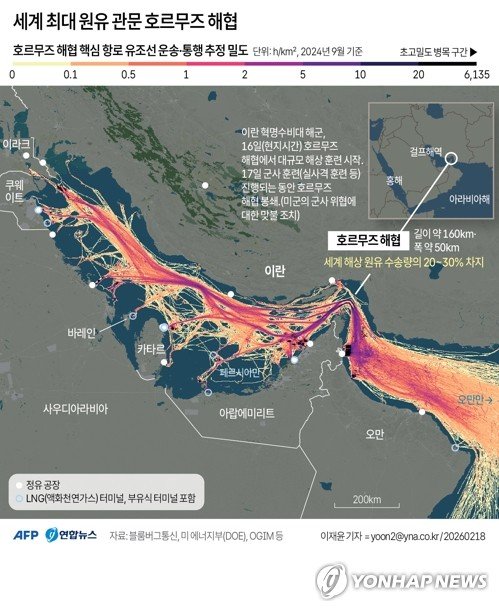
The Strait of Hormuz is a strategic chokepoint that lies between the Islamic Republic of Iran to the north and Oman to the south, connecting the Persian Gulf and the Gulf of Oman.
Because 20–30% of the world’s seaborne crude oil shipments pass through this strait, a prolonged decline in traffic is expected to trigger unavoidable ripple effects across international crude prices, LNG prices, and overall maritime freight rates.
[email protected] Seo Hye-jin Reporter