Ruling party pushes hard on U.S. investment bill...warns of a “major decision” if opposition keeps resisting
- Input
- 2026-03-02 15:37:53
- Updated
- 2026-03-02 15:37:53
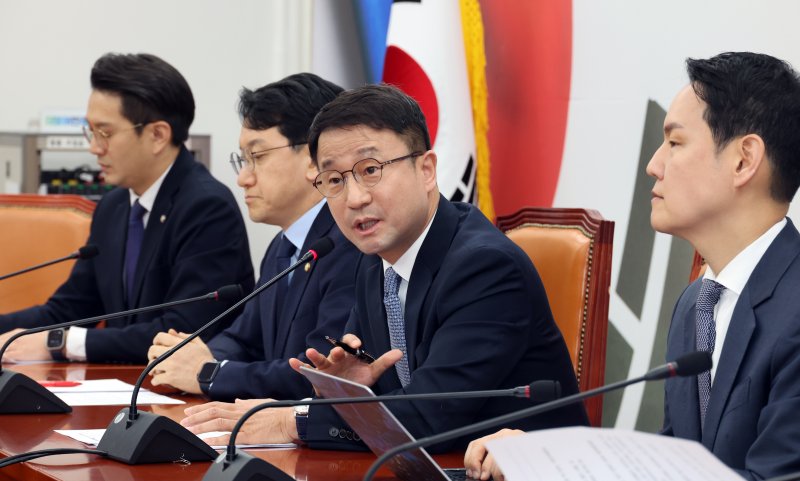
The Financial News reports that the Democratic Party of Korea (DPK) is moving into high gear to push through the Special Act on the Management of Strategic Investments between the Republic of Korea and the United States of America, also known as the U.S.–Korea Strategic Investment Special Act, which has stalled amid judicial reform battles. Party floor leaders have indicated they will not rule out a "major decision" if the People Power Party continues to refuse to cooperate. All options permitted under the National Assembly Act, including having the Speaker of the National Assembly bring the bill to a vote by exercising his authority, are expected to be on the table.
At a press conference at the National Assembly on the 2nd, DPK floor leader Han Byung-do said, "The U.S.–Korea Strategic Investment Special Act, on which the lifeline of Korea’s key industries depends, has been brought to a halt by the People Power Party’s irresponsible refusal to proceed with deliberations." He continued, "If the People Power Party does not cooperate, the DPK will take measures to restore normal parliamentary operations. We may move toward a major decision."
Han did not spell out what this "major decision" would entail. However, he stated, "If the bill is not passed by agreement by the 9th, we will then review what options are available under the National Assembly Act," adding, "Whether it is the Speaker of the National Assembly putting the bill to a vote by his authority or any other procedure under the Act, we will assess the situation and make our decision." This is the first time that the option of the Speaker’s unilateral referral has been raised in an official setting, after having been floated in some quarters.
If the Speaker of the National Assembly moves to place the U.S.–Korea Strategic Investment Special Act on the agenda by his own authority, it could break the current deadlock, in which the People Power Party holds both the chair of the Special Committee on the U.S.–Korea Strategic Investment Management Act and the chair of the Strategy and Finance Committee of the National Assembly of the Republic of Korea. Such a move would in effect bypass the standing committee’s bill review process.
Under Article 85 of the National Assembly Act, the Speaker’s authority to place a bill on the agenda allows the Speaker to set a review period and refer the bill to the relevant committee. If the committee fails, without just cause, to complete its review within that period, the Speaker may hear an interim report and then immediately submit the bill to a plenary session.
The circumstances under which the Speaker may exercise this authority are strictly limited to three cases: natural disasters; wartime, armed conflict, or a comparable national emergency; and situations where the Speaker reaches an agreement with the floor leaders of the negotiating blocs. After 99 bills were railroaded through by the Speaker’s unilateral referral during the 18th National Assembly, the requirements for such action were significantly tightened in 2012 through the National Assembly Advancement Act.
In this context, on the 26th of last month, DPK lawmaker Kim Won-i, speaking in a personal capacity, remarked, "Isn’t the People Power Party effectively thinking of never bringing the bill up at all?" He added, "Is this not an economic war, or an economic wartime situation? I am beginning to think that the Speaker should exercise his authority to place the bill on the agenda."
Although there is no formal state of war or declared national emergency, proponents argue that growing external economic uncertainty—exemplified by U.S. President Donald John Trump’s tariff measures—could be framed as an "economic wartime situation," providing grounds to push for the Speaker’s unilateral referral.
However, the DPK maintains that, consistent with its own description of such a move as a "major decision," resorting to an extreme measure like the Speaker’s unilateral referral should be considered only if the People Power Party’s opposition continues past the originally agreed deadline of the 9th.
In addition, a key official of the Special Committee on the U.S.–Korea Strategic Investment Management Act said that, during the recent filibuster—an unlimited debate allowed under the National Assembly Act to lawfully delay proceedings—the ruling and opposition parties began working to narrow their differences on the bill. With most contentious points already coordinated, the official expressed confidence that upcoming committee meetings can proceed efficiently and that the roughly six days remaining before the agreement deadline will be sufficient.
[email protected] Reporter Kim Hyeong-gu Reporter