LG to Unveil ‘Exaone 4.5’ in First Half of Year, to Power Humanoid Brains
- Input
- 2026-03-02 08:00:00
- Updated
- 2026-03-02 08:00:00
LG Corporation will unveil the next version of its in-house AI model, Exaone 4.5, in the first half of this year. The company plans to fully embed its more advanced EXAONE Vision-Language Model (VLM) technology into humanoid robots, aiming to secure leadership in physical AI.
‘Exaone 4.5’ to Lay the Groundwork for the Brain of a Korean-Style Humanoid
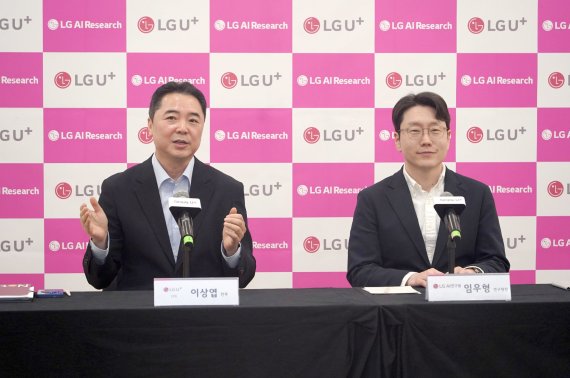
On the 1st (local time), Lim Woo-hyung, co-head of LG AI Research, said at a briefing for Korean media held a day before the opening of the world’s largest telecom exhibition, Mobile World Congress 2026 (MWC 2026), "Exaone 4.5 will expand its modalities to increase the model’s versatility, and among open-weight models of a similar size, it will deliver the best performance globally." He added, "It will be another opportunity to reaffirm LG’s technological capabilities, as the company that developed Korea’s first multimodal AI model."Exaone 4.5 is now in the final stages of development and is scheduled to be released in the first half of the year as an open-weight model. Starting with Exaone 4.5, LG expects that its increasingly sophisticated EXAONE VLM technology will serve as the brain of KAPEX, a Korean-style humanoid, and become a core technology that opens the era of physical AI.
LG has set a goal of elevating EXAONE, developed by LG AI Research as part of its Independent AI Foundation Model Project (K-LLM), to a world-class level. The company plans to develop EXAONE around four key strategies: securing leadership in foundation model development, pursuing expert-level AI, expanding practical deployment in industrial settings, and ensuring trust and safety for sustainable AI. During the second phase of its independent AI foundation model project in the first half of this year, LG aims to develop the highest-performing language model among existing global open-weight models.
Lim said, "The AI that LG pursues is not about competing over who has the highest intelligence, but about creating a partner that helps people in the real world and solves their problems." He continued, "Building good AI is important, but what we choose to build is ultimately the core. We will focus on creating AI that generates real value in the physical world beyond AX, in the real, physical spaces where people live."
Making ‘EXAONE’ a Global Leader
Timed with EXAONE entering its completion phase next year, LG Uplus will begin operating the largest AI data center in Korea.The Paju AI Data Center is being built with a capacity of 200 megawatts (MW), the largest in the Seoul metropolitan area. It will be able to accommodate up to 120,000 graphics processing units (GPUs). LG plans to showcase infrastructure that demonstrates the synergy between Korean-style AI (K-AI) and K-Semiconductor by combining LG AI Research’s EXAONE, LG Uplus’s enterprise AI platform, and FuriosaAI’s neural processing unit (NPU).
Lee Sang-yeop, CTO of LG Uplus, stated, "To realize AI that can truly help people in the real world, powerful infrastructure and connectivity technologies are essential." He added, "We are thoroughly preparing so that we can deliver the best possible experiences with AI that offers world-class performance."
LG Uplus also unveiled its next-generation agentic AI strategy, which it will pursue in collaboration with LG AI Research.
Lee said, "Along with improving the performance of our foundation models, it is crucial to build an evolutionary system architecture that can actually solve customers’ problems," emphasizing, "Securing an agentic architecture for this purpose is at the heart of LG Uplus’s agentic AI strategy."
By implementing a multi-stage agentic AI structure that continuously learns and evolves through repeated cycles of planning, execution, evaluation, and revision, the company aims to go beyond the traditional approach of simply responding to user queries.
To realize next-generation agentic AI, LG Uplus introduced four core technologies it has developed: self-improving capability, model and data foundry, Trusted Orchestration, and hybrid AI infrastructure.
LG Uplus plans to build a hybrid AI infrastructure architecture optimized for running agentic AI in real time and, through close technical collaboration with LG AI Research, accelerate the deployment of foundation models in real-world environments.
This architecture is expected to become a key technology that enables large language models such as EXAONE to be operated stably and cost-effectively within enterprise environments, with minimal latency.
Lee concluded, "In the AI era, true competitiveness does not lie merely in building bigger models or amassing more compute resources." He added, "The real battleground will be how precisely we can design an agentic architecture that evolves on its own through a recurring loop of planning, execution, evaluation, and revision, going beyond single-shot inference."
[email protected] Jang Min-kwon Reporter