172 trillion won in "dementia money" hits the middle class... My father has 200 million won in his bank account, but I'm responsible for nursing care costs [Retiree X's Plan]
- Input
- 2026-03-07 08:30:00
- Updated
- 2026-03-07 08:30:00

While it's difficult to prevent or cure, its progression can be slowed. Experts recommend seeking medical attention if symptoms such as repetitive memory loss, increased calculation errors, or personality changes persist for more than six months.

/Getty Images Bank [Financial News] "I have 200 million won in my father's bank account. But I can't use it." Hyeon Jeong-su (55, pseudonym), who lives in Gwangjin-gu, Seoul, was turned away from the bank a few months ago. He urgently needed about 10 million won to cover nursing home admission and hospital bills, but his father, diagnosed with dementia, didn't understand the process of consenting to a bank transfer.Financial institutions, fearing disputes, restricted transactions. Ultimately, the family filed for adult guardianship, and it took several months for the court to issue a decision.
In the meantime, the hospital bills were borne by his children. Mr.
While it's difficult to prevent or cure, its progression can be slowed. Experts recommend seeking medical attention if symptoms such as repetitive memory loss, increased calculation errors, or personality changes persist for more than six months.
Hyun said, “In the end, I had no choice but to spend the money I had first. It’s unfair to say it, but it was absurd that I had money but couldn’t spend it.
While it's difficult to prevent or cure, its progression can be slowed. Experts recommend seeking medical attention if symptoms such as repetitive memory loss, increased calculation errors, or personality changes persist for more than six months.” Money doesn’t disappear due to dementia. However, it is serious in that you stop ‘using’ money.
The average dementia patient with assets is 200 million won ‘Dementia money. ’ This is a word that has been appearing frequently in the media and the financial sector recently.The expression ‘dementia money (認知症マネー·dementia money)’, which was first used in Japan, was introduced to Korea. In the mid-2010s, as Japan entered a super-aging society, the term was created to refer to the phenomenon of the elderly’s assets being effectively frozen due to dementia.While it's difficult to prevent or cure, its progression can be slowed. Experts recommend seeking medical attention if symptoms such as repetitive memory loss, increased calculation errors, or personality changes persist for more than six months.
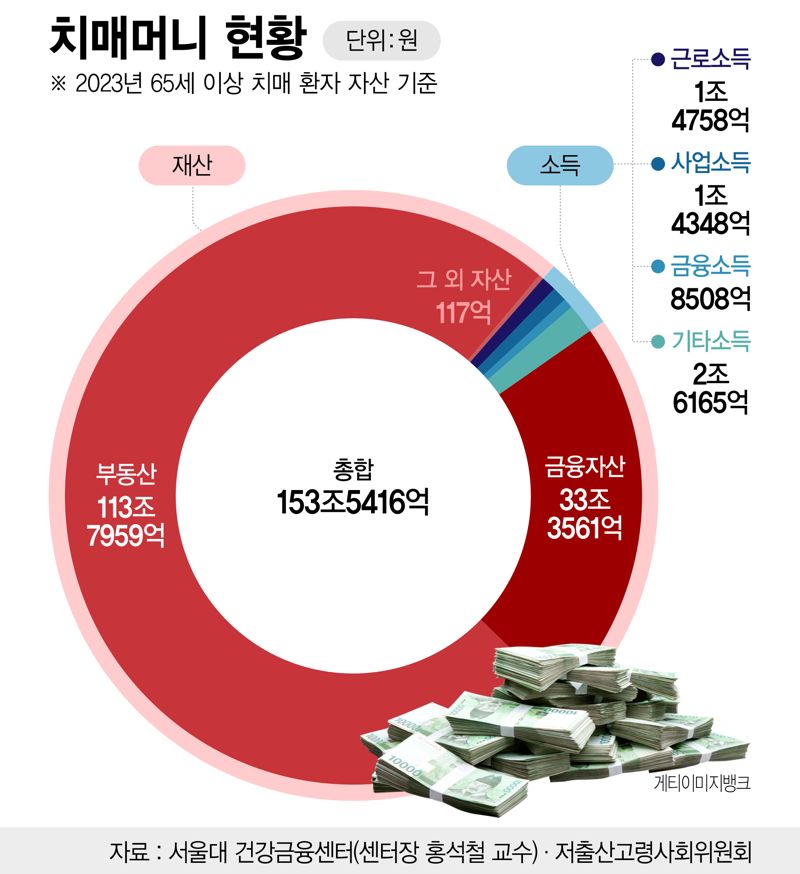
24 million dementia patients aged 65 or older as of 2023. Among them, 760,000 people own assets, meaning that more than 6 out of 10 people have assets.
The average dementia patient with assets is 200 million won ‘Dementia money. ’ This is a word that has been appearing frequently in the media and the financial sector recently.The total income and assets they own is approximately 154 trillion won. Based on 760,000 people with assets, the average is about 200 million won per person.7%). 61 million won.
Considering this, dementia is no longer a ‘problem for the poor. ’ It is also a problem for the middle class and the wealthy.
While it's difficult to prevent or cure, its progression can be slowed. Experts recommend seeking medical attention if symptoms such as repetitive memory loss, increased calculation errors, or personality changes persist for more than six months.
488 trillion won in 2050. Stagnant money increases According to estimates from the Ministry of Health and Welfare, assets held by dementia patients are expected to increase to 172 trillion won in 2025, 220 trillion won in 2030, 351 trillion won in 2040, and 488 trillion won in 2050.
While it's difficult to prevent or cure, its progression can be slowed. Experts recommend seeking medical attention if symptoms such as repetitive memory loss, increased calculation errors, or personality changes persist for more than six months.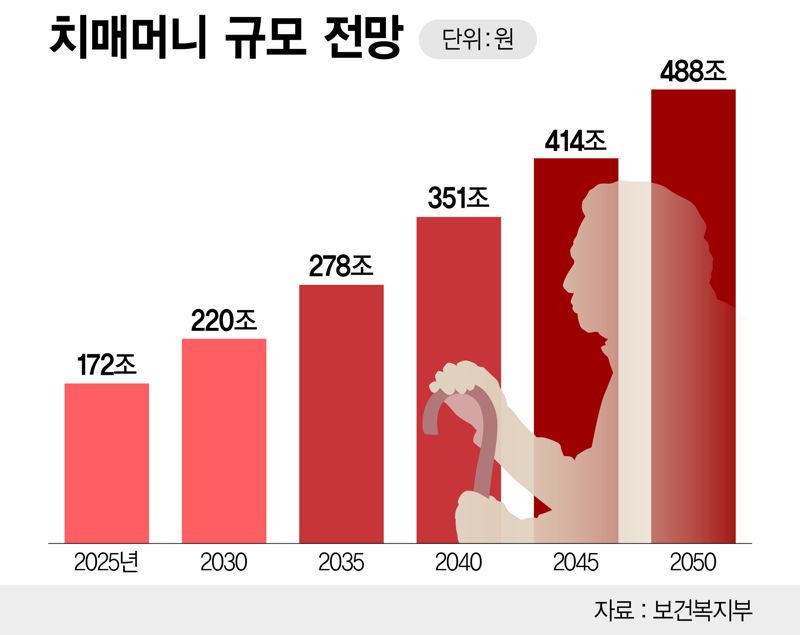
The Ministry of Health and Welfare made this forecast assuming the size of assets that could be effectively frozen if decision-making becomes difficult due to dementia. As the aging rate accelerates, dementia money increases exponentially.
If these assets do not circulate smoothly, it becomes a burden not only on individual households but also on the real economy. The essence is ‘separation of possession and control’ The essence of dementia money is ‘separation of possession and control’. This refers to a situation where even if you have assets, you cannot actually use them if you lose the ability to make decisions. After a dementia diagnosis, financial institutions restrict transactions if they cannot confirm the individual's clear intentions.Even family members face difficulties withdrawing funds from accounts or disposing of assets without legal authority. In practice, the question, "Why can't I spend the money when the owner is clear?" is a common one.
While it's difficult to prevent or cure, its progression can be slowed. Experts recommend seeking medical attention if symptoms such as repetitive memory loss, increased calculation errors, or personality changes persist for more than six months.
However, financial institutions often avoid allowing proxy withdrawals or account transactions due to the potential for conflict between family members. Even small transfers, let alone large transactions, are often restricted.
While it's difficult to prevent or cure, its progression can be slowed. Experts recommend seeking medical attention if symptoms such as repetitive memory loss, increased calculation errors, or personality changes persist for more than six months.The average dementia patient with assets is 200 million won ‘Dementia money. ’ This is a word that has been appearing frequently in the media and the financial sector recently.The problem is that costs continue to accrue during this time. Dementia increases medical and care costs while making it difficult to access assets.Ultimately, this can disrupt sustainable cash flow, a crucial element of retirement planning. While mechanisms like adult guardianship exist, the process from application to court decision takes time.
Meanwhile, hospital and care costs continue to pile up. Ultimately, the key to the dementia money problem lies not in post-mortem response, but in advance preparation.
There are two ways to prevent dementia money. The core of dementia money is not the disease, but the structure.
The problem is not that the money disappears, but the moment it becomes unusable. There are two main axes to reducing dementia money.
While it's difficult to prevent or cure, its progression can be slowed. Experts recommend seeking medical attention if symptoms such as repetitive memory loss, increased calculation errors, or personality changes persist for more than six months.
1 Planning the asset structure in advance △Using the voluntary guardianship system Many families apply for adult guardianship after a dementia diagnosis. However, it takes several months for the court to make a decision.
While it's difficult to prevent or cure, its progression can be slowed. Experts recommend seeking medical attention if symptoms such as repetitive memory loss, increased calculation errors, or personality changes persist for more than six months.In the meantime, hospital and nursing expenses continue to incur. It's like taking out insurance after an accident.
The average dementia patient with assets is 200 million won ‘Dementia money. ’ This is a word that has been appearing frequently in the media and the financial sector recently. On the other hand, the voluntary guardianship system is different. It appoints a guardian in advance when the person has cognitive ability.The average dementia patient with assets is 200 million won ‘Dementia money. ’ This is a word that has been appearing frequently in the media and the financial sector recently.If the person's judgment declines, the contract takes effect. It's pre-planning.△Dementia relief trust. ‘Automatic route’ of money Dementia relief trusts are spreading in the financial sector.
The average dementia patient with assets is 200 million won ‘Dementia money. ’ This is a word that has been appearing frequently in the media and the financial sector recently.This is a method of signing a contract with a bank while healthy and setting in advance so that funds are used only for specific purposes such as nursing and living expenses when diagnosed with dementia. The advantages are clear.It reduces disputes between children, prevents misunderstandings by children in care, and blocks the risk of voice phishing. It determines the flow of money in advance.△Establish minimum safety measures If the design is burdensome, minimum safety measures are necessary.These include setting up notifications for large transfers, clarifying insurance beneficiaries, documenting a list of assets, and agreeing on the roles of siblings.
After a dementia diagnosis, options are limited and procedures become complicated.
The average dementia patient with assets is 200 million won ‘Dementia money. ’ This is a word that has been appearing frequently in the media and the financial sector recently.That's why advance planning is emphasized. However, even if you have a perfect financial safety net, the most certain asset protection is ultimately delaying the onset of dementia itself.
The average dementia patient with assets is 200 million won ‘Dementia money. ’ This is a word that has been appearing frequently in the media and the financial sector recently.This is why the golden time of 'mild cognitive impairment', which the medical community emphasizes, is also the financial golden time.2 Delaying the onset Dementia is not a disease that can be completely prevented.
However, the medical community explains that it is possible to slow its progression.Experts recommend professional treatment if repetitive memory decline, increased calculation errors, and personality changes persist for more than six months.The Ministry of Health and Welfare and the Dementia Care Center provide cognitive screening tests (such as CIST) free of charge.
The average dementia patient with assets is 200 million won ‘Dementia money. ’ This is a word that has been appearing frequently in the media and the financial sector recently. Professor Choi Ho-jin of the Department of Neurology at Hanyang University Guri Hospital emphasized, "Unfortunately, there is currently no medication that can improve or cure dementia, so it is important to receive treatment at the mild cognitive impairment stage, which is the golden time for dementia." He continued, "While 1-2% of normal people develop dementia every year, 10-15% of patients with mild cognitive impairment over the age of 65 develop dementia.
While it's difficult to prevent or cure, its progression can be slowed. Experts recommend seeking medical attention if symptoms such as repetitive memory loss, increased calculation errors, or personality changes persist for more than six months.
" He advised, "Since they can be considered a high-risk group for dementia, active testing and treatment are necessary if mild cognitive impairment is suspected.
" Prevention strategies include: △Management of vascular diseases such as hypertension and diabetes; △Aerobic exercise 3-5 times a week; △Brain stimulation such as learning a foreign language or playing an instrument; △Maintaining a social network; △Getting enough sleep.These activities cost almost nothing.
The average dementia patient with assets is 200 million won ‘Dementia money. ’ This is a word that has been appearing frequently in the media and the financial sector recently.This is why it is said to be the most profitable investment.Overseas, defense through institutionalization of ‘pre-planning’ Countries that entered super-aged societies first chose ‘pre-planning’ rather than ‘reactive’.
The average dementia patient with assets is 200 million won ‘Dementia money. ’ This is a word that has been appearing frequently in the media and the financial sector recently.△Japan The ‘family trust’ system has spread in Japan.When the ability to make decisions is present, the asset management method is contracted in advance.
The average dementia patient with assets is 200 million won ‘Dementia money. ’ This is a word that has been appearing frequently in the media and the financial sector recently.Even after dementia, the designated trustee can manage the assets.△United States The United States has introduced the ‘Trusted Contact’ system.
When an unusual transaction occurs in a senior’s account, the financial institution notifies the designated contact.
The Senior Safe Act also established a legal basis to temporarily suspend suspicious transactions.
While it's difficult to prevent or cure, its progression can be slowed. Experts recommend seeking medical attention if symptoms such as repetitive memory loss, increased calculation errors, or personality changes persist for more than six months.
△United Kingdom The United Kingdom designates a representative in advance through the LPA (Lasting Power of Attorney) system.
While it's difficult to prevent or cure, its progression can be slowed. Experts recommend seeking medical attention if symptoms such as repetitive memory loss, increased calculation errors, or personality changes persist for more than six months.The average dementia patient with assets is 200 million won ‘Dementia money. ’ This is a word that has been appearing frequently in the media and the financial sector recently.When the ability to make decisions is lost, immediate asset management is possible. The commonality is clear: the structure is created before, not after, dementia. South Korea also included expansion of public guardianship, pilot projects for asset management support, and strengthening of the financial fraud prevention system in its recently released ‘5th Comprehensive Dementia Management Plan (2026-2030)’.It is progress that dementia policy has expanded from medical and care to financial and legal areas.Checks that retiree X should do now □ Do you know the location and structure of your parents' assets? □ Is the designation of insurance beneficiaries clear? □ Have you calculated the expected amount of medical and nursing expenses? □ Are the roles between siblings agreed upon? □ Have you set up a financial safety net, such as notifications for large transfers? □ Above all, have you started a conversation about 'let's decide when you have the ability to make decisions'? Although dementia is a disease of old age, preparations must be made in advance.If you don't plan, the money you have may not be 'your money.' The old formula of 'retirement = exit' is collapsing.
While it's difficult to prevent or cure, its progression can be slowed. Experts recommend seeking medical attention if symptoms such as repetitive memory loss, increased calculation errors, or personality changes persist for more than six months.
In an era where the average life expectancy is 83 years, the existing concept of retirement itself is being redefined as Generation X enters full-fledged retirement.[Retiree X's Design] , which contains the stories of their "second act of life," visits readers every Saturday morning.You can conveniently receive it by subscribing to the reporter's page.
While it's difficult to prevent or cure, its progression can be slowed. Experts recommend seeking medical attention if symptoms such as repetitive memory loss, increased calculation errors, or personality changes persist for more than six months.[email protected] Kim Ki-seok Reporter