Will Middle East Logistics Grind to a Halt? Shipping, Refining, and Airline Industries on High Alert
- Input
- 2026-03-01 14:48:44
- Updated
- 2026-03-01 14:48:44
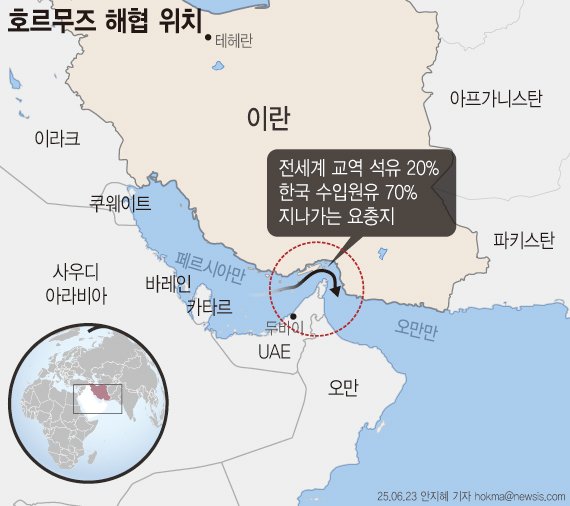
The Financial News reported that Iran, after coming under airstrikes from the United States and Israel, has declared a blockade of the Strait of Hormuz, known as a "global energy artery." This has raised serious concerns across South Korea’s logistics sector. Shipping and airline companies are expected to face higher costs due to transport disruptions and a sharp rise in crude oil prices. The domestic shipping and airline industries are closely monitoring the situation and working on response measures.
According to industry sources on the 1st, the Ministry of Oceans and Fisheries (MOF) held a meeting with shipping companies such as SK Shipping and Pan Ocean, whose fleets are heavily weighted toward bulk carriers, to discuss countermeasures to the Strait of Hormuz blockade. SK Shipping and Pan Ocean mainly operate tankers and bulk carriers, which must pass through the Strait of Hormuz. HMM Company Limited (HMM), the country’s largest shipping line, is also reported to have about 20 vessels, including one container ship, out of a fleet of roughly 150 that transit the strait.
Some foreign shipping lines have already begun turning back or rerouting their vessels. During past Middle East crises, ships sailed under the protection of Anglo-American allied forces, but such support is now unlikely because the United States is directly involved as a party to the conflict. South Korean shipping companies are also said to be reviewing route changes and emergency operating plans.
The airline industry is also experiencing flight suspensions. On February 28, Korean Air announced, "Due to airspace restrictions related to the war between the United States and Israel on one side and Iran on the other in the Middle East, disruptions are expected on flights to and from Dubai," adding, "We ask customers to check flight information in advance."
The measures apply from February 28 until midnight on March 7, and cover Dubai in the United Arab Emirates (UAE). Korean Air had scheduled a total of 12 flights on the route during this period. The first flight on February 28 returned to its origin, and the remaining flights were canceled. Korean Air has been the only Korean carrier operating the Incheon–Dubai route, offering round-trip service seven times a week.
A Korean Air official stated, "We will closely monitor how the situation develops and adjust subsequent schedules accordingly." The airline plans to provide updates on flight operations based on local conditions through its website and other channels.
With about 30% of global seaborne crude oil shipments passing through the Strait of Hormuz, the blockade is expected to drive oil prices sharply higher. If international oil prices surge on top of already strong exchange rates, shipping and airline companies, which bear heavy fuel costs, will see their overall cost burden snowball. South Korea relies on the Middle East for around 70% of its total crude oil imports, and 95% of that volume passes through the Strait of Hormuz.
In the shipping industry, fuel typically accounts for around 16% of total revenue, so the impact is expected to be significant. A shipping industry official noted, "In the short term, if vessels are forced to take longer detours, freight rates may rise, and the burden of costs such as international oil prices and insurance premiums could also increase sharply."
Airlines are also likely to suffer a decline in operating profit, as it will be difficult to fully offset higher jet fuel costs—one of their largest expenses—through fuel surcharges. About 30% of an airline’s operating costs are fuel, and major fixed expenses such as aircraft lease payments, maintenance, and overseas station costs are also paid in US dollars. As a result, any rise in the exchange rate directly increases their cost burden.
A shipping industry official said, "Although Iran has declared a blockade of the Strait of Hormuz, there have not yet been major reported disruptions—for example, an HMM container ship entered port just the previous day." The official added, "However, if the blockade is enforced in a more concrete way and geopolitical risks persist over the long term, the global economy could slip into a downturn, leading to an overall decline in cargo volumes."
[email protected] Kim Dong-ho Reporter