Thirty-seven years of an 'unprepared successor'... The Khamenei era comes to an end
- Input
- 2026-03-01 13:25:35
- Updated
- 2026-03-01 13:25:35
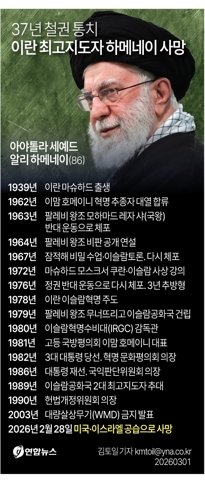
On the 28th local time, Donald Trump, president of the United States of America (U.S.), declared that "Khamenei died amid ongoing conflict," while a senior official from the State of Israel said his body had been found after joint U.S.–Israeli airstrikes. The Government of the Islamic Republic of Iran also announced a period of mourning. His death is more than a simple change of leadership; it is an event that threatens the very core of the Islamic Republic of Iran’s theocratic system, which has held for nearly four decades.The rise of an 'unprepared successor'Khamenei was born in 1939 in Mashhad, a holy city in northeastern Islamic Republic of Iran, as the second son of an Azerbaijani cleric. He often recalled his frugal childhood, saying that for dinner they would sometimes eat nothing more than "bread and raisins." This ascetic image later became closely intertwined with his political identity.
He began religious studies at the age of five and spent his formative years at a seminary in Mashhad before continuing his education in Najaf and Qom. However, he never formally attained the highest level of religious authority that his predecessor, Ayatollah Ruhollah Khomeini, had enjoyed. When he was designated Supreme Leader in 1989, he was effectively granted the title of ayatollah overnight, and this abrupt elevation fueled early doubts about his religious legitimacy.
In his early twenties, while studying in Qom, he fell deeply under the influence of Khomeini, then a radical religious thinker. When the Shah expelled Khomeini in 1964, Khamenei remained in the Islamic Republic of Iran and worked to spread his mentor’s doctrine of Islamic government. He was arrested six times by SAVAK (Organization of Intelligence and National Security), the Shah’s secret police, and is said to have endured solitary confinement and torture. Because SAVAK was widely believed to have been trained by U.S. and Israeli intelligence services, many analysts argue that his strong anti-American and anti-Israeli sentiments were forged during this period.Revolution and the consolidation of powerThe 1979 revolution toppled a monarchy that had lasted for 2,500 years, and Khamenei’s political standing changed overnight. After Khomeini returned from exile, Khamenei emerged as part of the revolutionary elite and later served as president of the newly founded Islamic Republic.
In 1989, shortly after the end of the Iran–Iraq War, Khomeini died and the succession question became uncertain. Akbar Hashemi Rafsanjani, then speaker of parliament, helped pave the way for Khamenei to take over. Many observers believed that, as a relatively young cleric, he would be someone the establishment could control. Over time, however, the two men clashed over economic liberalization and the concentration of power, and their rivalry continued for nearly three decades. When Akbar Hashemi Rafsanjani died in 2017, Khamenei effectively removed his most significant potential rival from the scene and completed the consolidation of his authority.
He built a loyal security apparatus centered on the Islamic Revolutionary Guard Corps (IRGC) and the Basij militia. Although there was an elected president and parliament, ultimate authority over nuclear and missile policy, as well as relations with the U.S., rested with the Supreme Leader. This hybrid system—clerical rule combined with limited democracy—functioned in practice so that almost nothing moved without his approval.A doctrine of rule built on 'resistance'Khamenei’s governing philosophy can be summed up in a single word: resistance. He defined the United States of America (U.S.) and the broader West as existential threats to the regime and placed anti-Americanism at the center of foreign policy. By supporting regional proxy forces such as Hezbollah in Lebanon and armed groups in Palestine, he expanded the Islamic Republic of Iran’s influence, and after the Iraq War and the Arab Spring, he exploited power vacuums to further entrench the country’s position in the Middle East.
The result, however, was isolation. The Islamic Republic of Iran was effectively cut off from the global financial system, and its currency plummeted in value. High inflation, unemployment, and a massive brain drain became structural problems. While some Middle Eastern states transformed themselves into hubs for finance, logistics, and technology, the Islamic Republic of Iran poured its national resources into enduring sanctions and sustaining military interventions.
In recent years, his rule has faced severe challenges. Skyrocketing prices and economic hardship sparked nationwide protests, and earlier this year the regime carried out the harshest crackdown since the revolution. Security forces opened fire on demonstrators chanting "Death to the dictator," resulting in bloodshed.
External conditions also deteriorated. After Hamas attacked the State of Israel in October 2023, the war in the Gaza Strip erupted, and the State of Israel began exerting pressure on the Islamic Republic of Iran’s proxy forces across the region. Hezbollah in Lebanon was weakened, and the regime of Bashar al-Assad in Syria collapsed. The U.S. demanded that the Islamic Republic of Iran abandon its ballistic missile program, but Khamenei rejected this, calling the missiles "the ultimate deterrent." Many analysts now argue that this hard-line stance helped set the stage for the latest airstrikes.
[email protected] Lee Byung-chul Reporter