Trump’s decision, Khamenei eliminated...A new order in the Middle East
- Input
- 2026-03-01 13:25:27
- Updated
- 2026-03-01 13:25:27
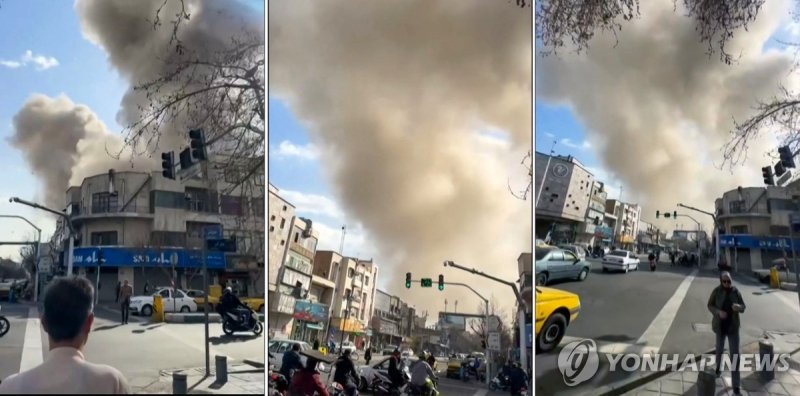
The Financial News, New York City – Lee Byung-chul, correspondent.The United States of America (U.S.) and the State of Israel carried out simultaneous airstrikes on major cities in the Islamic Republic of Iran on the 28th local time. The attack killed Ayatollah Ali Khamenei, Iran's Supreme Leader, who had ruled the country with an iron fist for 37 years. U.S. President Donald John Trump officially announced Khamenei’s death 15 hours after the strikes began, and Islamic Republic of Iran Broadcasting (IRIB) later confirmed the news. Depending on how Iran’s succession of power unfolds and how the U.S. responds next, the political landscape in the Middle East is expected to reach a major turning point. Whether this leads to heightened geopolitical risk is also likely to further increase uncertainty in the global economy.
The U.S. and the State of Israel launched their attack on the Islamic Republic of Iran at 1:15 a.m. Eastern Time, which was 9:45 a.m. in Iran. Around 2:30 a.m. Eastern Time, President Donald Trump posted an eight‐minute video on the social media platform Truth Social, formally acknowledging the operation. Trump said, "A short while ago, we initiated a major military operation inside Iran," adding, "Our objective is to protect the American people by eliminating the imminent threat posed by Iran." Addressing Iranian citizens, he went on, "When we are done with this operation, take over your government. It will be yours," and added, "You now have a president who will give you what you want." His remarks are widely interpreted as effectively signaling a push for regime change.
The operation was reported to have precisely targeted Khamenei and Iran’s air defense systems, among other assets. Israeli Prime Minister Benjamin Netanyahu stated, "We have destroyed Khamenei’s residence and eliminated commanders of the Islamic Revolutionary Guard Corps (IRGC) as well as senior nuclear officials," adding, "We are prepared to strike thousands of additional targets."
Reports said that, in addition to the Supreme Leader of Iran, Ayatollah Ali Khamenei, Iran's Islamic Revolutionary Guard Corps Commander-in-Chief Mohammad Pakpour was killed. Aziz Nasirzadeh, the Minister of National Defense, and Ali Shamkhani, a close aide to Khamenei who previously served as Chief of Naval Operations of the Islamic Republic of Iran Navy, were also reported dead.
Command-and-control facilities of the Islamic Revolutionary Guard Corps (IRGC), along with Iran’s air defense network, missile and drone launch sites, and military airfields, were also among the primary targets. The United States Department of Defense (DoD) named the operation "Operation Epic Fury." By contrast, the June attack last year on Iran’s nuclear facilities had been code‐named "Operation Midnight Hammer." Israel has dubbed the current campaign "Roar of the Lion," a name that echoes "Rising Lion," the codename used when it launched surprise strikes on Iranian nuclear facilities during the Twelve-Day War last June.
According to Iranian authorities, the attack caused damage in 24 of the country’s 31 provinces, leaving at least 201 people dead and 747 injured. However, they noted that the final toll could change as further assessments are carried out.
The U.S. and the Islamic Republic of Iran resumed nuclear talks on the 6th of this month and held three rounds of negotiations in Switzerland and Oman. However, the two sides reportedly failed to bridge their differences over the scope of Iran’s nuclear program and the lifting of sanctions. President Donald Trump said, "Iran has tried to rebuild its nuclear program and has rejected every opportunity to abandon its nuclear ambitions," declaring, "We can no longer tolerate this."
With the death of the Supreme Leader of Iran in this attack, the central pillar of the country’s theocratic system, which has endured for nearly four decades, has effectively collapsed. The security landscape in the Middle East could change dramatically depending on whether hardliners in Iran rally around a more aggressive course or whether internal fractures deepen amid the power vacuum. Analysts say that, in the coming weeks, the key variables will be Iran’s succession process, the level of loyalty within the IRGC, and the scope of any additional U.S. military action. As a result, many observers warn that international oil prices and volatility in global financial markets could also rise.
Meanwhile, in a statement issued on the 1st, the IRGC confirmed the death of Ayatollah Ali Khamenei and warned, "We will impose harsh, decisive, and unforgettable punishment on those who killed the Imam of the Ummah (the global Muslim community)."
[email protected] Lee Byung-chul, correspondent Reporter