Foreign Investors Net Sellers of 14 Trillion Won, Institutions Net Buyers of 8 Trillion Won: Diverging Flows in the KOSPI Index
- Input
- 2026-03-01 14:46:03
- Updated
- 2026-03-01 14:46:03
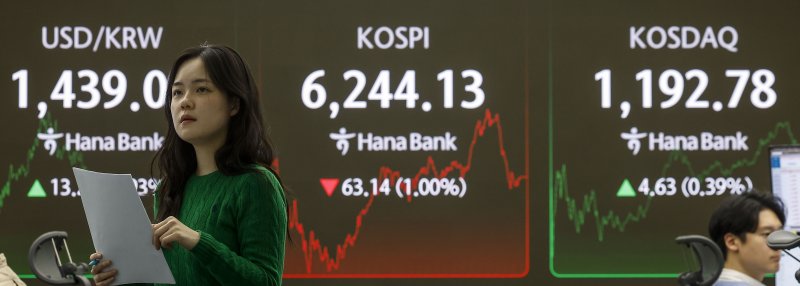
According to The Financial News, foreign and institutional investors are taking opposite positions, creating a standoff in supply and demand across the KOSPI Index market. Foreign investors have turned to large-scale selling over a short period, while institutions and retail investors have been net buyers, taking the other side of the trade. Analysts interpret the foreign selling as a reduction in exposure amid rising global volatility, and they largely do not see it as a signal that the broader uptrend is breaking down.
According to the Korea Exchange on the 1st, from the 13th to the 27th of last month, foreign investors recorded eight consecutive trading days of net selling in the KOSPI Index market, unloading a cumulative 14.404 trillion won. Over the same period, institutional investors were net buyers of 8.3294 trillion won, leading the demand side, while retail investors also joined the buying trend with net purchases of 4.7913 trillion won. Institutions maintained a net buying stance from the 6th of last month, with only a single exception on the 23rd.
By individual stock, the divergence in flows was most pronounced in large-cap KOSPI Index names, especially leading semiconductor stocks. During this period, the top net buy by institutions was Samsung Electronics, which saw 2.9329 trillion won in net inflows. SK Hynix (1.3693 trillion won), Doosan Robotics (561 billion won), Hyundai Motor Company (316.3 billion won), and Samsung Electronics Preferred Shares (270.2 billion won) also ranked among the major institutional net buys. In contrast, Samsung Electronics was the number one net sell by foreign investors, with selling reaching about 13 trillion won over the same period. SK Hynix (negative 2.6998 trillion won) and Samsung Electronics Preferred Shares (negative 1.2603 trillion won) were also among the top foreign net sells.
Retail investors likewise focused their buying on large-cap KOSPI Index stocks. Over the same period, they were net buyers of 8.5876 trillion won in Samsung Electronics and purchased 1.2449 trillion won worth of SK Hynix shares. In effect, institutions and retail investors have been absorbing the supply that foreign investors have been offloading.
Looking at price movements, large-cap semiconductor stocks continued to rise even amid heavy foreign selling. Samsung Electronics gained about 40% from early February through the end of last month, while SK Hynix rose roughly 20% over the same period. Although foreign investors have been taking profits, steady net buying by institutions and retail investors has helped drive the sharp rally in major semiconductor names.
Brokerages cite several factors behind the foreign selling: increased volatility in United States of America (US) technology stocks, weaker appetite for risk assets due to a stronger won–dollar exchange rate, and rebalancing by global exchange-traded fund (ETF) products. As semiconductor stocks have become a primary target for profit-taking in global markets, selling has concentrated in highly liquid large caps. Most analysts say it is difficult to interpret this as a shift in views on the semiconductor industry’s fundamentals or its medium-term earnings outlook.
Institutions, by contrast, appear to be increasing their exposure to large-cap KOSPI Index stocks based on earnings and valuation. Earnings forecasts continue to be revised upward, and despite the sharp rise in the index, they judge that valuation pressure on corporate value remains limited. Retail funds are also contributing to more stable flows, with more money going into ETFs and large-cap passive products rather than short-term trading.
Securities firms expect the standoff in supply and demand between foreign and institutional investors in the KOSPI Index market to persist for the time being. While short-term volatility driven by global factors is seen as unavoidable, they generally do not view the current phase as one that undermines the broader upward trend.
Kim Min-kyu, an analyst at KB Securities, said, "The semiconductor sector still has room for further gains over the mid to long term, but during a bull market, volatility can increase and periods of sharp corrections may recur," adding, "A KOSPI price-to-book ratio (P/B ratio) of 2 times could act as a short-term resistance level, but stronger earnings momentum than in the past could justify this and leave the door open for the index to reach new highs."
[email protected] Bae Han-geul Reporter