"Big profits, light punishment"... Over 10,000 counterfeit cases in five years
- Input
- 2026-03-01 16:14:20
- Updated
- 2026-03-01 16:14:20

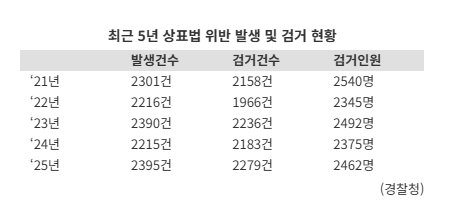
[The Financial News] Crimes involving trademark infringement, such as distributing counterfeit goods and attaching fake brand labels, have exceeded 10,000 cases over the past five years. Analysts say the perception that criminal profits are high compared to the level of punishment, combined with a social atmosphere that treats intellectual property infringement relatively lightly, has turned the "war on counterfeits" into a prolonged battle. Experts argue that the system must send a clear signal that those caught will suffer losses far greater than any criminal gains.
■ High profits and low sense of guilt as root causesAccording to data on "trademark law violations and arrests over the past five years" obtained by The Financial News from the Korean National Police Agency (KNPA) on the 1st, there were a total of 11,517 cases of violations of the Trademark Act between 2021 and last year. During the same period, there were 10,822 arrests involving 12,214 suspects. The annual figures fluctuated slightly but remained above 2,200 cases every year. On average, that translates to roughly 2,300 cases a year. Over the same period, the average annual number of arrests was about 2,160 cases, involving around 2,400 people. Observers say this shows trademark infringement has become a "constant" rather than a one-off crime.
The types of violations are also diverse. Cases repeatedly uncovered include smuggling counterfeit goods from overseas for domestic distribution, attaching famous brand labels without authorization to ordinary clothing or accessories and selling them, and trading fake products through online platforms. More recently, a division of labor has become pronounced, with separate actors handling production, label attachment, distribution, and sales at different stages.
A case uncovered in January by Seoul Gwangjin Police Station is a typical example. Police arrested a distributor who imported fake luxury watches and sneakers from overseas and supplied them in Korea, a vendor who attached counterfeit labels to clothing and sold it, as well as a delivery driver, a watch assembler, a seller of fake luxury labels, and the owner of an embroidery company. Over about five years, they earned illicit profits totaling around 3.5 billion won by selling counterfeit goods.
Experts point to both "high profitability" and a "low sense of guilt" as reasons these crimes persist. Kyoung Hwan Kim, a copyright law specialist, noted, "In Korea, awareness of intellectual property infringement is particularly low, so people tend to view trademark infringement as less serious than theft," adding, "Punishments must be toughened so people clearly recognize that violating the Trademark Act can trigger a serious financial crisis." Professor Shin I-cheol of Wonkwang Digital University also remarked, "Unlike serious violent crimes such as murder or rape that directly harm a person's life or body, trademark violations tend to generate a relatively low sense of guilt," and warned, "If offenders believe the punishment is not severe compared to the profits they can gain, such crimes will not easily decline."
In theory, the current Trademark Act allows for up to seven years in prison or a fine of up to 100 million won for violations. In practice, however, many offenders receive suspended sentences or fines at the sentencing stage. Last year, for example, a self-employed man in his 40s who ran both online and offline shops and sold 38 counterfeit luxury-brand bags and other items for about 10.6 million won was given only a fine because it was his first offense.
The spread of the digital environment is also cited as a factor that systematizes these crimes. As artificial intelligence (AI) technology advances, counterfeit products have become more sophisticated. Large volumes of goods entering the country through overseas direct purchases and international express shipping are also difficult to block completely at the customs stage. In addition, the current Trademark Act focuses on sanctioning direct infringers, and lacks explicit provisions defining the responsibility of online platform operators, which further complicates enforcement.
■ Economic sanctions and technological responses in tandemExperts unanimously stress that without both tougher criminal penalties and economic sanctions such as punitive damages, along with technological countermeasures, these crimes will inevitably recur. Professor Shin advised, "Sentencing guidelines should be raised so that trademark violations can result in up to 10 years in prison and fines of up to 500 million won, and the level of compensation should be set at five to ten times the actual damage to strengthen the punitive damages system." Professor Lee Keon-su of Baekseok University (BU) added, "AI-based detection systems should be actively used at the customs stage to screen out counterfeit goods in advance, and when they are caught, strong confiscation and forfeiture must be fully enforced in practice."
There are also growing calls to strengthen the responsibility of online platforms. Attorney Seungwoo Lee of Jeonghyang Law Firm emphasized, "It is urgent to establish a trademark protection framework tailored to the online environment, including legislation that imposes monitoring obligations on platform operators," and continued, "We must improve procedures for compensating consumer damage and introduce effective remedies such as class actions." Professor Kim Young-sik of Police Administration at Soonchunhyang University (SCH) likewise pointed out, "If platforms tighten their vetting of vendors at the onboarding stage and make platform operators bear some responsibility for the distribution of counterfeit goods, the damage can be significantly reduced."
[email protected] Reporter Kim Ye-ji Reporter