"We Won't Force the Taegeukgi"...A Fashion CEO Makes an Unexpected Decision on March 1st
- Input
- 2026-03-01 09:21:41
- Updated
- 2026-03-01 09:21:41
[Financial News] As the Republic of Korea (South Korea) marks the 107th anniversary of March 1st Independence Movement Day, it is still easy to spot clothing bearing the Stars and Stripes or the Union Jack on the streets. By contrast, fashion items that incorporate the Taegeukgi (the South Korean national flag) remain rare.
In recent years, the Taegeukgi has often been used for political purposes at rallies in South Korea, creating a social atmosphere in which many people feel reluctant to wear it on their clothes.
Against this backdrop, one social-contribution-focused fashion company has drawn attention by breaking these preconceptions and turning the Taegeukgi, Dokdo, and independence activists into fashion motifs.
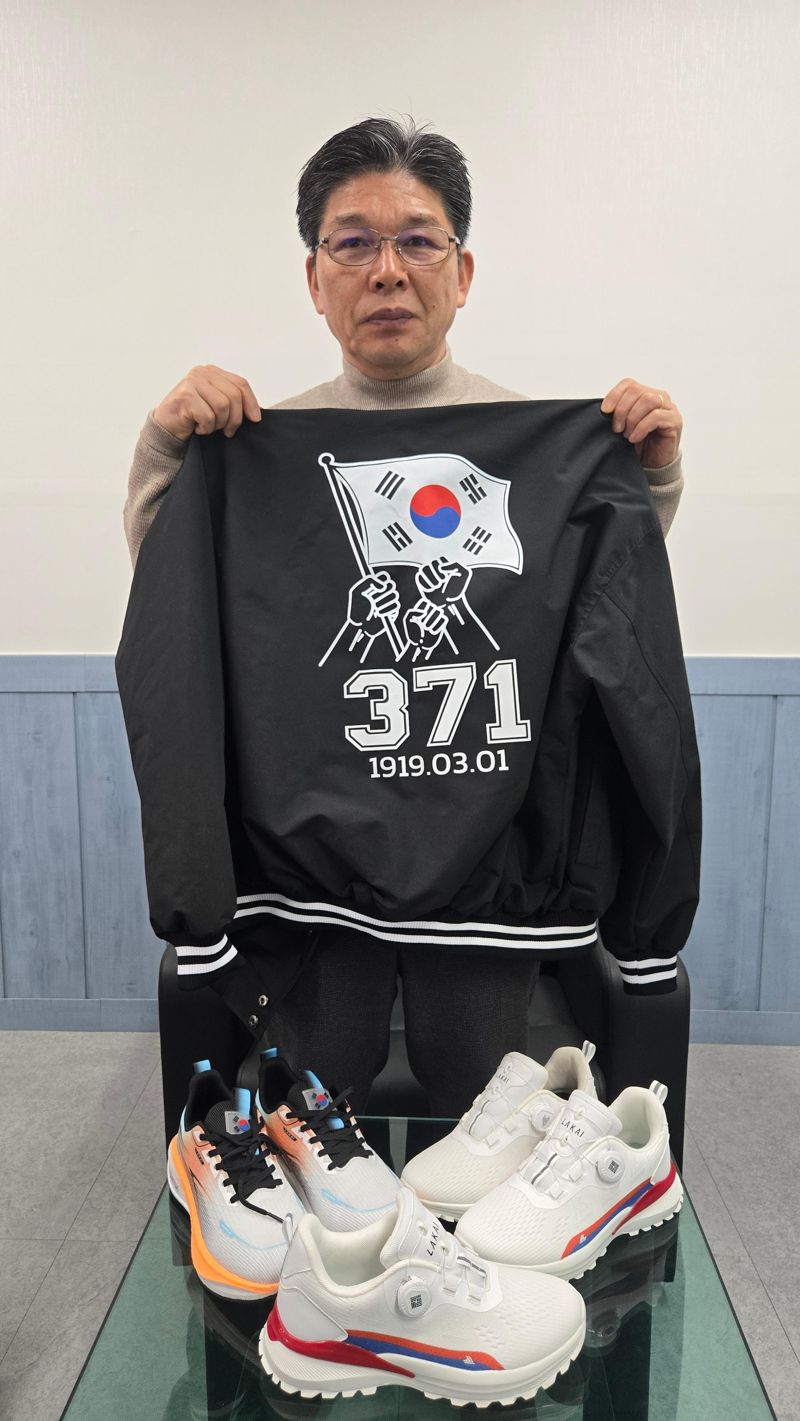
To mark March 1st Independence Movement Day, Lakai Korea CEO Kim Jae-bon unveiled three new products. However, this launch is more than just a seasonal release. Kim emphasized that it is "the result of real-world deliberation and choices regarding the use of the Taegeukgi in the current social climate."
Since its founding in 2017, Lakai Korea has used the Taegeukgi as a key design element while promoting awareness of Dokdo, correcting historical narratives about South Korea, and supporting descendants of independence activists. The brand’s identity itself has been rooted in historical symbols.
In the past few years, however, the Taegeukgi has become associated with certain political rallies, leading some consumers to develop negative perceptions. This shift has also affected the brand.
“We kept getting protest calls asking what connection we had with so-called Taegeukgi groups, and our sales were actually impacted,” Kim said. “More people also told us they felt uncomfortable wearing Taegeukgi designs in public or in everyday life.”
In response, Kim partially adjusted existing product designs. For the brand’s bestselling cap featuring Admiral Yi Sun-sin’s turtle ship, the original design included the Taegeukgi. Recently, however, the company changed the options so that customers can choose versions with or without the Taegeukgi. It was a decision not to force the flag on anyone.
“Within this context, we had intense internal debates over whether to include Taegeukgi designs in the three new products,” Kim explained. “But we ultimately decided we could not completely abandon the Taegeukgi, which has been central to our identity. We chose to move forward with the launch on the principle that ‘even if it doesn’t sell well, we will continue to release products that carry meaning.’”
Among the three new items, the Taeguk Wave Sneakers do not display the Taegeuk symbol directly. Instead, they suggest it indirectly through curves and color combinations. It is a compromise that embeds the symbol metaphorically rather than placing it front and center.
By contrast, the 1936 Wind Jacket and the Yu Gwan-sun 371 Wind Jacket both incorporate Taegeukgi designs.
The 1936 Wind Jacket is inspired by the historical significance of marathoner Sohn Kee-chung, who won at the 1936 Summer Olympics. Because it symbolizes both the pain of having to run under the Japanese flag and the pride that endured within that era, the Taegeukgi could not be left out, the company explained.
The Yu Gwan-sun 371 Wind Jacket follows the same logic. On the back, the design visually reinterprets the Taegeukgi as it appeared during March 1st Independence Movement Day, alongside the date 1919.03.01 and the number “371.”
The number 371 was not Yu Gwan-sun’s official prison number. It was a classification number written by the Japanese authorities on a photograph taken at the time, which later came to be widely known as her prison number.
“Fully aware of this historical context, we adopted the number as a design element for its symbolic meaning,” Kim noted. “Because the Taegeukgi is the symbol most associated with March 1st Independence Movement Day, we could not choose to omit it from these two products. We understand they may not sell in large numbers, but we believe someone has to keep making products that carry this kind of meaning,” he stressed.
Through this launch, Lakai Korea hopes to help people see the Taegeukgi not as a political emblem but as a historical symbol.
“The Taegeukgi does not belong to any particular group; it is the symbol of the entire Republic of Korea,” Kim stated. “Even in a reality where that symbol is misunderstood, we will maintain our brand direction of honoring history and culture.”
Lakai Korea was recognized for its ongoing efforts to promote South Korean history and, in January this year, received the ESG Management Award from the Social Contribution Association.
[email protected] Moon Young-jin Reporter