Japan Says Iran's Nuclear Development Cannot Be Tolerated, Urges Halt to Destabilizing Actions
- Input
- 2026-03-01 09:35:25
- Updated
- 2026-03-01 09:35:25
Reporting from Tokyo for Financial News, Seo Hye-jin: On the 1st, the Government of Japan declared that "the Islamic Republic of Iran's development of nuclear weapons can never be tolerated" and called on Iran to cease actions that destabilize the region.
According to Japan Broadcasting Corporation (NHK) and other Japanese media, the Government of Japan convened a ministerial meeting of the National Security Council of Japan (NSC) on the 28th of last month from around 11 p.m. for about an hour. Officials analyzed relevant information and discussed possible responses. Prime Minister Sanae Takaichi, Japanese Minister for Foreign Affairs Motegi Toshimitsu, Minister of Finance Satsuki Katayama, and Japan’s Minister of Defense Shinjirō Koizumi were among those present.
After the meeting, Chief Cabinet Secretary Minoru Kihara held an emergency press conference in the early hours of the following day. When asked whether Japan supports United States strikes on the Islamic Republic of Iran, he avoided a direct answer, saying only that Japan is "currently focused on gathering information."
However, he stressed that "talks between the United States and the Islamic Republic of Iran are extremely important for resolving the Iranian nuclear issue, and Japan has strongly supported them." He added, "The Islamic Republic of Iran's development of nuclear weapons can never be tolerated, and it must halt both its nuclear weapons development and actions that destabilize the region."
Japanese Minister for Foreign Affairs Motegi Toshimitsu likewise addressed reporters after the meeting. Asked whether Japan backs U.S. military action, he replied, "Japan's position is that the Islamic Republic of Iran's development of nuclear weapons can never be tolerated." He went on, "Japan respects the fundamental values of freedom, democracy, and the rule of law, and has pursued diplomatic efforts to resolve the Iranian nuclear issue," adding, "Talks between the United States and the Islamic Republic of Iran are extremely important, and we have strongly supported them."
He noted that "peace and stability in the Middle East, including energy security, and the maintenance of the international nuclear non-proliferation regime are extremely important for Japan," and pledged to continue all necessary diplomatic efforts in cooperation with the international community.
Earlier, on the 28th (local time), the United States and the State of Israel launched a military operation targeting the Islamic Republic of Iran and announced that they had eliminated Ali Hosseini Khamenei, the Supreme Leader of Iran and the apex of the Iranian Islamic theocratic system.
United States President Donald Trump posted on the social media platform Truth Social at around 4:40 p.m. Eastern Time that day, declaring, "Khamenei, one of the most evil people in history, is dead."
This was the first direct U.S. military strike on the Islamic Republic of Iran in about eight months, since it hit three nuclear facilities in Iran last June. Observers say the latest operation was far more extensive in scale than the previous one.
President Trump argued that the Islamic Republic of Iran has been trying to rebuild Iran's nuclear program and has "rejected every opportunity to abandon its nuclear ambitions." He declared, "We will no longer tolerate this," and identified Iran's missiles, its missile industry, and the destruction of its navy as key targets of the operation.
While maintaining that a diplomatic solution should come first and continuing nuclear talks with the Islamic Republic of Iran, President Trump had also deployed large-scale military forces to the Middle East, keeping open the option of military action against Iran.
The United States resumed nuclear negotiations on the 6th of this month after an eight-month hiatus and held three rounds of talks through the 26th in Switzerland and Oman. However, it appears Washington ultimately concluded that the Islamic Republic of Iran had no intention of abandoning nuclear weapons and proceeded with the attack.
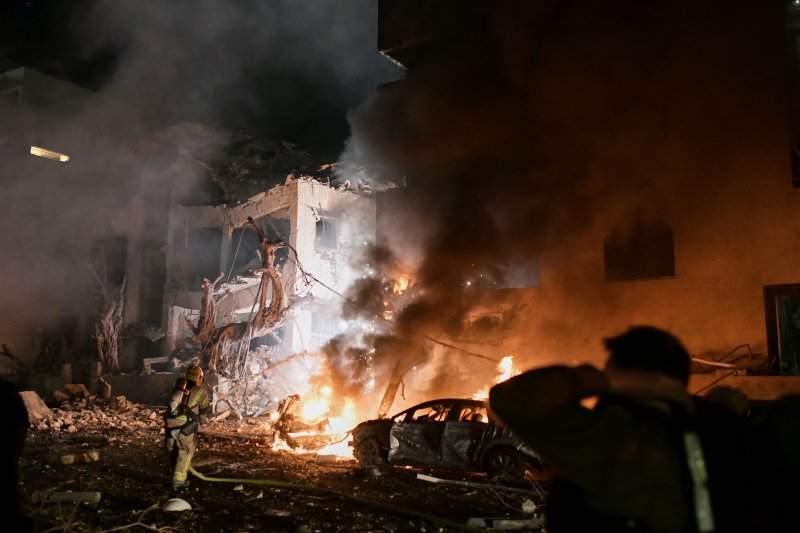
According to the Iranian Red Crescent Society, the latest strikes caused damage in 24 of Iran's 31 provinces, leaving at least 201 people dead and 747 injured.
The Islamic Republic of Iran condemned the United States and the State of Israel for attacking Iran, calling it an act of aggression in violation of international law, and launched an immediate counterattack. When the State of Israel carried out airstrikes on Iran last June, the Islamic Revolutionary Guard Corps (IRGC) responded about 20 hours later, but this time Iran struck back in roughly an hour.
In response, the Ministry of Foreign Affairs of Japan has decided to assist with overseas evacuation for any of the roughly 200 Japanese nationals currently staying in the Islamic Republic of Iran who wish to leave, and is moving quickly to confirm their intentions.
Chief Cabinet Secretary Minoru Kihara stated, "There are about 200 Japanese nationals in the Islamic Republic of Iran," and added, "So far, no Japanese casualties have been confirmed, but we will continue to do everything possible to ensure their protection."
[email protected] Seo Hye-jin Reporter