Will U.S. Strike on Iran Dampen KOSPI Rally? Middle East Risk Comes to the Fore [U.S. Strike on Iran]
- Input
- 2026-03-01 08:17:24
- Updated
- 2026-03-01 08:17:24
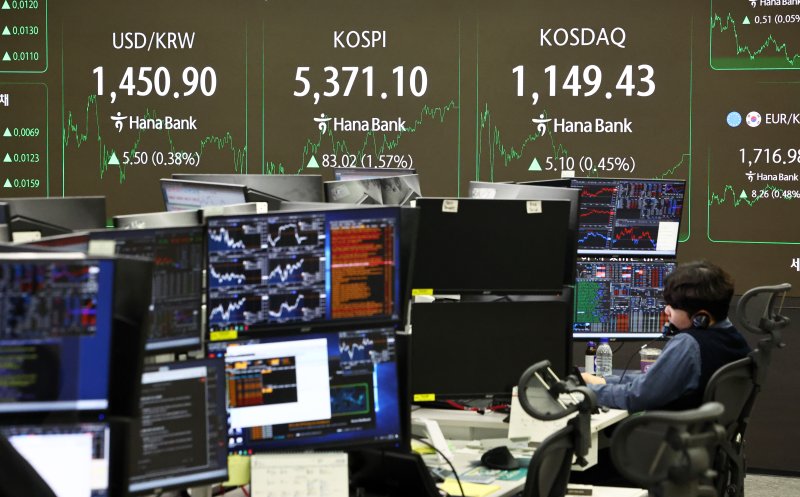
[The Financial News] With the exchange rate stabilizing and strong buying by retail investors, the domestic stock market had been in an exceptionally strong bull run. Now, an unexpected geopolitical risk from the Middle East has emerged. Markets are watching how the fallout from the United States of America (U.S.) and the State of Israel’s attack on the Islamic Republic of Iran will affect the exchange rate, inflation, and the real economy.
Observers warn that, depending on how the Middle East situation unfolds, it could shake the stock market and push up prices and the exchange rate, becoming a burden on the South Korean economy.
Korea Composite Stock Price Index (KOSPI) surges while demand for overseas stocks cools, putting downward pressure on the exchange rate
According to the Bank of Korea (BOK) economic statistics system on the 1st, last month’s average monthly US Dollar–South Korean Won exchange rate, based on the 3:30 p.m. closing price, was 1,447.39 won. This is the first time in four months that the monthly average has fallen below 1,450 won, since October last year, when it stood at 1,424.83 won. In particular, last week it repeatedly moved within the 1,420–1,430 won range, showing a relatively stable pattern.
Although the exchange rate is still in the 1,400 won range, many assess that the market has moved out of the phase of rapid won depreciation that at one point threatened to break through the 1,480 won level.
A key factor cited is a shift in capital flows among Korean individual investors investing in overseas stocks. While the Korea Composite Stock Price Index (KOSPI) broke through the 6,000-point level and continued a strong rally, the U.S. stock market has been sluggish amid talk of an Artificial Intelligence (AI) bubble, which has reduced demand for exchanging won into United States dollar (USD).
In a recent report, Shinhan Bank stated, "In the first week of February, Korean individual investors’ daily average investment in U.S. stocks reached 660 million dollars, but in the three weeks after February 9, it fell to less than 100 million dollars per day," adding, "The scale of large retail funds flowing into U.S. stocks has dropped sharply in recent weeks."
Citigroup also said in an analysis based on moving averages on the 20th that, in mid-February, Korean individual investors’ net purchases of domestic stocks surpassed their overseas investment volume. Citigroup noted, "Individual investors are shifting their focus toward the domestic stock market, and the pace of increase in overseas investment is gradually slowing."
The stock market boom is also having a positive impact on tax revenues. The securities transaction tax on KOSDAQ shares in January this year, which reflects trading volume from December last year, increased by 200 billion won compared with the same month a year earlier, and the Special Tax for Rural Development collected from expanded KOSPI trading rose by an additional 300 billion won.
Given that the KOSPI has continued to climb since the start of the year and that transaction tax rates have been raised, the tax-boosting effect is expected to grow further. From January, the securities transaction tax rates on KOSPI and KOSDAQ trades were each raised by 0.05 percentage points. The government projects this year’s Securities Transaction Tax revenue at 5.4 trillion won, 2 trillion won more than last year.
Meanwhile, analysts say that improved earnings at SK Hynix and Samsung Electronics, the two leading semiconductor stocks, are acting as a positive factor not only for corporate tax receipts but also for stock-related tax revenues.
Will private consumption be stimulated... Limits of a "semiconductor-led" bull market
From a macroeconomic perspective, the key question is whether rising asset prices will trigger so-called "wealth effects" that stimulate private consumption.
If such wealth effects fail to materialize, there are concerns that the gap between the capital market and the real economy could widen. There is also the possibility that this could further deepen income and wealth inequality.
Ultimately, analysts say the crucial issue is how broadly the heat in the capital market can translate into increased consumer spending.
Above all, the fact that the current bull market is centered on the semiconductor sector is seen as a factor limiting the spillover effect. Because the benefits of rising semiconductor share prices are relatively concentrated among a specific group of investors, many believe it is difficult to expect a broad-based boost to consumption on that basis alone.
Middle East shock emerges... Will exchange rate and prices be shaken?
The suddenly escalating "Middle East crisis" is emerging as a factor that could curb macroeconomic optimism built on the strong KOSPI. Analysts warn that if the domestic stock market enters a technical correction phase, it could negatively affect sentiment across the broader economy.
The biggest point to watch is the direction of international oil prices. If the Strait of Hormuz, through which about 20% of the world’s seaborne crude oil shipments pass, were to be blocked, it could directly lead to a sharp spike in international oil prices.
This could also put upward pressure on inflation. The recent relatively stable trend of consumer prices, which had been rising at just above 2%, may once again be shaken. Industrial products directly linked to international oil prices, as well as electricity, gas, and water rates, are expected to be affected first.
Previously, global investment banks such as JPMorgan Chase & Co. and major economic research institutes estimated that if the Strait of Hormuz were completely closed and military conflict spread, international oil prices could exceed 120–130 dollars per barrel. That would be more than 70% higher than the current level of around 70 dollars per barrel.
The US Dollar–South Korean Won exchange rate could also be affected. There is a view that the exchange rate, which had been trending lower in tandem with the recent strength of the domestic stock market, may come under renewed upward pressure. If funds flow into safe-haven assets such as USD and gold, the resulting strengthening of the dollar could push the exchange rate higher.
[email protected] Shin Jin-ah Reporter