Three Major Korean Mobile Carriers Head to MWC 2026 Together, Competing on New AI Technologies [MWC 2026]
- Input
- 2026-03-01 13:33:45
- Updated
- 2026-03-01 13:33:45
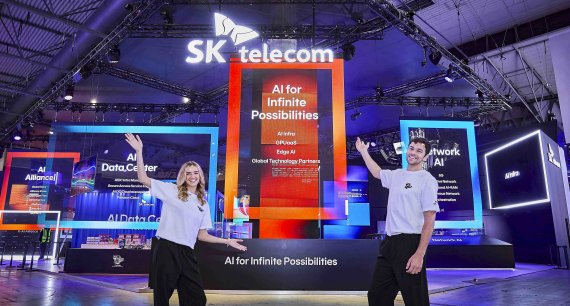
■SK Telecom to highlight its "full-stack AI" capabilitiesAccording to the industry on the 1st, SK Telecom has set the theme of its exhibition as "SK Telecom’s AI that creates infinite possibilities." In a 992-square-meter booth, the company will present core technologies related to AI infrastructure, including know-how accumulated in AI data centers (DC), as well as network AI and marketing AI.
SK Telecom will exhibit a total of 27 items across four areas: AI infrastructure, AI models, AI services, and the AI ecosystem.
First, the company will unveil the AIDC Infrastructure Manager, an intelligent platform that integrates diverse data within AI data centers into a single system, enabling real-time monitoring and efficient, stable operations. It will also showcase the high-performance, high-efficiency cloud platform Petasus AI Cloud; the SKT Enterprise AI Cloud Manager, a solution for optimizing GPU resources; and the GAIA real-time monitoring system, all brought together as the K-Sovereign GPUaaS solution. A next-generation solution called AI Inference Factory will also be introduced. Aimed at an AI market that is shifting from "training" to "inference," it integrates hardware, computing infrastructure, and software into a single offering to overcome the cost, power, and memory limitations of existing AI data centers.
SK Telecom will also present AI services designed to function as the brain, senses, and eyes of physical AI. Visitors will see a digital twin platform that precisely replicates the real world to support physical AI in making decisions and plans; a robot training platform that links virtual environments with real sites so physical AI can learn the senses it needs; and SynapsEgo, a vision solution that provides high-performance analysis of first-person-view video from the field.
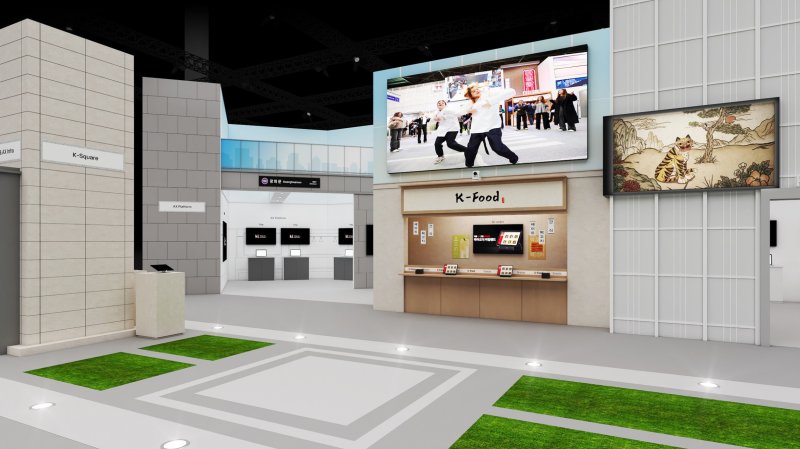
■KT: Implementing on-site physical AIKT has chosen "Gwanghwamun Square" as the theme of its booth. The company will present its physical AI strategy, which connects robots, equipment, and IT systems into a single intelligent ecosystem, along with its K RaaS robot platform (KT Robot as a Service).
The K RaaS robot platform goes beyond simply controlling individual robots. It is a robot orchestration platform that enables physical AI services that can actually be operated in the field.
Designed with a structure optimized for cloud environments, the K RaaS robot platform can monitor heterogeneous robots and equipment distributed around the world in real time, and integrate them for unified operation and management.
KT will also demonstrate a VLA (Vision-Language-Action) Agent. This next-generation robot intelligence understands visual information and language together and links that understanding to real-world actions. Visitors will be able to see in real time what the robot recognizes, how it reasons, and which actions it decides to execute.
In addition, KT will unveil an Edge R2R (Robot-to-Robot) Agent, which is built around three capabilities: providing integrated services for heterogeneous robots, orchestrating all agents and legacy systems on site, and carrying out missions through real-time linkage with the platform.
For example, in a smart factory, the humanoid robot Hugo inspects parts for defects using a VLA-based system and automatically concludes that the next step, "item transport," is required. When Hugo requests a work line, the platform immediately calls the Warehouse Management System (WMS) to check available lines and assigns the transport task to the mobile robot Mobi. Through direct robot-to-robot (R2R) collaboration and agent-to-agent (A2A) communication, the workflow is completed without central control or human intervention.
KT will also introduce the K RaaS Order/Delivery Agent, a customer-facing service in which AI agents cooperate to handle the entire process from order placement to robot delivery.
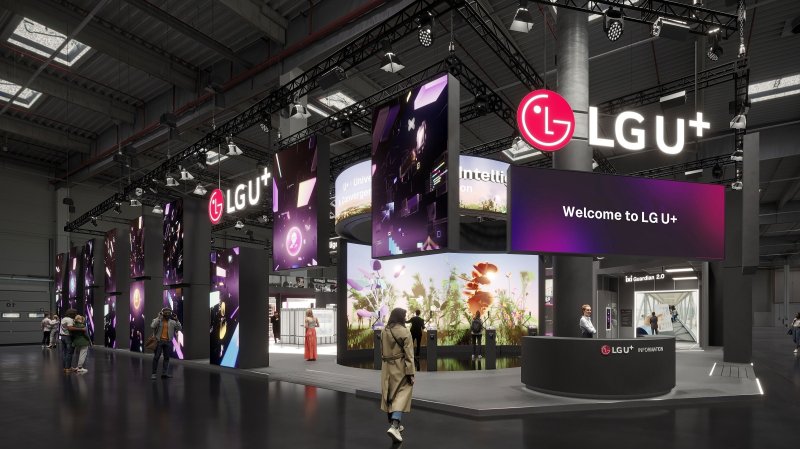
■LG Uplus to unveil four next-generation security technologiesLG Uplus has chosen "people-centered AI" as the overarching theme of its exhibition. The company plans to present a vision of the future created through technologies and services that connect people to one another.
The flagship exhibit will be Ixio Pro, an evolved version of the ixi-O AI Assistant. Ixio Pro is an active agent that goes beyond a passive assistant role by proactively suggesting what customers may need.
The Agentic AI Contact Center (Agentic AICC), developed in collaboration with OpenAI, can handle complex inquiries through natural conversation alone. The Self-Evolving AICC is a customer service AI that learns on its own by analyzing context and emotions in real time during calls, even when conversations deviate from predefined scripts.
LG Uplus will also showcase next-generation AI-based security technologies. These include AlphaKey, a cloud-based unified account management solution that applies AI-driven anomaly detection tailored to each customer; Homomorphic Encryption, which the company plans to apply to its AI calling app; optical transmission equipment that uses post-quantum cryptography (PQC); and the next-generation security platform U+SASE Secure Access Service Edge platform.
The company will further introduce Homomorphic Encryption technology that it plans to apply to the ixi-O AI Assistant calling app. Homomorphic Encryption allows data to be stored, processed, and searched while remaining encrypted, so that even if the data is leaked externally, its contents cannot be interpreted.
mkchang@fnnews.com Jang Min-kwon Reporter