KT to unveil 'K RaaS' robot platform at MWC, bringing Physical AI to the field
- Input
- 2026-03-01 08:00:00
- Updated
- 2026-03-01 08:00:00
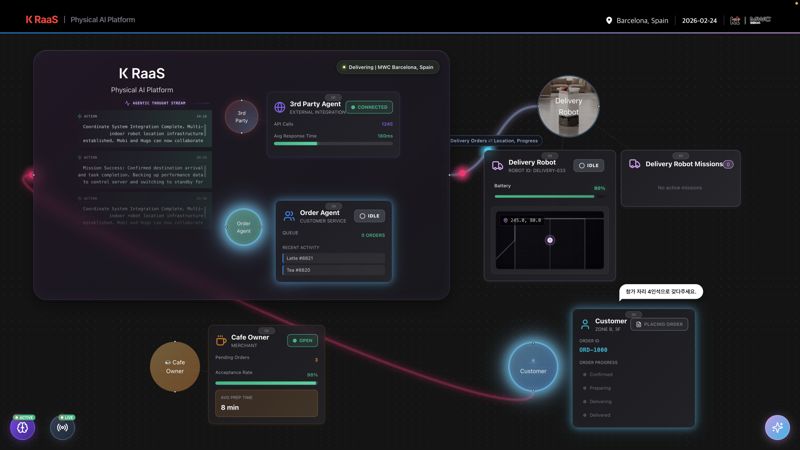
Barcelona, Spain – Reporter Jang Min-kwonKT Corporation (KT) announced on the 1st that at the Mobile World Congress (MWC) 2026 it will unveil its Physical artificial intelligence (AI) strategy, which connects robots, equipment, and IT systems into a single intelligent ecosystem, along with its K RaaS robot platform, "K RaaS (KT Robot as a Service)."■ Next-generation robotic intelligence: VLA AgentThe K RaaS robot platform is a robot orchestration platform that goes beyond simply controlling individual robots to deliver Physical AI services that can be deployed in real-world operations. By integrating robots, facilities, and legacy systems, it recognizes, analyzes, and operates across the entire service lifecycle, enabling AI-based automation to be applied directly in real business environments.
K RaaS is architected for cloud environments, allowing real-time monitoring of heterogeneous robots and equipment distributed around the world and unified operation and management of these assets. Rather than automating a single robot, it is designed so that an end-to-end Physical AI system, organized around service flows, operates organically.
The platform is equipped with multiple agents that perform different roles. The Service Builder Agent allows customers to design and deploy robot-converged services tailored to their environments without separate development work.
The K RaaS Agent, meanwhile, uses a natural language interface to check mission status, analyze operational data, and even generate reports. Managers who previously had to monitor dozens of control screens can now receive an integrated report through a single conversational interaction.
KT combines its ultra-high-speed network infrastructure, its generative AI model SOTA K, and robot orchestration technology to secure Physical AI reference cases across a range of industrial sites, including semiconductor fabrication plants, logistics centers, and smart buildings.
KT stresses that K RaaS is not just a technology for connecting or managing robots. It is a field-oriented Physical AI orchestration platform in which AI understands the physical environment and drives optimal execution.■ Autonomous robot-to-robot collaboration without human interventionVisitors can also explore the VLA (Vision-Language-Action) Agent. This VLA Agent represents next-generation robotic intelligence that integrates visual information and language, and then translates that understanding into concrete actions.
Because it is designed as a general-purpose architecture that is not tied to any specific robot type, any platform—whether a humanoid robot or a mobile robot—equipped with the VLA Agent gains perception, reasoning, and action capabilities. Whereas conventional service robots relied heavily on manual control, the VLA Agent enables robots to autonomously infer user intent and understand context based on wake words, gaze recognition, and similar cues.
Operators can also see in real time what the robot is perceiving, what reasoning process it follows, and which actions it triggers. Camera images and voice data are not stored; they are analyzed locally on the robot and then immediately discarded, with all processing performed on-device. This design meets the stringent security requirements of industrial environments.
In the VLA Agent demonstration, the robot accurately recognizes user intent even in crowded environments. When a visitor makes eye contact, waves a hand, or calls out "KT robot," the robot simultaneously recognizes the wake word and gaze, processes them, and responds. If the visitor asks, "Please guide me to a window seat," the robot evaluates the number of people and remaining seats, calculates the optimal location, and begins autonomous navigation. During movement, Light Detection and Ranging (LiDAR) sensors and depth cameras continuously scan the surroundings to automatically avoid people and obstacles.
If the information is insufficient, the robot asks follow-up questions. For example, in response to a request like "Please find me a seat," it will ask, "How many people are in your party?" It may also proactively suggest, "Would you like an apron?" to a customer wearing a white shirt. This demonstrates that the system is not just performing simple voice recognition, but providing service-oriented intelligence that understands situations and interacts with users.
KT expects this type of VLA Agent-based Physical AI to be applicable across many sectors, including hotels, the retail industry, and health care.■ From digital order to physical deliveryAt the exhibition, KT is also showcasing the Edge R2R (Robot-to-Robot) Agent, which is already operating at customer sites.
The Edge R2R (Robot-to-Robot) Agent performs three core functions: providing integrated services across heterogeneous robots; orchestrating all on-site agents and legacy systems; and executing missions through real-time linkage with the platform.
Visitors can intuitively understand how Physical AI works through a smart automobile factory scenario. The humanoid robot Hugo, powered by the VLA Agent, inspects parts for defects and autonomously concludes that the next step, "parts transport," is required. When Hugo requests a production line, the platform immediately calls the Warehouse Management System (WMS) to check available lines and assigns a transport mission to the mobile robot Mobi. Through direct robot-to-robot collaboration within the Robot-to-Robot (R2R) communication and collaboration framework and communication via the Agent-to-Agent Protocol (A2A), tasks are completed without central control or human intervention.
These demonstrations highlight that Physical AI is completed not at the level of individual robot intelligence or motion, but through platform-based agent orchestration capabilities.
The K RaaS Order/Delivery Agent is a customer-facing service in which AI agents work together to handle the entire process from order placement to robot delivery.
When a user orders from a menu via chat in a mobile app, the Order Agent analyzes the intent and requests delivery from the platform, which then assigns an appropriate robot. The robot autonomously moves by interfacing with various facility systems such as elevators and security gates, while the customer can check the robot's real-time location and order status. Throughout this process, the platform, edge systems, VLA Agent, and robots operate as a single ecosystem. It is a representative example of Physical AI, where a digital order is completed through physical delivery.
KT reiterates that K RaaS is not merely a technology for connecting robots. It is a field-oriented platform through which AI understands and optimizes the physical world.
Phil Oh, Head of KT's Technology Innovation Division and Vice President, stated, "K RaaS is designed to learn from data generated in the field using neural network-based models, and to feed those learnings back into service quality improvements and operational optimization." He added, "As learning and execution are repeated, performance will continue to improve, and we plan to expand this virtuous-cycle Physical AI framework across industries such as manufacturing, logistics, and buildings."
[email protected] Jang Min-kwon Reporter