[On the Scene] A March 1 Independence Movement Day Without Flags: Squares Full of Photo Ops, Alleys Left Silent
- Input
- 2026-03-01 15:52:30
- Updated
- 2026-03-01 15:52:30
In downtown Seoul on March 1, the 107th anniversary of March 1 Independence Movement Day, major roads were filled with waves of Taegeukgi flags. Yet in the very spaces where citizens live their daily lives—residential neighborhoods, apartment complexes, and back alleys—national flags were so rare that they could be counted on one hand. The government and local authorities’ "National Flag-Hoisting Campaign" appears to have run up against a wall of limited publicity, changing housing patterns, and public indifference. Experts noted that the answer should be sought in responding to social change and strengthening education.
■ Squares Turned Into Festivals, Alleys Left Forgotten
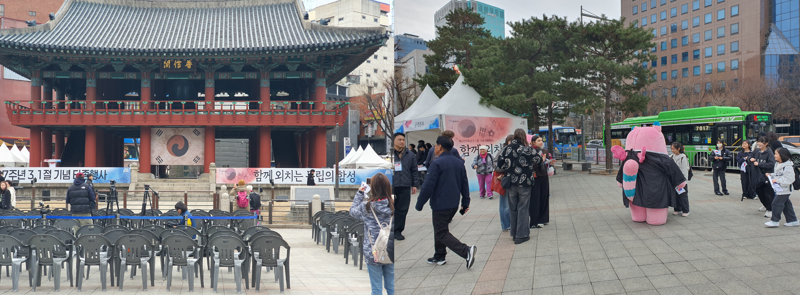
Around the Bosingak Bell-Ringing Ceremony held on the morning of March 1 in Jongno District, Seoul, crowds of citizens and foreign visitors carrying Taegeukgi flags gathered to take commemorative photos or watch the event, creating a festive scene. At one booth on the sidelines, organizers handed out Taegeukgi flags and explained the meaning of March 1 Independence Movement Day.
An office worker surnamed Hwang (34) said, "Because it is a March 1 Independence Movement Day event, I like that I can hold the Taegeukgi, take photos, and reflect on its meaning," but added, "Outside of events like this, I hardly ever see a sea of national flags anymore."
In Gwanghwamun Square and along Sejong-daero, it was also easy to spot people holding or draping themselves in the Taegeukgi. Some rally participants unfurled large national flags together with their companions, while many others walked the streets holding small flags in their hands. Street vendors selling Taegeukgi flags appeared around the square. Flagpoles along the Gwanghwamun roadway were all fitted with Taegeukgi, and large flags fluttered in the wind near City Hall and the post office.
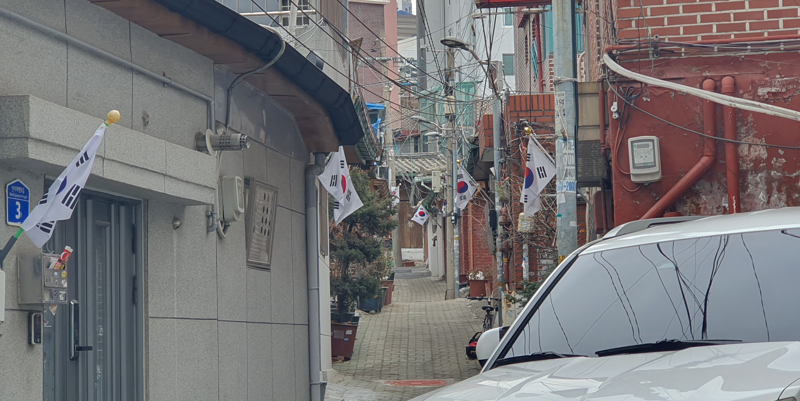
However, once you left the central squares and stepped into residential and commercial backstreets, the atmosphere changed completely. In the residential alleys stretching out across the Jongno area, homes displaying the Taegeukgi were few and far between. Even after scanning entire alleyways, the number of houses flying the national flag could be counted on one hand.
A shop owner surnamed Park (58), met at a nearby store, recalled, "In the past, there was a sense that every household would put up the Taegeukgi on national holidays, but these days you hardly see that anymore." Park added, "People are less interested, and many don’t even keep a flag at home." Office worker Jung (29) commented, "To be honest, I think of March 1 more as a public holiday than a day when you absolutely have to hang the national flag."
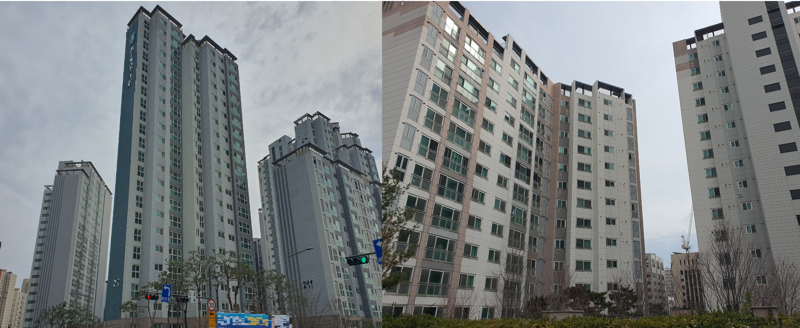
Other densely populated residential areas showed a similar pattern. In Mapo District, alleys of single-family homes where almost every house had a Taegeukgi contrasted sharply with nearby zones of multi-unit housing where such scenes were virtually nonexistent. In one apartment complex of about 500 households, fewer than 10 units were flying the national flag. Even when looking up at the balconies of the many-story high-rise buildings, it was difficult to find units with a Taegeukgi on display.
An apartment resident identified as A said, "In many newer apartments, the balcony railings are made of glass, so it’s hard to install a separate holder for the Taegeukgi," adding, "There is a shared flagpole at the entrance to the complex, but individual households almost never put up their own flags."
As resident A suggested, changes in housing design are cited as one reason for the decline in flag-hoisting. Newer apartment buildings tend to favor full-glass railings and built-in window systems, leading many to say that "even if you want to hang a flag, there’s nowhere to put it." In addition, most apartments now have extended balconies, meaning that the act of putting out a Taegeukgi is increasingly removed from residents’ everyday living spaces.
Experts, however, argue that there are no major architectural constraints. Choi Chang-sik, a professor of architecture at Hanyang University (HYU), noted, "The Taegeukgi itself is not a heavy attachment, so as long as the mounting fixture is properly designed, there is little concern in terms of structural safety or the risk of it falling off." He went on, "As multi-unit housing has increased, it is entirely realistic to replace door-to-door flag-hoisting with shared flagpoles placed in prominent locations within the complex."
Some also point to the fact that flag-hoisting cannot be legally mandated as a reason for the low participation. Under Article 8 of the Act on the Flag of the Republic of Korea, hoisting the Taegeukgi on national holidays such as March 1 Independence Movement Day and Liberation Day is recommended. Government offices and local government buildings are required to fly the flag year-round, but private homes and buildings are under no such obligation.
As a result, even the Ministry of the Interior and Safety’s efforts to promote the National Flag-Hoisting Campaign on each national holiday face inherent limits. An official in charge of legislative affairs at the ministry said, "We distribute guidance to local governments and public institutions and carry out various promotional activities so that agencies and households can take part in the National Flag-Hoisting Campaign," adding, "For places without flagpoles, we are encouraging the use of shared flagpoles or window-mounted Taegeukgi as alternative methods." The official also explained, "Under the Act on the Flag of the Republic of Korea, the Taegeukgi may be flown 24 hours a day, year-round."
Other experts argue that solutions should be sought in broader social changes and the impact of education. Huh Chang-deog, a sociology professor at Yeungnam University, observed, "In the past, within a strong community culture, it felt natural to hang the Taegeukgi on national holidays, but now it has become much more a matter of individual choice." He added, "It is important that elementary, middle, and high schools continue to teach the meaning of national holidays."
Huh further noted, "These days, there is a strong culture of sharing one’s actions through social media," and suggested, "If a culture of sharing photos of hoisting the Taegeukgi—much like posting proof shots after voting—were to spread, it could help create a broader atmosphere of participation."
[email protected] Choi Seung-han Reporter