Supreme Court Final Rulings Could Be Overturned...Ruling Party Pushes Series of Judicial Reforms
- Input
- 2026-02-28 05:00:00
- Updated
- 2026-02-28 05:00:00
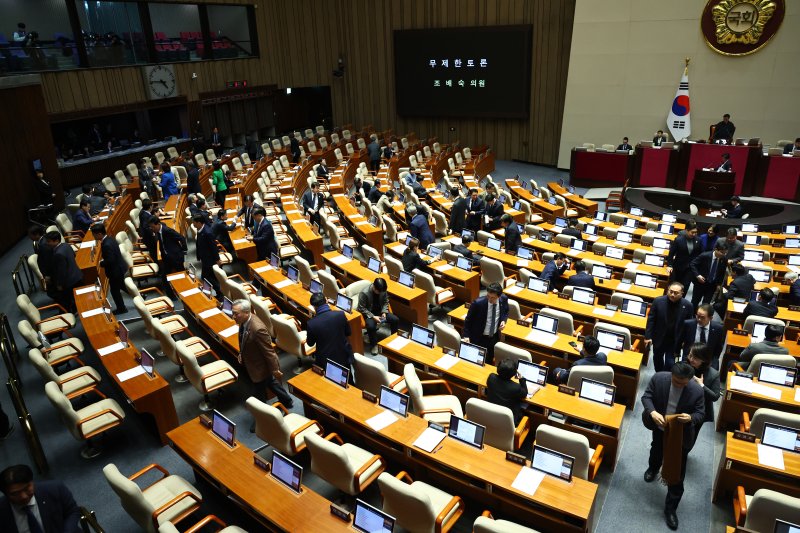
[Financial News] The National Assembly has passed an amendment to the Constitutional Court Act introducing a system that allows a constitutional complaint against court rulings. It is one of the three judicial reform bills led by the Democratic Party of Korea (DPK).
According to political sources on the 28th, the National Assembly on the 27th approved an amendment to the Constitutional Court Act that adds to the Constitutional Court of Korea’s jurisdiction cases where a final judgment of the Supreme Court (third instance) is deemed to potentially infringe basic rights.
This bill is one of the three judicial reform bills pursued by the DPK. The other bills are: a Criminal Act amendment bill, passed at the plenary session on the 26th, which criminalizes the distortion of evidence interpretation and application of law by judges and prosecutors in criminal cases; and an Amendment to the Court Organization Act, which would increase the number of Supreme Court justices to 26 and was placed on the plenary agenda to be taken up after the Constitutional Court Act amendment.
The People Power Party argues that these bills violate the Constitution and represent an attempt by the Lee Jae Myung administration and the ruling party to bring the judiciary under their control.
The party has responded with a filibuster—an unlimited debate allowed under the National Assembly Act to delay proceedings—but under the Act, a motion to end the filibuster can be filed after 24 hours. As a result, it can only postpone the vote by about one day. Like the Constitutional Court Act amendment, the Amendment to the Court Organization Act is therefore expected to be put to a vote after the filibuster is cut off.
The People Power Party has called on President Lee Jae Myung of South Korea to exercise his presidential veto power, formally a request for reconsideration of a bill. It is also reported to be considering filing a petition for an Adjudication on the Constitutionality of Law with the Constitutional Court of Korea if the bills pass the Cabinet meeting and are promulgated.
Meanwhile, as the DPK nears completion of the three judicial reform bills, it has turned its fire on Chief Justice of the Supreme Court of Korea Cho Hee-dae. While internally reviewing an impeachment bill against him, party leader Jung Chung-rae has personally stepped up pressure for his resignation. The People Power Party has condemned this as an "attempt to seize control of the judiciary" and is strongly protesting.
[email protected] Kim Yoon-ho Reporter