Manual Finalized for Yellow Envelope Act: Separate Bargaining Principle for Principal and Subcontractor Unions
- Input
- 2026-02-27 12:10:04
- Updated
- 2026-02-27 12:10:04
[The Financial News]
With the Yellow Envelope Act (the amended Articles 2 and 3 of the Trade Union and Labor Relations Adjustment Act) set to take effect on the 10th of next month, principal employers will be required to bargain with at least two separate unions, including the principal-contractor union and the subcontractor union.
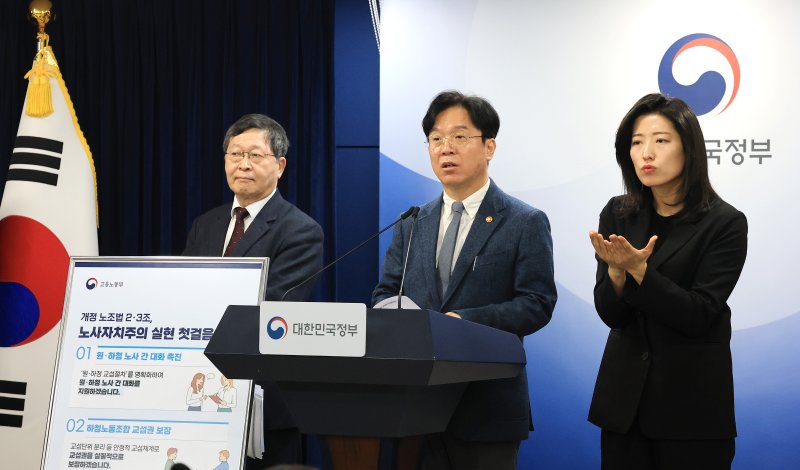
On the 27th, Minister of Employment and Labor Kim Young-hoon and National Labor Relations Commission Chairperson Park Soo-geun announced at Government Complex Seoul a "win-win bargaining procedure manual for principal and subcontractor employers" that sets out these rules.
The core of the Yellow Envelope Act is that an entity can be recognized as an employer if it exercises "structural control," even without a direct employment contract. As a result, collective bargaining between large principal contractors and subcontractor unions will now be possible.
According to the manual, the principle of unifying the bargaining channel is maintained, but the principal employer and subcontractor unions will bargain separately.
The Ministry of Employment and Labor explained, "Because the principal-contractor union is not a bargaining party within the bargaining unit concerned, there is no need to go through a bargaining-unit separation procedure for bargaining between the subcontractor union and the principal employer."
Authorities view the principal-contractor union and subcontractor unions as belonging to different bargaining units, given fundamental differences in the scope of bargaining rights, the extent of employer responsibility, worker characteristics, interests, and how working conditions are determined. The fact that the principal-contractor union already has a collective agreement with the employer also supports the conclusion that the bargaining units are distinct. In practice, this means the principal employer will have at least two bargaining channels: one with the principal-contractor union and another with the subcontractor union.
When a subcontractor union requests bargaining, the principal employer must post a notice of that request, for seven days from the date it is received, on the bulletin board or similar locations at the workplace. This is intended to inform other unions and workers so they can participate in the bargaining-channel unification process.
If the principal employer fails to post the notice, a correction request may be filed with the Labor Relations Commission. If the employer does not post the notice without just cause, it may be deemed an unfair labor practice in relation to the union that filed the request and could become subject to judicial action.
If another subcontractor union decides to join the bargaining after seeing the notice, the subcontractor unions must then go through a bargaining-channel unification procedure among themselves.
Bargaining-channel unification can be achieved if, within 14 days from the determination of the unions requesting bargaining, the unions autonomously agree on a representative bargaining union, or if they obtain the principal employer’s consent to bargain individually with each union.
Although unifying the bargaining channel among subcontractor unions is the basic rule, the Labor Relations Commission may decide to separate bargaining units when there is a clear need, such as significant differences in working conditions, employment types, or established bargaining practices.
Minister Kim stated, "If principal–subcontractor bargaining is conducted at the level of all subcontracted workers, the bargaining rights of subcontractor unions will be effectively guaranteed, while principal employers will feel less burden because the process will not be affected by their existing bargaining with the principal-contractor union," adding, "This can provide tangible benefits to both labor and management."
[email protected] Reporter Park Ji-young Reporter