Special Prosecutor on Insurrection: "Yoon’s emergency martial law declaration was not impulsive... it was to maintain a monopoly on power"
- Input
- 2026-02-27 14:37:56
- Updated
- 2026-02-27 14:37:56
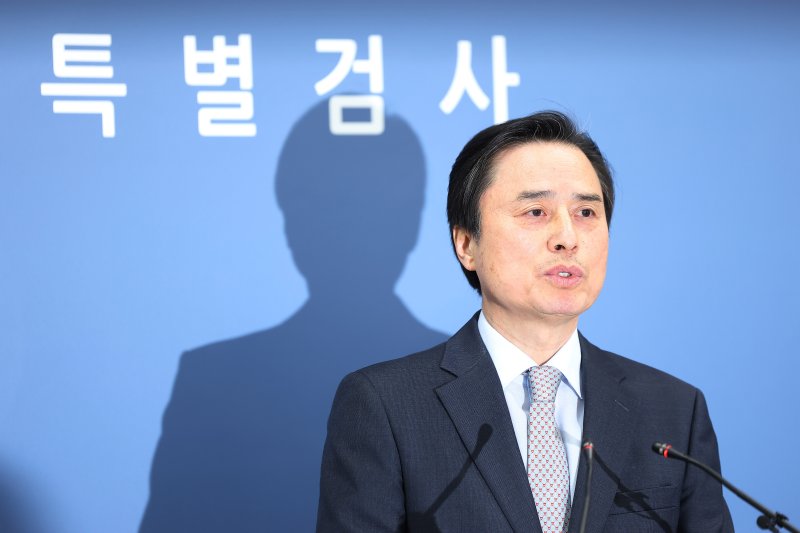
In its appeal, the Special Prosecutor Team for Insurrection and Treason argued that the trial court had misunderstood the applicable law in assessing the charges against former President Yoon. First, the team challenged the court’s finding that the emergency martial law had been planned only two days before it was declared. The special prosecutor team stated, "The emergency martial law was not an impulsive measure, but something that had been conceived and prepared over a long period of time, starting before October 2023," adding, "It was intended to monopolize and maintain power, with no deadline set for restoring the original constitutional order.
" As evidence, the team cited what is known as the "Noh Sang-won notebook. " According to the special prosecutor team, the notebook contained records of the declaration of emergency martial law, follow-up measures, and step-by-step plans, as well as entries on military general appointments, the schedule for parliamentary elections, and plans to detain specific politicians. The October 2023 timeframe highlighted by the team coincides with when the Ministry of National Defense of the Republic of Korea carried out personnel reshuffles of senior military officers.
By comparing the notebook’s contents with the actual appointments of generals, the team concluded that the plan had been meticulously crafted. The team argued, "Nevertheless, the trial court erred by overlooking the timing of the notebook’s creation and its probative value as evidence, and by reaching the illogical conclusion that 'the time when the Noh Sang-won notebook was written cannot be determined,' in violation of rules of logic and common experience. " The team also took issue with Yoon’s own remarks.
They pointed to a comment Yoon made to former Capital Defense Command commander Lee Jin-woo: "So I said we needed to move the troops before martial law was declared, but everyone opposed it. " From this, the special prosecutor team inferred that Yoon had drawn up plans to deploy troops even before the emergency martial law was proclaimed.
In their view, Yoon, together with former Minister of National Defense Kim Yong-hyun, former Army Special Warfare Command commander Kwak Jong-geun, and former Defense Counterintelligence Command chief Yeo In-hyung, concretized the execution of emergency martial law on November 9, 2024, prior to the formal declaration. The team further argued, based on the arrest lists accepted by the court, that Yoon sought to monopolize and maintain power.
They noted that not only political opponents but also leaders of civic groups, journalists, and members of the legal community were designated as targets for arrest, and claimed this was reinforced by orders to cut off power and water to certain media outlets and to blockade the National Assembly. The special prosecutor team criticized the ruling, saying, "The court erred in failing to recognize that the purpose of the emergency martial law was to monopolize and maintain power, as demonstrated by objective documentary evidence and by Yoon’s outward conduct revealing his inner intent.
" They also asserted that the court had misunderstood the legal requirements for establishing the crime of insurrection. The team argued, "Any citizen with ordinary common sense could easily recognize or conclude that the situation at the time did not warrant the declaration of emergency martial law, and that there was no military necessity or need to maintain public safety and order.
" They added, "By excessively narrowing the purpose of undermining the constitutional order to only the coercive subjugation of the National Assembly, the court omitted any assessment of the other unconstitutional purposes advanced by the special prosecutor, and misapplied the legal principles established in cases such as the May 18 Gwangju Uprising treason case. " The team also challenged the sentence itself.
They stated, "Yoon is the ringleader who directly commanded and ordered this case," and argued, "The court failed to properly assess the positions, roles, and degrees of involvement of the defendants, and imposed sentences that are too light compared with their culpability. " Yoon is accused of conspiring with former Minister of National Defense Kim Yong-hyun and others to declare unconstitutional and unlawful emergency martial law, even though the legal requirements for such a declaration were not met, and of instigating a violent uprising with the aim of undermining the constitutional order.
He is also charged with mobilizing the military and police to blockade the National Assembly in order to obstruct a vote to lift emergency martial law, and with attempting to arrest and detain key figures such as National Assembly Speaker Woo Won-shik, then Democratic Party of Korea (DPK) leader Lee Jae-myung, former People Power Party leader Han Dong-hoon, and staff of the National Election Commission (NEC).
[email protected] Jung Kyung-soo Reporter