BOK Says Semiconductor Sector Is Strong; Raises This Year’s Growth Outlook from 1.8% to 2.0%
- Input
- 2026-02-26 18:29:10
- Updated
- 2026-02-26 18:29:10
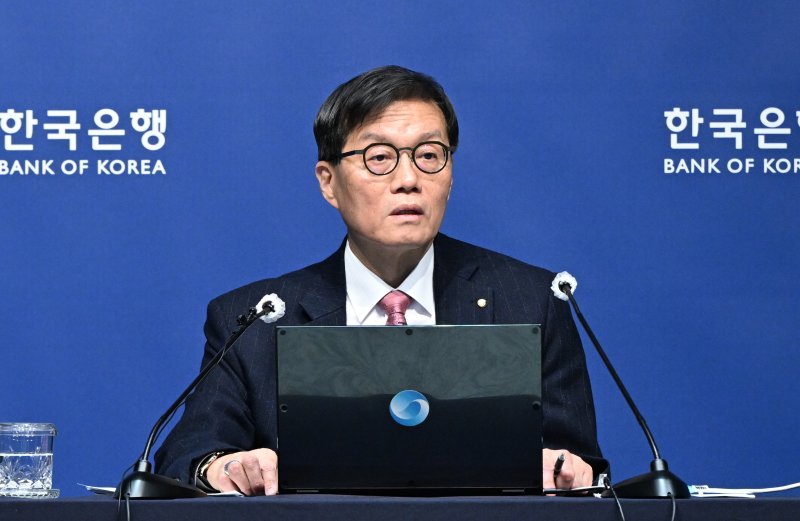
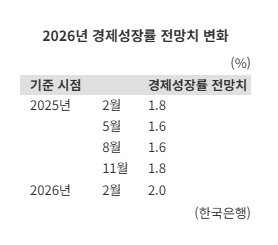
On the 26th, the Monetary Policy Board of the BOK set the 2026 economic growth forecast at 2.0% at its meeting on the monetary policy stance. This is 0.2 percentage points higher than the 1.8% projection released in November last year. All four forecasts published last year were in the 1% range, but this is the first time the outlook has moved up into the 2% range. The figure is the same as the projection by the Ministry of Finance and Economy.
Governor Rhee Chang-yong explained, "Stronger-than-expected exports and facility investment, driven by favorable semiconductor conditions and solid global growth, are estimated to have raised overall growth by 0.35 percentage points," adding, "Improved income conditions on the back of robust corporate earnings contributed another 0.05 percentage points."
On the other hand, delays in the recovery of construction investment shaved 0.2 percentage points off the growth outlook. The growth rate for construction investment this year is now projected at 1.0%, less than half of the 2.6% forecast made in November last year.
This year’s consumer price inflation and core inflation are forecast at 2.2% and 2.1%, respectively, each 0.1 percentage points higher than the November projections of 2.1% and 2.0%. The upward revision mainly reflects cost pressures in certain categories such as electronic devices and insurance premiums. For next year, however, both headline and core inflation are expected to fall back to 2.0%, in line with the target.
The current account surplus for this year is estimated at 170 billion dollars, 40 billion dollars more than the previous forecast of 130 billion dollars. The goods balance is expected to remain in surplus, supported by higher semiconductor prices.
The BOK lowered its 2027 growth forecast by 0.1 percentage points, from 1.9% to 1.8%. Rhee said, "From 2024 through this year, semiconductors have had a large impact on the growth rate, so that contribution is likely to ease somewhat next year," adding, "The gap between information technology (IT) and non-IT sectors is also widening." In its "February 2026 Economic Outlook" released the same day, the BOK cited "worsening weakness in the non-IT sector" as a downside risk to the growth path.
The base rate was kept at 2.50% per year. The Monetary Policy Board has left the rate unchanged for seven consecutive meetings since cutting it to 2.50% in May last year. As a result, the base rate will remain frozen for roughly another two months, until the next meeting in April, meaning it will have stayed at 2.50% for a full year.
[email protected] Reporter Kim Tae-il Reporter