Once-‘Unbeatable’ Gangnam 3 Districts See Home Prices Fall... Yongsan Also Declines [Gangnam Home Prices Turn Downward]
- Input
- 2026-02-26 18:29:07
- Updated
- 2026-02-26 18:29:07
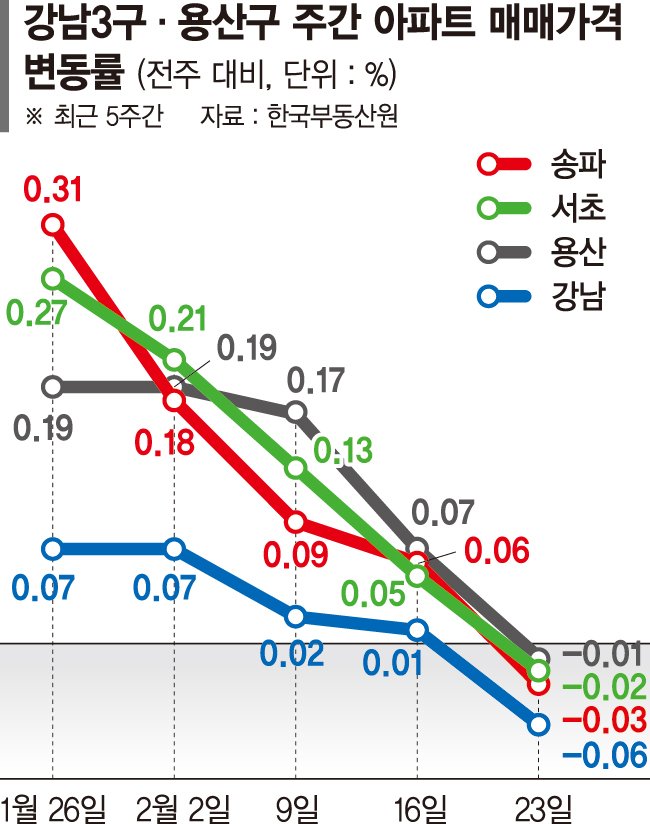
According to the “Weekly Apartment Price Trends for the 4th Week of February (as of the 23rd)” released on the 26th by the Korea Real Estate Board (KREB), apartment sale prices in Seoul rose 0.11% from the previous week. This is the smallest increase in 23 weeks, since the second week of September last year, when prices rose 0.09%. The growth rate, which had expanded to 0.31% at the end of January, has slowed through February, moving from 0.27% to 0.22%, then 0.15%, and now 0.11%. In 22 districts other than Yangcheon District, gains either narrowed or turned negative. Notably, Gangnam District (-0.06%), Songpa District (-0.03%), Seocho District (-0.02%) and Yongsan District (-0.01%) all shifted into decline. Gangnam, Seocho and Yongsan have fallen into negative territory for the first time in about two years, and Songpa for the first time in about a year.
With apartment prices in core areas now on a downward path, Lee said at a senior presidential aides’ meeting at Cheong Wa Dae (the Blue House) that “significant home price declines are appearing in major areas of Seoul.” He added, “We must normalize this abnormal real estate market and move decisively toward an economy that works for everyone, in order to bring real improvements to people’s lives.”
In fact, recent apartment transactions in Seoul show a series of deals at lower prices. An 84-square-meter unit in Raemian One Bailey in Banpo-dong, Seocho-gu, Seoul changed hands for 6.08 billion won late last month, down 1.12 billion won from its peak price of 7.2 billion won. Major complexes in the Gangnam area such as Acro River View and The H Bangbae, as well as Helio City in Songpa District, have also seen contracts concluded at prices roughly 700 million won below previous highs. In upper mid-tier neighborhoods such as Mapo District, deals have been closing at around 300 million won less than peak levels.
A licensed real estate agent near Raemian One Bailey said, “Since the announcement that the grace period for heavier capital gains tax will end, around seven to eight additional listings from multiple-home owners have come onto the market.” The agent continued, “For 84-square-meter units, asking prices are in the low 7-billion-won range, but some owners have indicated they are willing to accept prices in the mid-6-billion-won range.” The agent added, “There is a strong chance that a tug-of-war between sellers and buyers will continue through March.” Even complexes with strong expectations for redevelopment are seeing adjusted prices. An 84-square-meter unit in Shindonga Apartments in Bogwang-dong, Yongsan-gu was sold on the 13th for 3.8 billion won, 380 million won below its peak of 4.18 billion won.
Experts say this trend reflects a combination of sticker shock after rapid price run-ups and the impact of tax policy changes. Choi Won-cheol, head professor of the Advanced Program in Future Real Estate Development at Yonsei University, explained, “Prices that had surged in a short period are now going through a correction,” adding, “The release of some listings from multiple-home owners is having a significant effect.” Park Hap-soo, an adjunct professor at the Konkuk University Graduate School of Real Estate, also noted, “Given how sharply prices have risen in some complexes over the past year or so, a certain degree of correction is inevitable,” while cautioning that “the trajectory may differ by area.”
Analysts are also cautious about the outlook. Ham Young-jin, head of the Woori Bank Real Estate Research Lab, said, “It is not only the end of the grace period for heavier capital gains tax that matters; tax and lending regulations are interacting as well.” He forecast, “Rather than a steep plunge, it is more likely that we will see slower gains or limited corrections.”
[email protected] Jang In-seo, Choi Ga-young Reporter