Ruling Party and Government Vow to Fast-Track U.S. Investment Special Act to Avoid Becoming Trump’s “Example”
- Input
- 2026-02-26 09:59:52
- Updated
- 2026-02-26 09:59:52
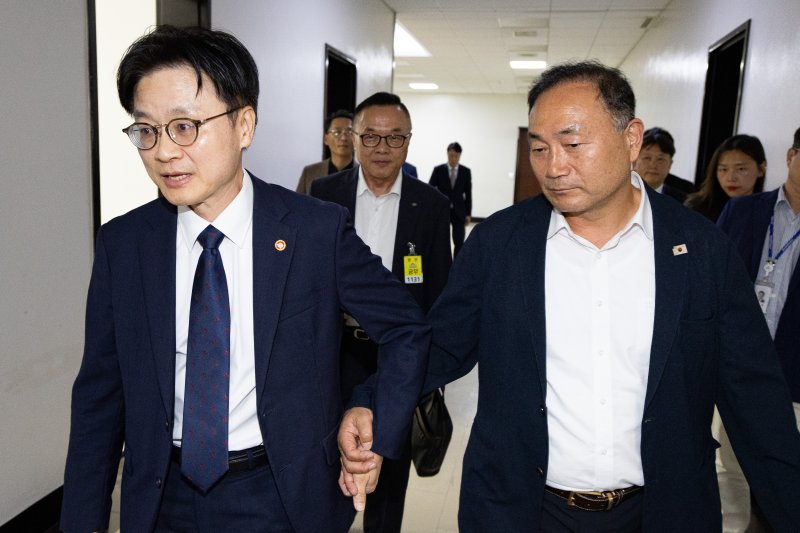
[The Financial News] The Democratic Party of Korea (DPK) and the Ministry of Trade, Industry and Energy (MOTIE) agreed on the 26th that the "Special Act on Korea-U.S. Strategic Investment Management" must be handled swiftly. Their agreement comes after a ruling by the Supreme Court of the United States (SCOTUS) invalidated U.S. President Donald Trump’s reciprocal tariffs strategy, once again heightening economic uncertainty.
Kim Won-i, a DPK lawmaker who serves as the party’s secretary on the National Assembly’s Trade, Industry, Energy, SMEs, and Startups Committee, told reporters after the party–government consultation that day, "Today (the 26th), we reviewed and shared the current situation regarding investment in the United States." He added, "In conclusion, we must pass the U.S. Investment Special Act as quickly as possible. Passing this act is the first step toward removing uncertainty between Korea and the United States."
Kim said, "Right now, I see President Trump as having his pride somewhat wounded by the Supreme Court’s ruling that struck down his tariffs," and continued, "He needs an example that can restore his pride, and in this situation, South Korea must not become that case."
In other words, the U.S. Investment Special Act needs to be processed quickly to preemptively block any unexpected "economic retaliation," such as additional tariffs imposed by Trump.
The problem is that the "Special Committee on the US Investment Special Act," which was launched through an agreement between the ruling and opposition parties, has been repeatedly thrown into disarray. Due to the fallout from DPK-led judicial reforms, the People Power Party has boycotted the entire National Assembly schedule, and because the party holds the chairmanship of the special committee, its operation has been anything but smooth. The formation of a subcommittee to review the bill has been delayed, and even the formal introduction of the bill has been put off.
As a result, some are calling for the Speaker’s authority to directly refer the U.S. Investment Special Act to the plenary session. Under this authority, the Speaker of the National Assembly can set a review period and refer the bill to the relevant standing committee, and if the committee fails to complete deliberations within that period without justification, the Speaker may receive an interim report and immediately place the bill on the plenary agenda. In practice, this power is usually considered only for time-sensitive bills when the ruling and opposition parties cannot reach agreement.
Speaking in a personal capacity, Kim said, "Right now, it seems the People Power Party has no intention of bringing the bill up at all," and went on, "Is this not an economic war, or at least an economic wartime footing? That is why I am thinking that the Speaker should exercise the authority to directly refer the bill to the plenary session."
He continued, "President Trump is still watching closely," adding, "He will have been briefed that the Special Committee on the U.S.–Korea Strategic Investment Management Act is in operation, and he will be expecting to see whether the special act is deliberated after the committee’s mandate ends. If that does not happen, he may think, 'So it was a lie after all,' and decide to target us."
[email protected] Reporter Kim Hyeong-gu Reporter