“Why Are Funeral Plan Ads Popping Up in Stock Chat Rooms?” ‘Yukcheonpi’ Rout Slams Double Inverse ETF
- Input
- 2026-02-26 08:00:45
- Updated
- 2026-02-26 08:00:45
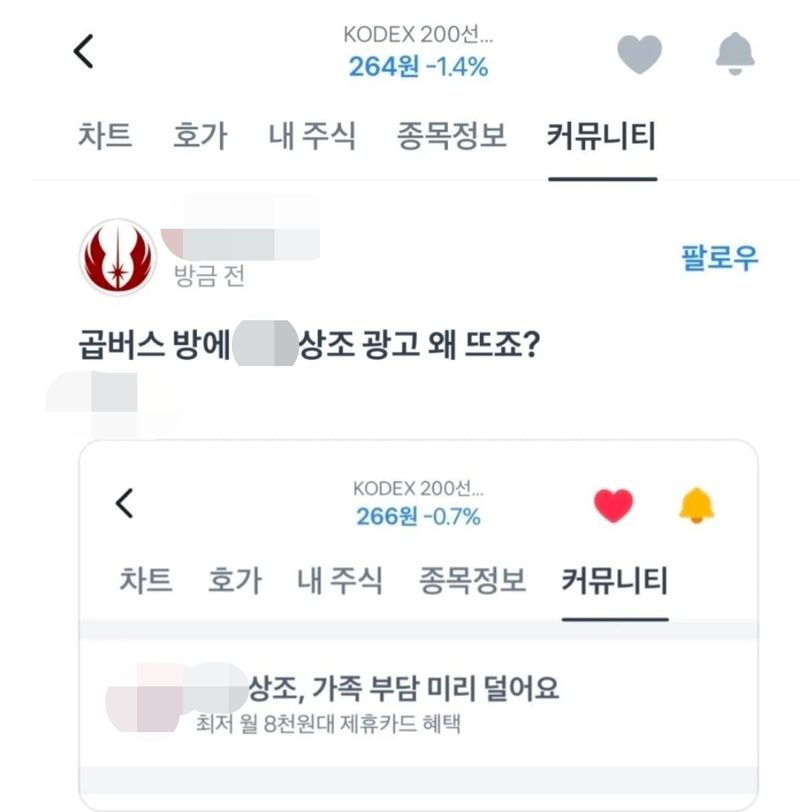

[The Financial News] While the KOSPI continues to surge day after day, some investors are looking particularly grim. They are the ones who bought inverse Exchange-Traded Funds (ETF), such as double inverse leveraged ETF products that bet twice on index declines, known locally as “gopbus.” As the index’s rally drags on and these inverse products sink toward penny-stock levels, a darkly comic story is making the rounds that funeral plan ads have started appearing in the online stock discussion rooms where these investors gather.
Double inverse ETFs that bet on index declines tumble into ‘penny stock’ territory
According to the Korea Exchange on the 26th, all domestically listed “KOSPI 200 Futures Inverse 2X” ETFs have fallen into the 200-won range. KODEX 200 Futures Inverse 2X closed at 258 won on the 25th, while RISE 200 Futures Inverse 2X at 260 won, Kiwoom KOSEF 200 Futures Inverse 2X ETF at 263 won, and TIGER KOSPI 200 Futures Inverse 2X ETF at 272 won are trading at similar price levels.
Just over a year ago, these products were trading in the 2,000-won range, but they have now plunged to around 200 won, roughly one-tenth of that level. Among ETFs trading in the 200-won band, only the inverse 2X products fall into this category. If the KOSPI were to break above the 7,000 mark, these ETFs could potentially sink into the 100-won range. Because they are structured to deliver minus (-) two times the KOSPI’s daily return, the higher the index climbs, the stronger the downward pressure on the ETF price becomes.
From 2,000 won to 200 won... Talk of reverse stock splits emerges
The concern is that if an ETF’s price becomes too low, liquidity issues can cause the order book to thin out or the bid-ask spread to widen, driving up trading costs for investors. ETFs have a liquidity provider (LP) that posts bid and ask quotes, but once prices fall into the 100-won range, even a 1-won move has a large impact, making it difficult to keep spreads stable. On top of that, if short-term money rushes in simply because the 200-won price looks “cheap,” it could become another source of volatility for the broader stock market.
In the market, more voices are calling for reverse stock splits as an alternative. However, under current regulations, domestic ETFs are classified as collective investment schemes (funds), so it is hard to apply the concept of a stock’s par value directly. Back in 2020 and 2022, the introduction of reverse splits and stock splits for ETFs was reviewed, but the idea was shelved after the Ministry of Justice stated that “under the Commercial Act, split and reverse-split provisions apply only to shares and are difficult to extend to funds or bonds.”
There is also a cautious view that hasty reverse splits could create new side effects. A trading halt is inevitable during the split process, and if market volatility spikes in that period, the nature of leveraged and inverse ETFs means the gap between the underlying index and the ETF price could widen significantly.
The Korea Exchange is closely monitoring the situation as well. An exchange official said, “We are aware that inverse 2X ETFs have fallen to penny-stock levels,” and added, “We are carefully watching market conditions and reviewing a range of possible measures.”
[email protected] Kim Hee-sun Reporter