[Editorial] Birth rate rebounds to 0.8, policies must continue with a focus on efficiency
- Input
- 2026-02-25 18:41:45
- Updated
- 2026-02-25 18:41:45
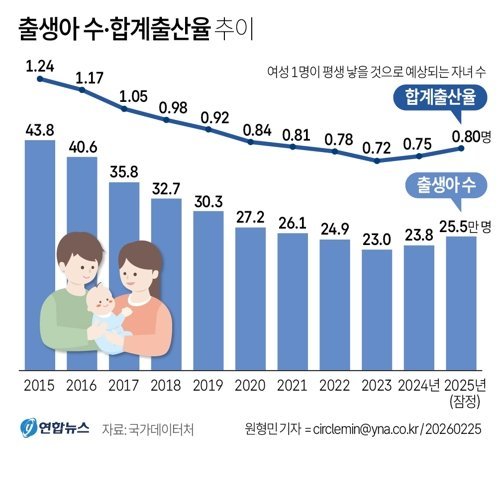
The total fertility rate had fallen to 0.72 in 2023, the lowest level in the world. It has now begun to rebound, returning to the 0.8 range. The increase may look small, but its significance is not. Despite a multitude of low-birthrate measures and astronomical spending, the rate had kept falling; the fact that it has turned upward again matters.
The reasons people choose not to have children are complex. Above all, the burden of raising children, including education, is heavy. With more dual-income couples, caring for children has become extremely difficult. Any effort to raise the birth rate must put this issue at the very center of policy. The social attitude that looks askance at fathers taking parental leave also needs to change.
Competition in Korea’s education system is exceptionally intense. Strong enthusiasm for education translates into high costs. For many young couples, raising their children well and sending them to a good university is a paramount goal, even if they do not live in Gangnam, Seoul. Spending several hundred thousand won a month on private tutoring is commonplace. This kind of overheated competition, rare by global standards, pushes some to conclude it is better not to have children at all.
You have to look up at the sky if you want to reach for the stars. People must marry before they can have children, yet there are clear reasons why many young people postpone marriage or decide not to marry at all. Rising youth unemployment and soaring housing prices are key factors. Without a stable job, marriage itself is difficult, and even after marriage, heavy housing costs leave little room in the household budget for childrearing.
In essence, the causes of low birthrates are this straightforward. But when you examine each cause, none is easy to resolve. This is why countless measures over the past decades have repeatedly fallen short. It is also necessary to review whether the enormous budgets allocated to tackle low birthrates have truly been used in ways that directly address the problem.
Escaping the low-birthrate trap will take a long time and will only be possible if we address fundamental social and economic issues. It is impossible to boost the birth rate overnight. Rather than being elated or dejected by short-term fluctuations, the government must pursue consistent policies with patience and a long-term perspective. It should also bring together all low-birthrate programs and measures and rigorously assess their effectiveness. Above all, policies must be shaped by listening broadly to young couples who actually have to decide whether to have children and by addressing the specific pain points they raise.
Booyoung Group has reportedly seen positive results by providing a one-time payment of 100 million won to couples who have a child. Institutional support for childbirth is essential, but direct financial assistance is also one of the most practical tools available. Not only the central and local governments but also companies and society as a whole must step forward, take an active interest in childbirth and childcare, and treat the issue as their own.